Pat Rafter: ‘Why aren’t we producing players like Spain? I don’t know’
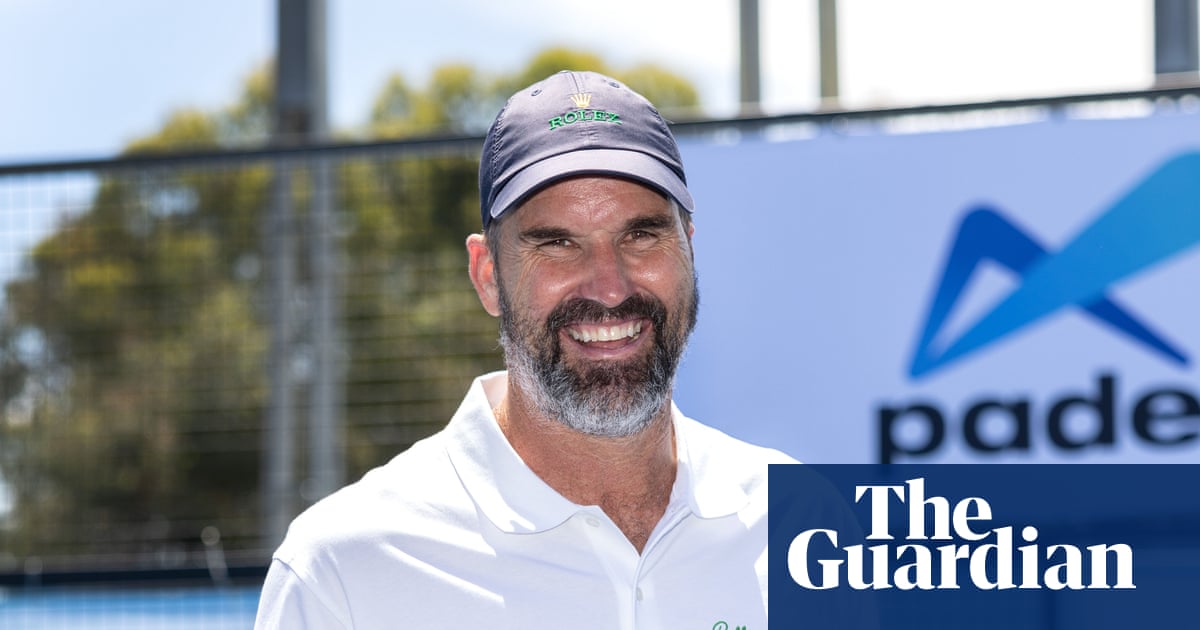
Pat Rafter is Australian sporting royalty. A man whose genuine friendliness still radiates into mid-life and whose looks once made him an underwear model, with a tennis career that took him to No 1 in the world.He is the kind of person anyone would want on their team, so it is no surprise to see him named as a member of the Aussie Crocs. They are the national squad of tennis-adjacent pursuit padel – a kind of miniature form of the game – and are due to compete in an exhibition at the Sydney Opera House starting 15 August.Rafter may officially be a Padel Australia ambassador, but the 53-year-old is adamant his position as a Croc is fully deserved, and reflects his status in a sport which is growing even if it remains very much still amateur.“I do train pretty hard,” the two-time US Open tennis champion says. “The body doesn’t allow me to do any more than a certain amount, but it’s a lot more than the other guys who are working, and doing all that sort of thing.”A typical day at home in Byron Bay involves 40 minutes of stretching and strength training “so I can just walk and get moving”, Rafters says. Most days he will get 90 minutes or more on the padel court, along with the odd beach session playing a rugby-variant with mates, and ending with a gym session, sauna and an ice bath. “That’s for wellbeing as well, and I enjoy doing those types of things, but it also incorporates the health that I need to be on the padel court.”Tennis Australia has adopted padel, alongside the similar mini-tennis variant pickleball, as it looks to build a broader family of racket sports. Rafter is its biggest advocate, but he retains a presence in traditional tennis as vice captain at the Laver Cup, scheduled for next month in London.There he will catch up with current Australian No 1 Alex De Minaur as part of the Rest of the World team. The 27-year-old reached the top five last month, becoming the first Australian man to do so in 17 years.Yet De Minaur has been unable to break through to a grand slam semi-final, having lost in the quarters now seven times. “That’s not where he wants to be,” Rafters says. “He’s been so good and so solid for so long, but he wants to be better than good. He’ll be the first to admit it, he wants to go deep into these events, he wants to win a grand slam.”A major title might have eluded him so far, but De Minaur is Australian tennis’ shining light in 2026. Indeed, he has carried the torch in the post-Ash Barty era through the flashes of promise of others like Nick Kyrgios. The rankings halfway through the year highlight an outlook not altogether flattering for the Australian game.No Australian woman is in the top 50, with naturalised Russian Daria Kasatkina the highest ranked as she looks to put a stuttering, injury-hampered year behind her. Young trio Maya Joint, Talia Gibson and Emerson Jones have shown promise but are yet to cement themselves as grand slam second-weekers.On the men’s side, James Duckworth at 83 is the next highest after De Minaur, as recent top 40 players like Alexei Popyrin and Jordan Thompson have slipped. Rafter, like Australian tennis fans, wonders where the next grand slam champion will come from. “Australia does have opportunities and we do have great programs and systems in place to produce players. Why aren’t we producing players like Spain? I don’t know.”He suspects the isolation of Australia is an impediment to development, leaving Australian teens behind overseas peers in development. But he also recognises there is no single answer.“You can put all these narratives together, but what is the correct answer? I think in the past, we’ve always produced players, and I always think that at some stage we’re going to produce them again. It’s just been a bit lean in terms of grand slam winners, but it’s been lucky that we’ve always had someone to cheer for.”This week saw a significant moment in Australian men’s tennis, when De Minaur met Cruz Hewitt in the second round in Washington. The latter’s father was the last Australian man to win a slam, at the 2002 US Open.Hewitt Jr became the first Australian to reach the boys final at Wimbledon this year since De Minaur, and is one of the best prospects in the country, fresh off winning his first ATP tour match.While he may celebrate like his father, hand cocked back towards his nose, he is regarded as a player who – rather than the defensively nimble Hewitt, or De Minaur – likes to take the initiative.“He’s 17, the next three or four years is going to be interesting to see how he develops,” Rafter says. “I don’t really know how good he’s going to become yet. He’s definitely a player. How good he gets, we don’t know.”Despite his promise, Hewitt proved no match for the man 10 years his senior. Yet it was a contest marked with goodwill. “It was a pretty special moment to be part of, and one I’m grateful for,” De Minaur said afterwards, reflecting on a relationship that – through Hewitt Sr’s prominent role in Australian tennis – goes back a decade.At the end of the 61-minute encounter, De Minaur wished Hewitt luck for not only the next match, but the next decade, in acknowledgement the teenager is just scratching the surface of his potential.Whatever the fate of Hewitt, Rafter can relate in his own sport of padel, introduced to him by a neighbour in 2023. “Is it a good idea for my body? Probably not, but I just figure I’ll go hard while I can,” he says. “At my level, where I’m at right now, I am scratching the surface at how to get better and go past the next level.”


Most Popular
The Good and Not So Good About Australia
8 hours ago