Schweinsteiger sneaked in at night, two stars fled through the window: the legendary home of FC Bayern Munich
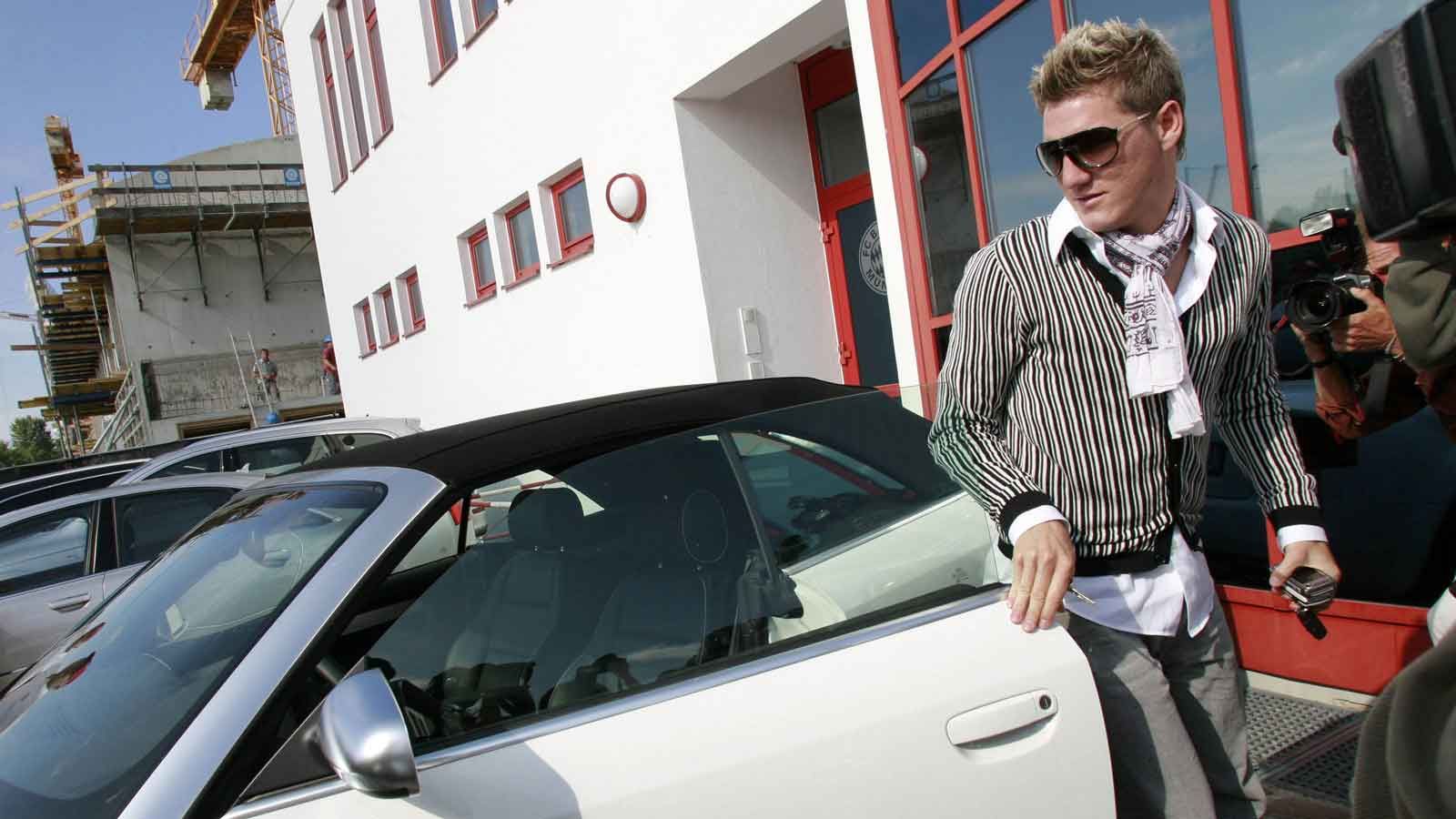
Edmoses was designed by the architectural firm Arnold / Werner. In early 2008, the Munich-based architects had their sights set on an even bigger project. FC Bayern wanted to modernise its then-outdated club grounds on Säbener Straße. Or rather: the designated coach Jürgen Klinsmann wanted this, and the bosses Uli Hoeneß and Karl-Heinz Rummenigge, buoyed by the 2006 World Cup ‘summer fairy tale’, agreed.“A few architects were invited to a pitch at the Hotel Palace in Bogenhausen,” recalls Sascha Arnold in conversation with SPOX. “There we had to present our concept for a campus with a restaurant, wellness area, changing rooms, an auditorium and so on to Klinsmann, Hoeneß and Rummenigge.” His firm was awarded the contract partly “because we were running a few bars at the time that Bayern players also frequented, such as Edmoses. The bosses thought we had a connection with the younger generation and understood their needs.”The plan was set to work out. Christian Lell, at 23 very much part of this younger generation, raved about a “really cool location” once it was finished. Jokingly, Lell even asked for a granny flat: “If you build me one, I’ll be here all the time.” That didn’t happen, but from then on the FC Bayern players had to spend eight hours a day at the new facility anyway. Klinsmann wanted to improve team cohesion on the one hand, and keep an eye on the players’ health and nutrition – and everything else – on the other. He had found inspiration for this from the major NBA and NFL clubs in his adopted home, the USA.Following the refurbishment, Säbener Straße suddenly boasted an auditorium with booths for simultaneous interpreters, a library, language courses, common rooms with table tennis and pool tables, a PlayStation and a DJ booth. “This is unique in the world; neither Real Madrid nor FC Barcelona have anything like it,” enthused Klinsmann. Captain Mark van Bommel, who had previously played for Barça himself, said: “You don’t see anything like this anywhere in Europe. Perhaps in hotels in Dubai, but not at a football club.”To add a spiritual touch, Klinsmann’s personal interior designer Jürgen Meißner had Buddhas installed. They quickly became a symbol of his failure as a manager. Klinsmann was sacked without winning a single title after just ten months. In terms of infrastructure, however, he brought the country’s biggest club into the modern era.FC Bayern 1900 was founded at Café Gisela near Odeonsplatz; its first training ground was on Schyrenstraße by the River Isar. Until the Second World War, the Munich team played here and there, and the club’s offices also moved several times.In 1949, President Kurt Landauer made a groundbreaking move when he secured the rights to use the Harlaching district sports ground on Säbener Straße from the City of Munich, thereby giving his beloved club a real home. The complex is situated south of the city centre, not far from the historic Grünwalder Stadium and the grounds of local rivals TSV 1860. Today, it is guarded by a statue of the legendary president.“At first there were three training pitches,” recalls Sepp Maier in conversation with SPOX. The future world-class goalkeeper joined FC Bayern in 1958 as a 14-year-old youth player. “Next to them was the groundsman’s house. Downstairs was a kitchenette, upstairs he lived. Attached were flat wooden huts for changing and showering. On the left for the pros, on the right for the amateurs and the youth team. Behind that was our bootmaker Sepp Renn’s workshop.” Voilà!There was hot water in the showers, Maier assures us. “But not for long. You always had to make sure you were one of the first to shower, because afterwards it was cold until the boiler had reheated the water running through.” The office was still located in the town centre back then. “We had to go there once a month to collect our wages,” says Maier. “Bank transfers didn’t exist yet.”Under these circumstances, the up-and-coming team led by Sepp Maier, Franz Beckenbauer and Gerd Müller developed into the best in the country. Promotion in 1965, first Bundesliga title in 1969. But Germany was not enough; FC Bayern were chasing the European crown. To compete on equal terms with the continent’s biggest clubs, the Munich side planned their first major infrastructure project. How fortunate that they had a building contractor, Wilhelm Neudecker, as president, and generous members to boot.In 1970, FC Bayern appealed in its club newsletter for donations towards the construction of a new clubhouse on Säbener Straße. It was to serve not only as a home for the teams, as before, but also for the administrative offices. 500,000 marks were raised; ultimately, the construction cost 3.8 million. On 17 May 1971, the complex was opened in front of 150 guests, including Munich’s Lord Mayor Hans-Jochen Vogel. In addition to the spacious premises with changing rooms and offices, there was also a restaurant, a multi-purpose sports hall, four grass pitches and a hard court. The old barracks were initially retained and served as sheds for garden tools.As would later be the case under Klinsmann, the aim of this renovation was also to keep the players on the club grounds for longer – but the first attempt failed. “In the new building, there were a few rooms with beds. They were actually intended for us to stay overnight on Fridays after training and prepare together for the match on Saturday,” recalls Maier. “But we only did that maybe three times. Then we complained because there was no comfort at all. It looked like a youth hostel. We couldn’t stand it.”The already revolutionary manager Robert Schwan quickly showed understanding for the stars’ concerns. Ultimately, President Neudecker also agreed to hotel stays; before big matches, they even went to the posh Bachmair on Lake Tegernsee. The improved training conditions on Säbener Straße, coupled with the general professionalisation, were to pay off. In 1974, 1975 and 1976, the Munich side won the European Cup.Meanwhile, the dormitories were converted into additional changing rooms for youth teams and amateurs, whilst the professionals had been getting changed in the basement ever since the renovation. “There were four changing rooms down there,” Klaus Augenthaler recounts in an interview with SPOX. “The first for the coaches, the second for the stars – Beckenbauer, Maier and Müller – the third for the rest of the first-team players, and the last one for everyone else. The team’s hierarchy was clearly reflected in the dressing room allocation.”When Augenthaler, who would later become captain, arrived in 1975 at the age of 17, he had to take his place at the very back of the queue, including when it came to medical care. “Our masseur, Josip Saric, actually only treated the big-name players who gave him tips.” Only on the pitch were everyone equal, stars and young newcomers alike. “When we came back from the summer holidays, the pitches were always beautifully prepared,” says Augenthaler, “but by autumn they were no longer fit for a Bundesliga club.”The fans were always able to see this for themselves. All training sessions were open to the public, and there was a real buzz, especially during the school holidays. The new “Insider” restaurant, with its raised terrace next to the training pitches, was a popular spot for refreshments. After training, fans and players would sometimes sit together there. “When we played badly, the onlookers would have a go at us,” recalls Maier. “‘You played a right load of rubbish on Saturday,’ they’d say, ‘but never mind, we’re not angry with you anymore, let’s have a pint, come on then.’”Soon, fans had another reason to make the pilgrimage to Säbener Straße: inspired by a trip to the USA, the young manager Uli Hoeneß opened the so-called Bayern Boutique in 1983 to sell fan merchandise. In 1989, the shop was expanded; furthermore, during the second major refurbishment, the glass dome – which remains a striking feature to this day – was constructed, along with a separate building dedicated solely to the professional squad.Since then, the players have clearly found it a wonderful place to be. Whilst Sepp Maier & Co. insisted on staying in hotels because of the former youth hostel atmosphere, Bastian Schweinsteiger now even came to visit of his own accord. In 2003, the then 18-year-old rising star was enjoying himself in the hot tub with a young lady at 2 am. When the security guards, alerted by the alarm system, arrived, he introduced her as his cousin.In 2000, however, Mehmet Scholl and Giovane Elber just wanted to get out. After a fire broke out in the sauna in the basement, the two stars had to use ropes to escape through windows on the first floor. The facility was severely damaged at the time, with the damage amounting to around two million marks. Minor refurbishments were followed in 2008 by the last major renovation to date, carried out under Klinsmann."All in all, that was definitely the most ambitious project we’ve ever undertaken," says architect Arnold today. "Before that, the clubhouse grounds were a 1970s building in a 1980s style, which in parts looked like a Bavarian card-playing corner. In seven weeks, over 2,000 square metres were stripped back to the shell and then completely rebuilt from scratch." The project is said to have cost 15 million euros. Work went on round the clock in three eight-hour shifts. "That was an incredible achievement, especially by the site management and the tradespeople."The players naturally benefited from the new facilities. But there were also those who suffered – namely the loyal training spectators and landlady Erika Niemeyer, as her pub had to close. “I am appalled and extremely sad,” lamented Niemeyer at the time. “They are tearing my heart out. Everyone here, including the fans, is losing a piece of home." Years later, the "Paulaner Treff" was established as its successor. However, it is only accessible during public training sessions and is thus even more exclusive than Edmoses once was. Fans are now only permitted on a few dates each year.High curtains were installed on the fences to provide privacy during secret sessions. In 2024, Bild reported that even fans standing behind the curtains to listen to their idols training were being chased away. Since 2017, even the club’s own youth players have been barred from watching. Due to a lack of space, the entire youth academy, including the boarding school, moved to the new €70 million campus in the north of the city, near the Allianz Arena.Meanwhile, during the 2010s, a modern multi-purpose hall, an additional office building and new outdoor areas featuring a sandpit and a football tennis court were constructed on the club’s grounds on Säbener Straße. The architectural firm Arnold / Werner installed a swimming pool with a counter-current system for aqua jogging and added a new medical area on the top floor. In 2013, the Munich-based architects also redesigned the office of the new coach, Pep Guardiola.“For the desk, I gave him a choice between a standard model by Norman Foster and a unique, asymmetrical, sculptural piece I had designed myself,” reports Arnold. “Pep thought my desk was cool and absolutely wanted it. So we had it made by a joiner.” Arnold recommended “a grey Eames aluminium chair with a soft pad” as a suitable seat. Due to a long delivery time, Guardiola was given the same model in black in the meantime. “When the grey chair finally arrived, I took the black one,” reports Arnold. “I still use it today. Pep’s chair is still comfortable to sit on.”However, his former creation on Säbener Straße could soon be given a facelift. “Hotels generally need to renovate every ten to twelve years,” says Arnold. “So it’s no surprise that Bayern are now planning a refurbishment after 18 years.” Former CEO Oliver Kahn had already hinted at a refurbishment. His successor, Jan-Christian Dreesen, announced in a press release in 2024: "A new training centre is a key component in ensuring that FC Bayern can continue to attract international players and remain competitive at the very highest level."The Münchner Merkur reported in December that preliminary planning permission had now been obtained. On Tuesday, there were reports that construction of a new training ground could begin shortly. This may well mark the start of the major refurbishment. The project is expected to take three years to complete and cost around 100 million euros; work could begin as early as 2026. First barracks, then a youth hostel vibe, finally a hotel like in Dubai – and what now?




Most Popular