
Cyprus to change robot competition rules before start - Cyprus Mail
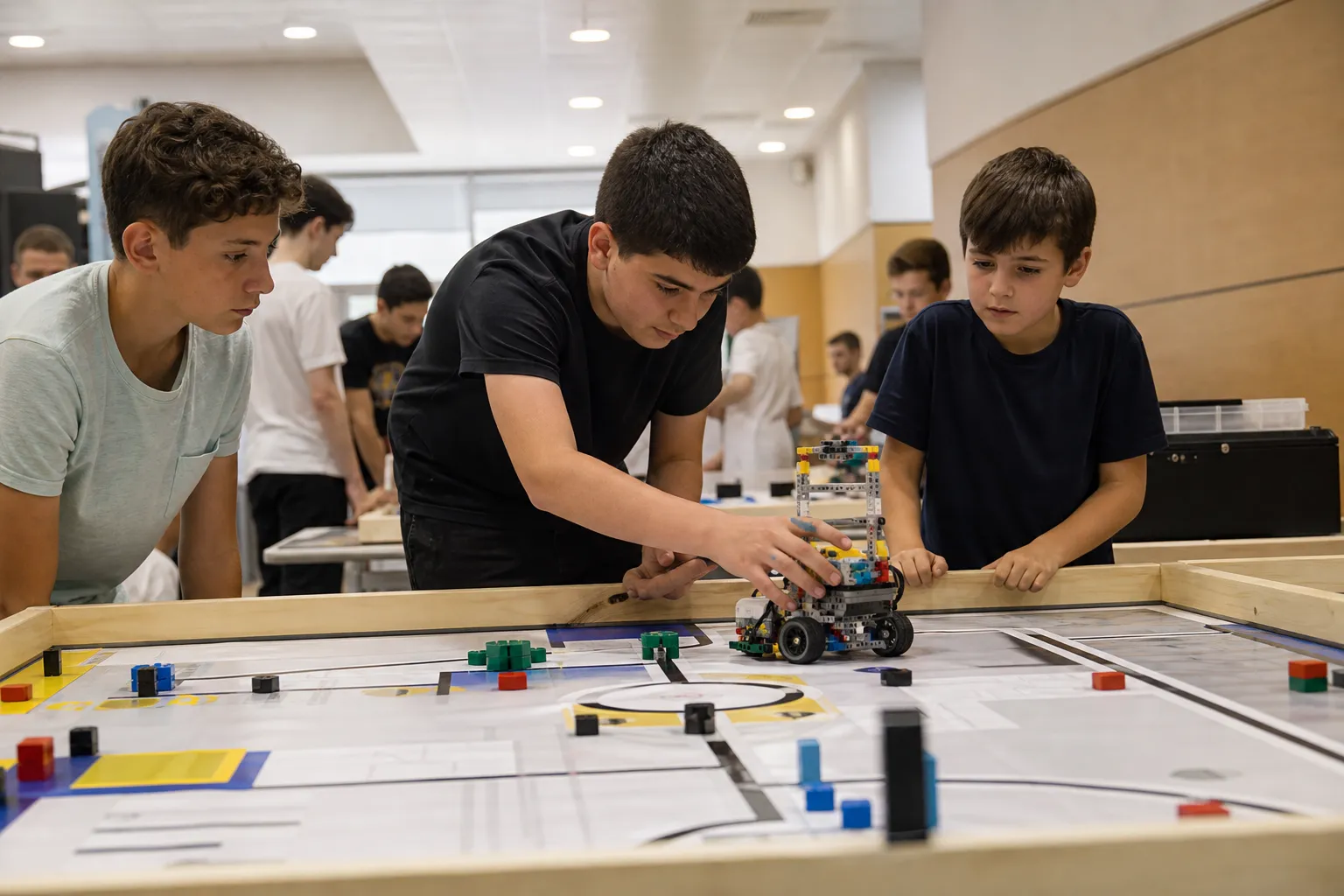
On September 19, participants in Cyprus’s national World Robot Olympiad competition will receive an unexpected rule change shortly before the tournament begins. School students aged 8 to 19 will gather at European University Cyprus in Nicosia and, after the announcement of the so-called “surprise rule,” will have limited time to alter their robots’ programming.The competition is organized by the Cyprus Computer Society under the auspices of the Ministry of Education. The tournament’s official theme is “Robots Meet Culture.” The robot field will be rearranged before each round, meaning the machines will not be able to simply reproduce a pre-memorized route and will have to make decisions while moving, Cyprus Mail reports.Competition and robot mistakesIn June, 709 participants in 216 teams took part in Robotex Cyprus. Their robots competed in mazes, sumo rings and sports disciplines at the sports center of the University of Cyprus.Robot mistakes were also noticeable at the World Humanoid Robot Games in Beijing, which brought together 2,056 machines. Robots took part in races, football, dancing, combat, as well as challenges related to work at factories, restaurants and emergency services. The Tiangong Ultra humanoid completed 100 meters in 8.64 seconds, while Usain Bolt’s world record is 9.58 seconds. At the same time, these results were obtained under different conditions. Some machines crashed into safety barriers, fell on the track, and one robot caught fire after a race.More current news is available on the UA.News Telegram channel Telegram.Robotics for practical tasksIn Cyprus, robots are also being developed for more complex work. The Intelligent Robotics and Interaction Lab at AUB Mediterraneo in Paphos is creating a robotic arm for warehouses. The 100,000-euro project is funded by the Research and Innovation Foundation, and its implementation will continue until 2027. An operator will be able to intervene in the machine’s work through an augmented reality interface.The same laboratory is testing robots for construction sites, including the Unitree Go2 quadruped robot. In Nicosia, researchers at the KIOS Research and Innovation Center of Excellence use drones, sensors and robotics for emergency response: mapping flooded or burned-out areas, inspecting power lines and coordinating groups of drones.The Cyprus Marine and Maritime Institute in Larnaca works with surface and underwater vehicles, ground robots and drones for search and rescue operations, inspections, aquaculture and ocean research. Last year, a Franco-Cypriot project demonstrated a swarm of small underwater vehicles at Ayia Napa Marina, designed to photograph the seabed and monitor marine life.Read us on Telegram and Sends




Most Popular