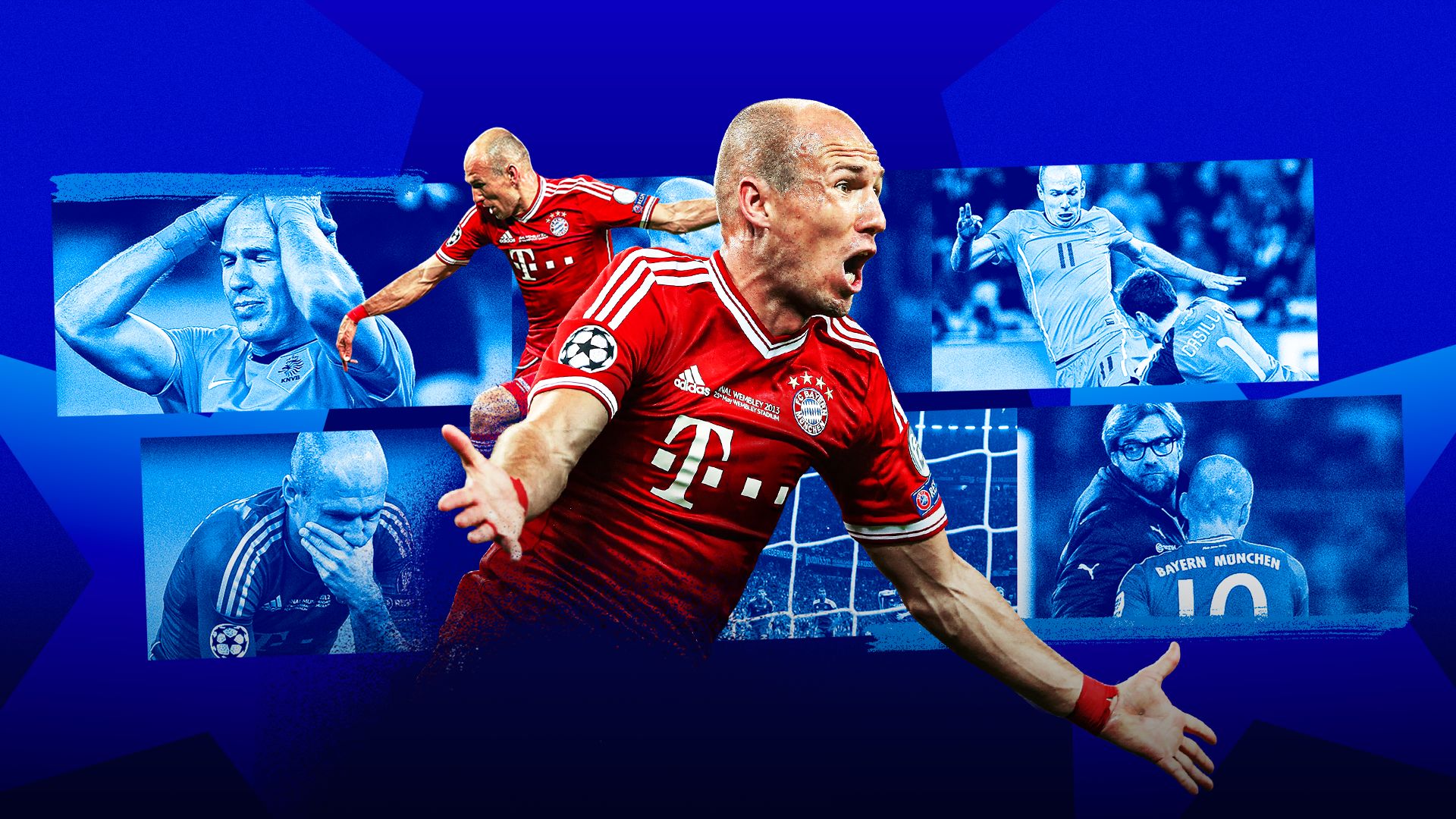
Arjen Robben's redemption: How deadly Bayern Munich winger went from big-game bottler to Champions League final hero
.png)
Before he garnered a reputation for failing on the big occasion, Robben was among the most lethal attackers in football.Easy to predict, impossible to stop, the Dutch winger terrorised full-backs when he drove down the wing, cut inside and curled home a beauty with his left foot.He counted the likes of Manchester United, Barcelona and Borussia Dortmund among his victims in famous Champions League nights, and he won domestic titles with PSV, Chelsea, Real Madrid and Bayern Munich.So, in 2010, it seemed time for Robben to conquer Europe with a Bayern Munich side consisting of the likes of Mario Gomez, Thomas Muller, Franck Ribery and Bastian Schweinsteiger.They were looking strong under magnanimous coach Louis van Gaal. Bayern won the league and cup in 2009-10, but they had to overcome a slow start to the Champions League. It was thanks to Robben they even made it past Fiorentina in the last-16.Bayern won the first-leg 2-1 with Robben scoring a penalty, but they ended up trailing 3-1 in the return fixture in Italy. In the 65th minute, Robben took possession in the middle of Fiorentina’s half and scored one of the most gorgeous goals of his career. At 4-4 on aggregate, Bayern went through on away goals.A similar story followed in the next round. This time, Manchester United were lucky to see him ruled out through injury in the first-leg, which Bayern won 2-1, but the trip to Old Trafford saw Bayern again fall 3-1 behind. Robben met a corner from Ribery with a shot so precise he seemed to be in awe of it himself as he celebrated the goal. Once more, Bayern went through on away goals. In the semi-final, too, Robben stunned fans with an impulsive long-range shot that left Lyon goalkeeper Hugo Lloris with no chance in a 1-0 win.Robben was winning games almost single-handedly.In the Santiago Bernabeu against Jose Mourinho’s Inter, though, he struggled. Bayern opted for a front two of Ivica Olic and Thomas Muller, while Franck Ribery was suspended. The Germans were tame and Robben was powerless in the 2-0 loss.That summer, he experienced another defining moment.By now known as the ‘Man of Glass’ for his persistent hamstring injuries, Robben's introduction to the World Cup was delayed by fitness issues, but he was vital again in Oranje's journey to the final.After opening the scoring in a narrow win against Slovakia in the last-16, he set up a key goal in the 2-1 win against Brazil in the quarter-finals, and then headed home what turned out to be the semi-final winner against Uruguay.Dutch media called it 'The toe of Casillas'. That was all it took to end the Oranje’s dreams and plant the seed for the reputation that would soon follow Arjen Robben.It was a contentious final in Johannesburg between Bert van Marwijk’s Netherlands and Vicente Del Bosque’s Spain. Nine Dutch players received a yellow card over the 120 minutes. The image of Nigel de Jong's boot being planted in Xabi Alonso's chest lingers in most people's minds as the epitome of Netherlands’ style, but the crucial moment was between Robben and Casillas just after the hour mark.Sneijder’s quick pass through the middle sent Robben galloping in behind the Spain defence. He was careful in picking his moment. Perhaps too careful. Just as he tried to tuck it to his left, Casillas threw his legs at it and sent it out for a corner."When I saw Robben coming at me, all I could think was: 'Stay on your feet, stay on your feet, stay on your feet, stay on your feet',” Casillas later said. “Eventually, I dived for the ball because I assumed he would get past me," Casillas reflects. "Of all the options he had, Robben chose exactly the wrong one. Really, if he had scored there, that final would probably have ended very differently.”Netherlands couldn’t recover, and Andres Iniesta went on to score the winner in extra-time."It hurts to miss such a chance," Robben said four years later. "It’s part of sport, just a moment, a snapshot. But it will be part of me and part of my career for all of my life."A couple of defining snapshots were still to come.Robben was barely fit in the 2010-11 season, but he was still deadly. In just 14 Bundesliga appearances he scored 12 and set up a further eight. He shook off early injury worries the following season to deliver another blistering campaign and help Bayern make the Champions League final.In the semi-final second leg at the Santiago Bernabeu against his former team Real Madrid, the odds were against Bayern. They were 2-0 down inside 14 minutes on the night, and at 3-2 down on aggregate their dream was slipping away. Then, in the 27th minute, Bayern were awarded a penalty.Facing his former club with the weight of Munich on his back, Robben stepped up, eye-to-eye with Casillas two on from the final in South Africa. Instead of a toe, this time Casillas threw a fingertip at it but couldn’t reach. It was all square on aggregate, and Bayern went on to win on penalties.It turned out to be a dress rehearsal for the key moment in the European decider against Chelsea, but this time Robben fluffed his lines.With the final tied 1-1 against Chelsea in extra time, Didier Drogba brought down Franck Ribery in the Chelsea penalty box. Again, Robben was trusted with the spot kick. He struck it low toward the bottom corner, but Petr Cech guessed the right way and smothered it.The Allianz Arena went silent. Again, it went on to penalties, but this time Bayern lost. It came weeks after he missed a title-deciding penalty against Borussia Dortmund in the Bundesliga, the narrative was set in stone."I can't describe how I feel with words, but it's been a terrible night. Two or three times, you feel you have the cup in your hands but at the end you stand with nothing," Robben said."It wasn't a good penalty. I wanted to shoot the ball hard and high in the goal, but the ball didn't go high enough. It was a terrible penalty kick. After that, I still played well but you have to change your mindset at that point."As the injury troubles continued to plague him, it was feared the 2012-13 campaign might pass Robben by. He was limited to just 16 Bundesliga games, always being left out for chunks of the season.Bayern tore up the league in his absence, but they were lucky that he somehow managed to stay fit for Champions League knockout games.In the semi-final against Barcelona, Bayern put on a 7-0 aggregate demolition, with Robben the orchestrator. In the first leg in Munich, he tormented Jordi Alba from start to finish, scoring a sublime third goal as Bayern won 4-0. But it was the return leg at the Camp Nou the world saw trademark Robben.Early in the second half, Robben received a long pass on the right wing. With a single, razor-sharp touch, he cut inside Adriano, carved out the space he needed and unleashed a glorious effort into the top corner.“That 4-0 was my best game at the Allianz Arena,” Robben told Sport Bild years later. “Against such a great team. With an uncharacteristic Robben goal. I broke through on the right wing with a stepover and had time to curl the ball into the far corner from a tight angle.”He wasn’t finished yet.The final against Borussia Dortmund was intense. Jurgen Klopp’s heavy metal mavericks had the upper hand in the first half, but it was the Bavarians who took the lead in the second when Robben teed up Mario Mandzukic. Eight minutes later, Dortmund were level via a penalty. Shortly afterwards, Robben was denied a great chance for an easy finish by defender Subotic, sparking fears the Dutchman's trend of final failures would continue.A long, searching pass floated toward the edge of the Dortmund box. Franck Ribery battled for it and instinctively flicked a delicate backheel the swarm of yellow shirts, and Robben pounced on it.Weidenfeller was in front of him, Hummels and Subotic on his sides, and the weight of Johannesburg and Munich on his shoulders.He breezed past the defenders and left the goalkeeper beaten with a feather-light that defied the tension of the moment and sent the ball trickling across the grass before kissing the net."When I got the ball, I was free," Robben told reporters after the game. "I anticipated Franck’s movement. The only thought was: 'I hope he puts the ball there' because I saw the space. I took it well. My first choice was actually to go past [Weidenfeller] on the left side but then he made a move and I could put it to the other side. He was on the wrong leg."Bayern were champions again."To finally win this Champions League, that's a dream come true," he said. "You can't describe it – so many emotions go through your head, especially because you know what it is like to lose. I think you can enjoy it even more when you win the title."He added: "After the disappointment of last year, and to a [lesser extent] 2010, and the World Cup for me – that's three finals and you don't want the stamp of a loser. At last we did it today, and we can forget about the other things a bit. It was a sense of 'finally'."In 2025, Bayern fans voted that goal the best in the club’s 125-year history. The runner-up was Robben’s goal against Manchester United.His final demons exorcised, the Dutchman went from strength to strength over the following years.A 30-year-old Robben arrived at the 2014 World Cup in Brazil playing with terrifying freedom.Netherlands’ opening game was a 2010 final rematch against Spain, and Robben produced a performance for the ages as the Oranje steamrolled La Roja 5-1.Tormenting the Spanish defence, he scored after plucking a long pass out of the air and leaving Sergio Ramos hopeless before applying a fine finish.It was his second goal that was truly awe-inspiring, however. Tearing towards goal at a staggering speed to outsprint Ramos, Robben collected a long ball, dragged Casillas onto the grass, and picked his moment to lash into the net while the goalkeeper was still scrambling on his knees.Robben was brilliant for a Netherlands side that arguably punched above their weight under Louis van Gaal, making it all the way to the third-place play-off.The legend surrounding Robben had been completely rewritten. While injury issues still hindered him, he was no longer viewed as the ‘big-game bottler’. He was a phenomenon, and the success kept coming.He helped deliver a staggering eight Bundesliga titles and five DFB-Pokals during his decade in Bavaria, contributing 144 goals and 101 assists in 307 appearances.After the 2013 Champions League final win, they made four more semi-finals, though lost out on each as Pep Guardiola failed to deliver the European crown.When he tearfully departed Bayern in 2019, lifting his final league title, the same supporters who had once whistled him off the pitch serenaded him as a legend of the game.No longer the tragic figure who buckled under pressure despite his incredible talent. Now, Robben was the ferocious forward who had felt the crushing weight of personal and collective failure on the grandest of stages and recovered to etch his name in the history books.

.jpg)

Most Popular
Japan name squad for historic India T20I in Sano
8 hours ago

A good year to win Ballon d'Or
7 hours ago