
Cricket’s children in war-torn Beirut: Refugee kids in Lebanon who escaped ISIS horrors find hope through cricket, idolise Virat Kohli & Smriti Mandhana
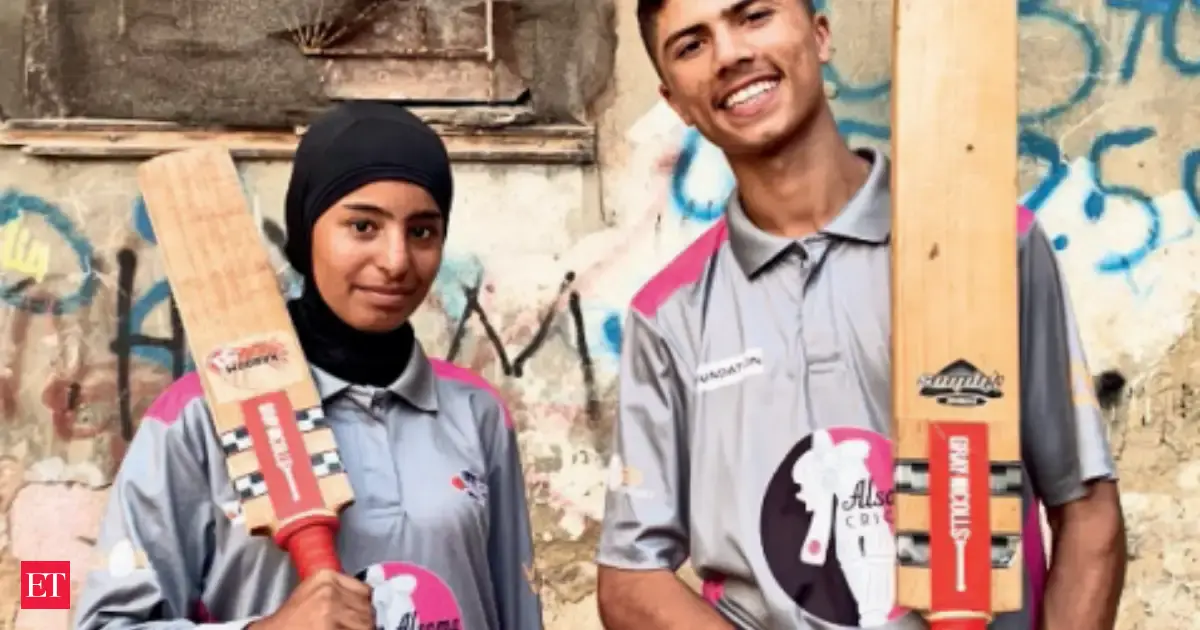
SynopsisEscaping ISIS horrors, Maram found solace and a new path in Shatila refugee camp through cricket. The Alsama Project, co-founded by Mohammad Kheir, uses the sport to foster education and social integration for over 950 refugee children, bridging gaps and offering hope.It was from the sky that the worst of hellfire rained down.The Islamic State of Iraq and Syria (ISIS) had taken control of large swathes of land across borders. In the Syrian region of Deir ez-Zor in 2014, Maram, only 7, witnessed unspeakable horrors and barely escaped with her life. If some miracle ensured that she survived the ISIS, bombs targeting the occupying forces flattened the homes right next to hers. Forced to flee, Maram, like thousands of others, somehow made it to the Shatila refugee camp in Beirut.Seven years later, Maram, in her early teens, was set to be married off. She was illiterate and had never seen the inside of a school. But at Shatila, she saw some children play a sport she did not recognise—cricket. Her curiosity about the boy hurling a ball with his “arm straight” and another hitting it “on both sides” was so sharp that she just had to try it for herself.That marriage didn’t happen. Instead, Maram mastered the fundamentals of cricket and became proficient enough to take on the bigger boys and captain the girls’ team.Mohammad Kheir, a Palestinian Syrian, is the coach who showed Maram the basics of the game. He is the cofounder of the Alsama Project—an NGO providing education to refugees in West Asia—alongside Meike Ziervogel, Kadria Hussien and Richard Verity. Ziervogel is a German-born novelist and publisher who once worked as a journalist; Hussien, a refugee herself, is a community leader who had the respect and trust of Shatila even before Alsama was founded; and Verity is a former McKinsey partner who worked in the global energy sector.Live EventsLET’S PLAYKheir is the backbone of Alsama’s cricket programme. It’s a matter of great pride to him that more than 800 people from the refugee camps play the game. More than 30 coaches, International Cricket Council Level 1 certified, grow the game, taking it beyond the camps. It’s a stunning achievement that Alsama organises an annual cricket tournament that features a joint Indian-Pakistani team, a Sri Lankan team and teams made up of locals. At these tournaments, cricket opens the door, but music and food follow, with each diverse group bringing to their fellow displaced what they miss most about home.“People often ask me, Why cricket? Why not football? Or basketball? Cricket is unique,” says Kheir. “It’s a non-contact sport. This means boys and girls can play together and, through this, learn how to socialise. As a game, it is as much mental as it is physical, which means that even if you are younger or smaller, you can play against others. Also, in cricket, there are many events to celebrate—a wicket, a six, a four, a catch—while in football, the team comes together to celebrate only when a goal is scored. That may happen a few times in a match. But in cricket, there is always something to celebrate together.”Initially, when Kheir and the kids started a street game of cricket, it was a curiosity to passersby. How do you know this game, they would wonder. “Cricket thus helps us understand their culture, and take our culture to them,” says Kheir. “In other countries, cricket is just one option. For us, cricket is a need. It is where the culture and values of Alsama come together as a curriculum.”LET’S STUDYAlsama does not exist to grow cricket although it does a fine job of that. Alsama’s schools help 950 students across four centres go from illiteracy to university in six years. The core subjects are Arabic, English and maths, with skill-based training in information technology, science, logical reasoning and professionalism. This, along with yoga, music and awareness, works to bridge the gap for these students, 60% of whom are girls.The traditional timeline is compressed because many of the children in need did not get the start they needed and do not have the luxury of 12 years of continuity. Alsama’s rapid literacy programme, which covers the basics in just six months, won the 2024 International Prize of the Library of Congress Literacy Award and the 2025 Ockenden International Prize. Alsama has managed to deliver education at just 83% of Lebanon’s average cost for refugee education, according to UN.Alsama relies on institutional and individual donations to fund its work. It’s small enough to be highly credible—81% of funds goes directly to student education—and large enough to warrant grants from the likes of the Altenburg Foundation and the Angus Lawson Memorial Trust in the UK and the Girls Opportunity Alliance of the Obama Foundation. It counts among its partners the Marylebone Cricket Club, which is as establishment as it gets.Alsama’s funding has grown, from about £260,000 in 2021, its first year, to £755,000 in 2022, £815,000 in 2023 and £1.27 million in 2024, according to filings made to the Charity Commission for England and Wales.This may sound like a lot of money, but it isn’t when there are more than 3,000 children on a waiting list, hoping that a fifth Alsama centre will open soon.ROAD TO LEBANONRichard’s surname Verity blesses him with cricket pedigree—his distant relation Hedley was a legendary Yorkshire and England off-spinner, peerless in his time, with nearly 2,000 First Class wickets. Hedley, who died of war wounds in Italy in 1943, just shy of his 38th birthday, is remembered for exhorting his fellow soldiers to “keep going” even after being hit in the chest by a bullet. Richard and Hedley share more than a surname and bloodline.It was a conversation with Ziervogel on a walk on the Scottish island of Coll in the Hebrides in 2017 that put Verity on the path to Lebanon. The two outdid each other in talking about how dissatisfied they were with their lives, which were utterly prosperous and outwardly enviable. Their kids had grown up, and it occurred to them that there might not be many significant milestones between then and death. “We looked back and there was success for each of us,” says Verity. “I had an impact, raising the share price of McKinsey clients, but on the wider world? I was indifferent to the people at the bottom of the social hierarchy, and it was here that I was drawn to those in the Lebanese refugee camps.”Verity took what he learned in his job to his vocation: quality of processes. He also brought something that set Alsama apart from many NGOs: honouring data and using it to course-correct and make decisions.EDUCATION IS A PRIVILEGE HEREBut Verity had to rethink some of the fundamentals in his new life. “The children we work with look different, have a different religion, language, culture and set of life experiences from my own,” he says. “But in these teenagers I could recognise the same foolishness, aspirations, strength, ability to grow and acquire new knowledge—there are ways in which all teenagers are the same, irrespective of context. My idea of how different they were, and how hard it would be to bridge the gap, was challenged. There is one significant difference: in the rich world, teenagers perceive education as an almighty chore imposed on them; at Alsama, teenagers realise it is a privilege, not a right. And that reflects in their attendance, discipline, work ethic and, ultimately, academic achievements.”Alsama had one near-death experience in 2024, when the bombing of southern Beirut forced many students back to Syria, and embassies brought significant pressure on their nationals to leave. The teachers of Alsama stayed. Mobile phones and data cards were sourced and delivered so classes could continue on WhatsApp. A fundraiser paid for makeshift dormitories in the Christian quarter to ensure final-year students could stay and reach the finish line. Alsama registered their schools with the UN in the hope that if a foreign country bombed Beirut, they might avoid its coordinates. A worthy bet, but far from certainty in the times we live in.Alsama had to do that, says Verity, to give students “the real certainty that we were committing to them and that if they committed to us, their education would continue”.THE ARC OF THE BALL?So, where do you see yourself in five years? This overused question is not one you ask someone in a refugee camp. Shatila was set up in 1949 as a temporary settlement, but some of those who ended up there have grown up there. They are some of the most forgotten people in the world.But Alsama has allowed Wissal, who has been there from the beginning and is now 18, the gift of dreaming coupled with a pathway. “When I was 11, ISIS forced me to wear a niqab,” she says. “Before Alsama and cricket, our families underestimated us because we were girls. They did not believe in us. Now, as we learn and grow from players to coaches, something has shifted. They see us. They value us. When a decision has to be taken at home, they ask us what we would do.”Wissal, who likes watching English cricketers Sophia Dunkley and Jofra Archer, believes cricket and education are inextricably intertwined. “When I have spent the week, 7 am to 5 pm, preparing for the SATs, I need that game of cricket on the weekend to release stress, clear my mind and set goals for the next week. It looks like a day off, and it is, but it’s also not,” says Wissal. “I am Syrian by ethnicity, Lebanese by nationality, I speak English... as a refugee, I am everybody, and I am nobody. But, because of cricket, I have an identity.”Wissal wants to be a psychologist. “Cricket teaches you to listen; from listening comes understanding,” says Wissal, who is a child protection officer to whom young ones come with their problems—of school, friends, home. “I am from them, so they come to me. But they have the solutions. They just don’t know it. I listen, I speak and we unlock it.”CRICKET IS CONNECTION?Wissal’s friend, Maram, whom they call the Iron Butterfly, says, “I am happy and at peace when I am on the ground. My teammates are the flowers I flit to so I am the butterfly.” She adds, “But if you hit me for a four or a six, I will keep bowling off spin to you till I get you out. Even if it takes 1,000 balls, I will bowl, so I am the iron butterfly.”“The thing is, girls use their brains all the time,” she says. “Boys? They only use their brains when muscles don’t work. In one match, I got hit for a six by a good player. Everyone cheered and he felt like a king. I saw the crowd and said to myself, ‘This is the moment everything changes.’ Step by step, the butterfly made her move. I got him out. I won’t forget that moment. He won’t either.”Maram likes Virat Kohli (obviously!), “adores” Smriti Mandhana and explains how cricket taught her equity. “How can you call yourself a member of the cricket community if you have gender bias?” she asks so stridently that it feels like she might pop out of the Zoom screen any moment.“When I went back to my village, I had to teach a young girl how to bowl. I told her to draw the biggest circle she could with her arm, and from then on, it was straight. It takes a month to go from throwing to bowling, but she got there in two days,” recalls Maram. “I can talk to you about cricket for 100 years, but you won’t get it. Give me a ball and I can show you and you will learn. Cricket is connection: without that, would you and I be talking?”It was initially hard to convince Maram’s parents that education was useful. “They thought I was studying to escape the family. Now they realise that I play, I learn and I will get a university degree to support my family,” says Maram, who has won awards, earned a place to finish her education in the UK, but chose to stay, because her ultimate goal is at home. “I want to bring the world to my village. They have no running water, no electricity, no technology—all the things we think are normal. I want to go back and build a small school because you have to start from zero. Then one and one make two, two and two four, and that’s how the world is built.”There’s an idiom you do not use around the children of Alsama: the sky is the limit. In Arabic, alsama means “sky” or “heavens”. For the children of these camps, sky is merely the stepping stone to grow wings and fly.The writer is former joint editor-in-chief, Wisden India(You can now subscribe to our Economic Times WhatsApp channel)(Disclaimer: The opinions expressed in this column are that of the writer. The facts and opinions expressed here do not reflect the views of www.economictimes.com.)



Most Popular

Pepperdine University Athletics
6 hours ago

Senegal's World Cup jersey won't have two stars
6 hours ago


Women's Tennis Set for Sunday Road Clash at NIU
5 hours ago