Back to the future - 2016: Djokovic, a first title in Paris
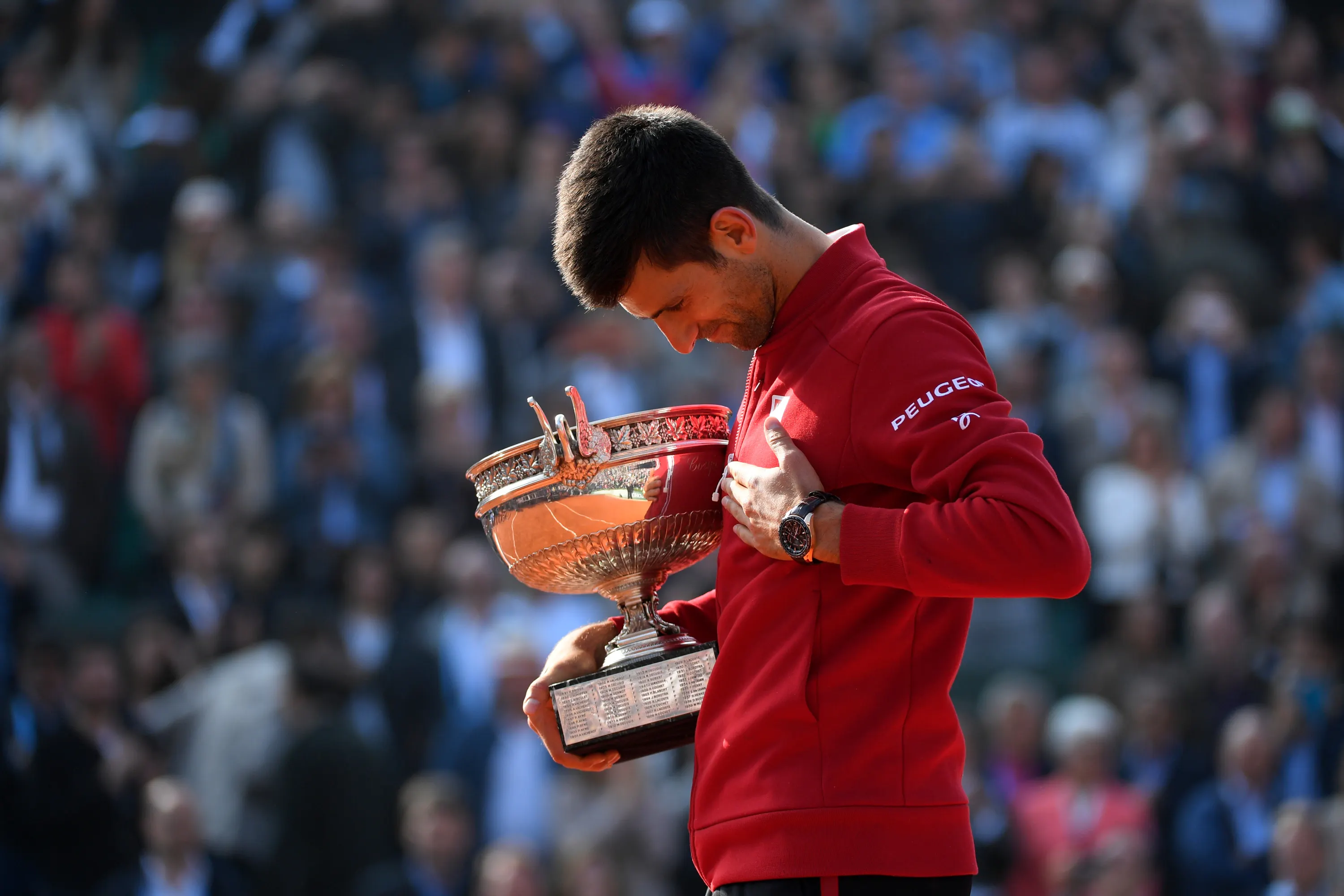
Djokovic – Murray: non-identical twins, true rivalsIn 2016, tennis was at a sort of crossroads, and Roland-Garros marked both the completion of a mission and the end of a cycle. Roger Federer, plagued by back pain, was unable to compete in the tournament for the first time in his career and Rafael Nadal, suffering from a wrist injury, was forced to withdraw ahead of his third-round match against fellow Spaniard Marcel Granollers. Though unfortunate, these two absences cleared the way for Novak Djokovic and Andy Murray, the other two members of the Big 4, to walk off with the trophy and the world tennis crown.Having both just celebrated their 29th birthday only a week apart, the Serb and the Scot, World No.1 and No.2 respectively, set up an almost inevitable duel in the final, just like a few months earlier in Australia. It was the seventh encounter between the two men, just one shy of the record (for the Open era) set by Federer and Nadal, who had played one another for the first time ten years before, in the very same venue and in a Major final.The Serbian was playing big in Paris. Having won the last three Grand Slam titles, he was aiming to complete the legendary “four in a row” over two seasons. What made this even more extraordinary was that Roland-Garros was the only Major still missing from his trophy cabinet, and this was a golden opportunity to complete his collection. The premature exit of clay king Nadal, who had defeated the “Djoker” in the final in 2012 and in 2014 (Nole’s efforts had been foiled by Stan Wawrinka in the 2015 final), could have been more of an added pressure than a blessing, but for Djokovic it was nothing of the sort.“This year, when I arrived, it felt really different from any other year [...] I didn’t feel too much pressure, honestly,” Nole said after his victory. Marjan Vajda and Boris Becker’s protege certainly seemed very relaxed over the course of the tournament fortnight, coming out in a beret and moustache on Roland-Garros Kids’ Day, lending an umbrella to a spectator on court, and initiating celebration dances with the ball kids.He was also winning his matches fairly easily, despite the tournament being plagued by rain, with play stopped on several occasions (on one day not a single point was played, something that had not happened in Paris since 2000), which meant he had to return to the court five times in six days. The World No.1 took it all in his stride and even used it as extra motivation to wrap up his matches quickly. On his way to the final, he only dropped one set, against Roberto Bautista Agut in the Round of 16 (3-6 6-4 6-1 7-5). He saw off Tomas Berdych in the quarter-finals (6-3 7-5 6-3) then defeated a young Dominic Thiem (6-2 6-1 6-4), who, at age 22, was playing in his first Grand Slam semi-final.Conversely, Murray had endured quite a rough ride. He came back from a two-set deficit in the first round against Radek Stepanek (3-6 3-6 6-0 6-3 7-5) and was two sets to one down before rallying against surprise French contender Mathias Bourgue (6-2 2-6 4-6 6-2 6-3). He was then very close to losing the first two sets in the quarter-finals against Richard Gasquet (5-7 7-6(3) 6-0 6-2), who enjoyed his best-ever run at Roland-Garros. But the British player managed to step up to the plate and played what might be considered his best-ever match on clay to defeat defending champion Stan Wawrinka in the semi-finals (6-4 6-2 4-6 6-2).By doing so, he did Djokovic a favour by sparing him a repeat of the previous year’s torturous final. As it turned out, the man from Belgrade came to this final encounter feeling much fresher than his rival, who had notched up almost five hours more playing time. Despite taking the first set, the Scotsman started to wither, while his opponent only played better as time went on. Djokovic finally clinched the coveted title with a 3-6 6-1 6-2 6-4 victory in just over three hours, celebrating his win by drawing a heart in the clay, as a tribute to Gustavo Kuerten. He had conquered Paris, in all senses of the word.Novak Djokovic took home his twelfth Grand Slam title, his fourth in a row and the very first at Roland-Garros. He became the eighth man ever to win all four Major tournaments, after Donald Budge, Fred Perry, Roy Emerson, Rod Laver, Andre Agassi, Roger Federer and Rafael Nadal. Having won the Australian Open and the Masters 1000 tournaments at Indian Wells, Miami and Madrid, he became the first man since Jim Courier in 1992 to win the first two Majors of the season. This string of achievements affirmed his status as the boss of world tennis.Nevertheless, this title marked the end of a cycle for Nole, who then experienced a sort of ‘comedown’, both physically and mentally. He lost his place on the No.1 throne to Andy Murray at the end of the season, after a symbolic duel won by the latter in the final of the Masters. It was difficult to imagine at the time, but the two men were nearing the end of their fierce rivalry and would play one another for the 36th and last time in early 2017, in the final in Doha. As for Djokovic, he would have to wait two years before securing another Grand Slam title, at Wimbledon in 2018.The American lost her second consecutive Major final (after losing the 2016 Australian Open to Angelique Kerber) and once again failed to secure her 22nd Grand Slam title, which would have made her the most decorated woman in the Open era, alongside Steffi Graf. She would not have to wait long, however, as she exacted her revenge by defeating Kerber a month later in the Wimbledon final.In the meantime, it was Muguruza’s time to shine. After a nervous start and having dropped a set in the first round, she sailed through the rest of the tournament and became World No.2 along the way. And she did not stop there...Dates: 22nd May – 5th June 2016Women's final: G. Muguruza (ESP) d. S. Williams (USA) 7-5 6-4Men's final: N. Djokovic (SRB) d. A. Murray (GBR) 3-6 6-1 6-2 6-4


Most Popular