
Diageo’s USL calls for RCB bids by early February amid suitor frenzy; Dr Ranjan Pai in advanced talks with KKR
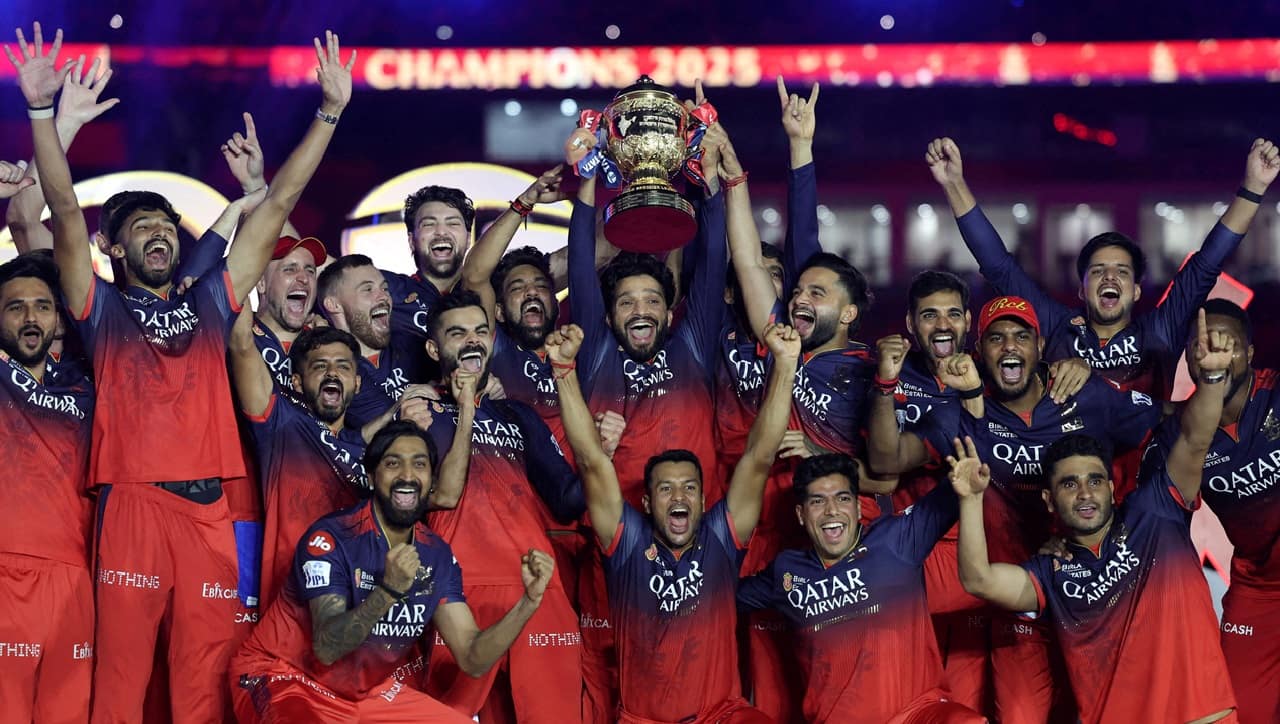
Global liquor giant Diageo Plc’s Indian arm United Spirits ( USL) has sought preliminary offers or non-binding bids by early February for the sale of its subsidiary Royal Challengers Sports Private Limited (RCSPL), whose business comprises ownership of the popular Royal Challengers Bengaluru (RCB) franchise team, multiple industry sources in the know told Moneycontrol.The move follows a strategic review of the arm RCSPL (non-core to USL’s alcobev business) initiated in November and expected to conclude by March 31, 2026. RCB participates in the men's Indian Premier League (IPL) and Women's Premier League (WPL) cricket tournaments hosted annually by the BCCI.“RCB, which lifted the IPL trophy last year, is a marquee asset without doubt and the ongoing sale process has seen frenetic inbound interest with more than 50 NDAs ( non-disclosure agreements) signed by a mixture of Indian strategics, global sports funds, private equity funds, sovereign wealth funds, NRI entrepreneurs and HNIs ,” said one of the persons quoted above.To be sure, an NDA by an interested party does not ensure eventual bid submission but “many of the parties who have expressed interest in the pre-bid phase are likely to join hands and explore consortiums later in the race rather than go solo as it’s a big cheque”, a second person elaborated.A third person said, “Preliminary bids or non-binding offers have been sought by early February for RCB. Though the sell-side ask for a 100 per cent stake in RCSPL is around $2 billion, a few prospective suitors are keen to value the target between $1.5 billion to $1.7 billion. Further clarity will emerge on valuations post due diligence, during the binding bid stage.” Investment bank Citi is steering the mega transaction, this person added.On October 9, 2025, Adar Poonawalla, CEO of Serum Institute of India and Chairman of Poonawalla Fincorp had referred to the RCB divestment on social media platform X by posting ; “ At the right valuation, @RCBTweets is a great team.”Last week, he publicly confirmed his interest in the team and said on X , “ Over the next few months, will be putting in a STRONG and COMPETITIVE bid for @RCBTweets, one of the best teams in the IPL.”According to two other persons familiar with the deal, Bengaluru-based Manipal Group’s Dr Ranjan Pai has held advanced talks with US private equity major KKR to be the lead PE partner, form a consortium and bid jointly for RCB, subject to internal approvals. Singapore investment giant Temasek is also evaluating the possibility of joining the combine and becoming the third investor if required, these two persons added. Additionally, a source close to JSW Group said that the diversified conglomerate which co-owns IPL team Delhi Capitals is “not in the race for either RCB or Rajasthan Royals.”On January 23, ‘The State of Play’ first reported that Temasek was exploring a partnership with Pai and private equity major TPG is backing Poonawalla.All the six persons quoted above spoke to Moneycontrol on the condition of anonymity.In response to a detailed email query from Moneycontrol, USL parent Diageo, KKR, Temasek and Citi declined to comment. An email sent to the Manipal Group remained unanswered at the time of publishing this article.M&A action in IPLOver and above RCB, there are parallel stake sale processes underway at other IPL team as well.On December 8, 2025, Moneycontrol had reported that a majority stake sale process was underway at Rajasthan Royals, the winner of the inaugural IPL, targeting a valuation of $1 billion-plus, with The Raine Group roped in as the sell-side advisor. The same suitors may evince interest in both Rajasthan Royals and RCB, the report highlighted.The report also indicated that depending on the strategy of the incoming buyer and the lead investor Manoj Badale, a 100 per cent stake in Rajasthan Royals may be available if feasible to all stakeholders. Badale can also exercise the option of ceding control but holding onto a part stake and not making a complete exit from the team, it added.British-Indian entrepreneur Manoj Badale's Emerging Media Ventures holds around 65 per cent stake in Rajasthan Royals as per reports, with minority investors including American investment management firm RedBird Capital Partners ( around 15 per cent stake) and Fox Corporation's Lachlan Murdoch, among others.Later on December 18, 2025, Moneycontrol was the first to report that a part stake sale was brewing at Kolkata Knight Riders.The KKR franchise is owned by Knight Riders Sports Private Ltd, which was set up in 2008 as a joint venture between Bollywood superstar Shah Rukh Khan's Red Chillies Entertainment and actress Juhi Chawla and industrialist Jay Mehta-backed Mehta Group.According to reports, Red Chillies Entertainment owns a majority stake of 55 percent in the joint venture, Mehta Group owns the balance 45 percent stake, and the trio of Khan, Chawla and Mehta (Chawla's husband) paid around $75 million for the team in the inaugural IPL auction."Unlike RCB and RR, which are exploring a proposed majority stake sale, when it comes to KKR, only the Mehta group plans to offload a minority stake and unlock value. Investment bank Nomura has been mandated as an advisor,” the Moneycontrol report had said.Why is the IPL a lucrative opportunity?As per the "IPL Valuation Study 2025" by Houlihan Lokey, the IPL business value has risen to $18.5 billion from $15.4 billion in 2023. On the other hand, the IPL brand value rose to $3.9 billion from $3.2 billion in 2023.As per the study, RCB maintained the top position on the brand value chart ( $269 million), followed by Mumbai Indians ($242 million), Chennai Super Kings ($235 million) and Kolkata Knight Riders ($227 million)The study also highlighted the difference between the IPL and global sports leagues like the NBA and EPL when it came to aspects like transfer fees and operating costs."From a dealmaker’s lens, IPL represents a near-perfect blend of predictable cash flows and cost discipline, a rarity in the global sports asset universe. Revenues are underwritten by BCCI’s long-term, well-negotiated media rights contracts and front-loaded sponsorship deals, creating annuity-like cash flows," the study said.The top franchisees clock Rs 650 crore to Rs 700 crore in annual revenues, with up to 80 percent visibility secured before the start of the tournament. On the cost side, the presence of a salary cap (Rs 120 crore per team) functions as an embedded margin protector, preventing wage inflation (a major concern for global sports teams) and ensuring competitive parity among teams.Moreover, franchisees operate with minimal fixed-asset exposure, benefitting from ready access to stadium infrastructure already created by BCCI, translating into a capital-light model with structurally high return on employed capital, the study said.The study added, "When benchmarked against global peers like EPL and NBA teams that wrestle with high player transfer fees, variable wages, and high stadium operating costs (including servicing stadium debt), IPL franchisees operate with an asset-light, revenue-guaranteed model, a structure that not only cushions downside risk but also amplifies operating leverage on the upside."For institutional investors, this makes the IPL not just a sports league but a high-growth compounder in the entertainment space, catering to a fast-growing fan base with rising disposable income and a strong appetite for premium digital experiences."


Most Popular



From bats to bonds: Uganda's 'cricket grannies'
16 hours ago

NZ Women vs SA Women 3rd T20I Match Prediction
17 hours ago