Joseph Schooling's Olympic gold medal
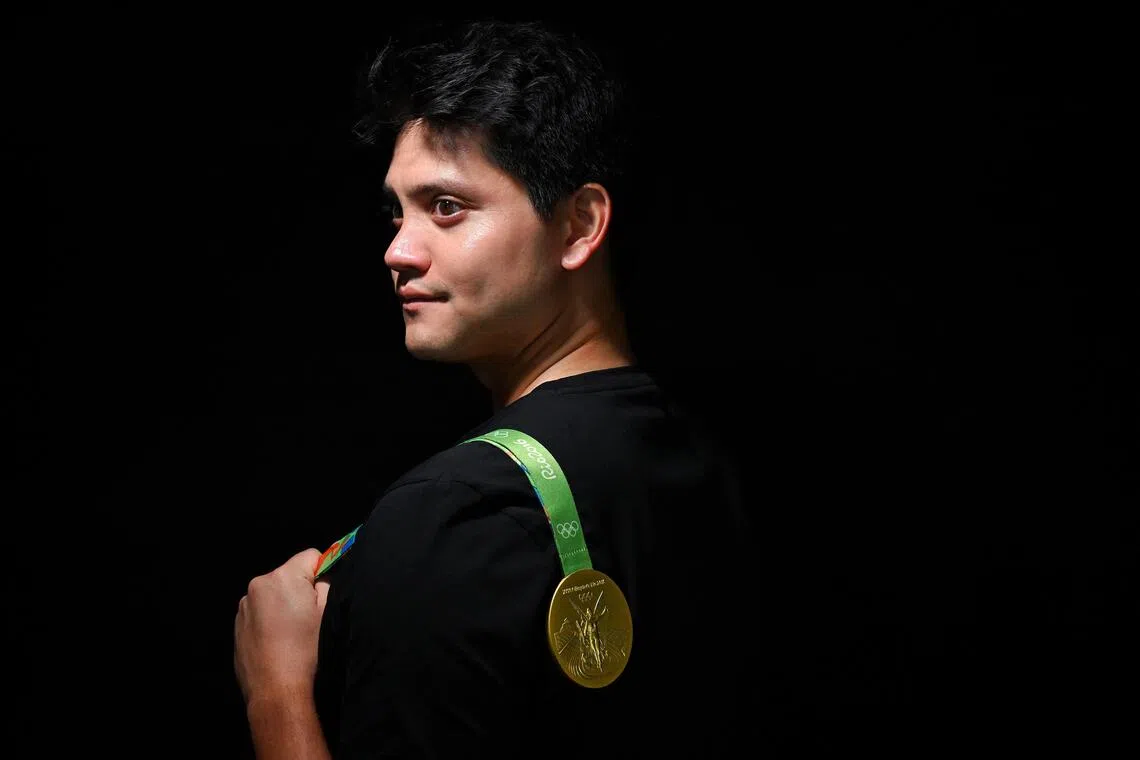
In a bus one August day in 2016 in Rio de Janeiro, the Singaporean, 21, his insides swirling with hope, belief, anxiety, swagger, all those ricocheting emotions that flare at an Olympics, suddenly blurted out something to Ryan Hodierne, the biomechanist who was helping to tune him for the race of his life.“I can vividly remember Joseph a few days before the heats,” says Hodierne now. “He turns to me and says, ‘I am going to win the heats, going to win the semis and win the whole thing’.“I didn’t say a word but I thought, ‘Who was this guy?’ He had the utmost belief in himself.”Ten years from that soaring, history-rewriting, Michael Phelps-beating summer of 2016, a summer which altered him forever and sent his name into worldwide headlines, a summer which propelled Singapore into a part of the medal table it had never visited before, Joseph Schooling is grinning after being told that Hodierne story.“Sounds like me,” he says.It’s a Friday afternoon in July 2026 and Schooling is late. On land he has a loose relationship with time, in water he was wedded to the clock. Perched on a chair in his Marine Parade office which is cluttered with photos, old accreditation cards, golf memorabilia, he’ll tell you the past doesn’t interest him and yet he’s imprisoned forever by this singular act of greatness. When he’s 80, he’ll still be Singapore’s golden boy. Now he’s only 31 and on the 10th anniversary of his gold-medal feat, I ask a favour: Can he time travel his way across the years to a swimming pool 15,000km away called Estadio Aquatico Olimpico.And so he agrees to peer at his 21-year-old self on an iPad screen. There he is, Aug 12, 10.12pm Rio time, lane 4, red Singapore parka, headphones on, and he’s not sure if it’s Blink 182 or Limp Bizkit he was listening to. Just that, like a warrior and his marching tune, it’s “one of the angry songs”.That final morning he was tense during his bus ride to the stadium, but now he’s cloaked in calm. He asked Sergio Lopez, the former Spanish Olympic medallist who was his primary mentor and also his coach at The Bolles School in the US, to walk him to the call room. As Lopez remembers now, “Joseph told me, ‘Don’t worry, I got this’ and he walked away with such conviction. I got goosebumps.”On the blocks, Schooling was surrounded by greatness. In lane 2 on his right, the American Michael Phelps, who’d finish his Olympic career in Rio with 23 golds, three silvers, two bronzes. In lane 5 on his left, the South African Chad le Clos, who had beaten Phelps in the 200m butterfly at the 2012 Olympics. But Schooling saw nothing but the inviting lane. He followed his usual superstition of splashing water on himself and exhaled. It was as if he was letting out every remaining demon.“You want to be in a tranquil state,” he says. “You’re anxious, excited, nervous, and you’re at peace with that.“What went through my mind? Nothing.”The buzzer sounded. The dive followed. And a single word was repeated in his head.“Go. Go. Go.”‘He had different gears’At home in Singapore in 2016, his dad Colin sat. In the stands, mum May shouted. In the press box, May Chen and Jonathan Wong of The Straits Times scribbled notes. Across the planet there were multiple witnesses to Singapore’s greatest sporting day. Even in Dunedin, New Zealand, Kirsty Fairbairn was shouting at her TV.Fairbairn was Schooling’s sports dietitian, visiting him in the US, rolling her eyes at his “Texan diet” of “fried chicken, mashed potatoes, hot chips with a side of soft drinks” and offering him a reality check. “It’s normal for 19-year-olds in the US,” she told him, “but you’re not trying to be normal.”Now, Schooling laughs. “I was terrible.”But he switched, with Fairbairn’s nudging, to salmon, avocados, eggs, nuts, olives, wholegrain, pasta, brown rice. It was these little pieces which would fuse in Rio to produce a competitive masterpiece. Pieces like longing, technique, ambition and a body which for years was “always sore” because it was being pushed inexorably towards excellence.But this suffering is “a kind of joy”, explains Schooling. Pain as progress. “You do what you need to do to win. And if suffering comes with it, then you know what? This is part of the territory. You don’t like it? Maybe this isn’t for you.”What he owned was a rare intuitive skill, a skill invisible to us but Lopez saw it early. It was a feel for liquid, how it behaved, how his body reacted in it, a sort of magic which allowed him to hold water, a talent as mysterious as a great gymnast instinctively knowing where she is in the air.“To me,” Schooling says now, “feel in the water is knowing exactly how it runs through my fingertips, goes through my body, how it feels through my sides, how my feet feel when I kick, how I can angle myself into the right position to go fast.”This feel was working for him all week. Of 43 competitors from 32 nations, Schooling was fastest after the heats (51.41sec) and fastest after the semis (50.83sec) and yet Sonya Porter, then high-performance manager for Singapore Aquatics (SAQ) and now a technical consultant, just knew.“He still had different gears.”‘Thonk, thonk, thonk’Schooling is watching himself on the iPad, modest interpreter of his own greatness. “First two strokes I’m just thinking... Take it nice, smooth and easy. Right around here (in the early part of the race), I just kind of like to see where everyone is.”The world was behind him.He led, Phelps lurked.In Singapore we had no concrete idea of how gifted Schooling was then but his rivals did, they’d seen him rise, registered his splits, taken in his speed. A year before at the 2015 world championships in Kazan, le Clos had taken note.“(Joseph) was in lane one,” he tells The Straits Times in July. “He went out in 23.5 (23.53, for the first 50m) and I was like 23.7 (23.72) and I actually watched him swim underwater. He was a bit ahead of me, which was quite surprising.”Le Clos eventually won that race, Schooling got bronze, but the South African knew.“The writing was on the wall.”As Schooling ate up the water in Rio, Lopez’s eyes were closed. Porter, who was alongside him, wondered if he was nervous.“Then,” says Porter, “Sergio opened his eyes and looked at me and just said ‘He’s got this’. He was listening to Joseph’s kick and the way he connects his kick and what he could do with it was insane. Sergio could hear this timing: ‘Thonk, thonk, thonk’. It’s what he was listening for.”Lopez understood the machinery of Schooling and knew his secret weapon: the kick. “To me,” says Lopez now, “that kick was what made him special. The things he could do with it in practice, I don’t think nobody in the world could do. It’s very powerful and when it’s working his body shoots forward in a way that’s pretty impressive and very efficient.”In 2016 that kick took Schooling to the 50m wall faster than anyone.‘Home free, baby’There’s an art to following science. To breaking down a race into strokes, splits, underwater kicks. To then following it like a sacred text. To rehearsing it till the muscles remember what they must do.Hodierne, student of data, and now senior movement scientist at the Queensland Academy of Sport, knew the first 50m was vital. The target was 23.60sec and 16-17 strokes. Accelerate with such purpose that by 65m Schooling was a rabbit so far ahead that no talented greyhound could catch him.This theory was a beautiful thing, but reality in a high-heart-rate, no-second-chance, 15,000-people-watching, decibel-rising arena was something else.Could you even think? Would your body obey?“At that level,” says Porter, “everyone has talent but to work through the heats, semi-final, final, you have to control your energy expenditure and your emotions one race to the next.”But it was a state of emotional control which Schooling arrived at. “It takes years of practice,” he says now. “At the 2012 Olympics, I did not manage my emotional state that well. But in 2016, I could swim a race, switch off, sleep like a baby, because I knew the work was done. I knew I deserved to be there. I was ready to execute.”His only imperfection, which cost him an eyelash of time, was that he was “long to the wall”. He glided longer than he should. So instead of 23.60 for the first 50m, he clocked 23.64, but he was still ahead of everyone, including Phelps, whose first 50m was 24.16.The water for Schooling was always what the canvas was for an artist. “It’s where I express myself,” he says. But this moment, this final, demanded a masterpiece and he found it, surging after the turn, devouring the clock, eating up the metres, like some caged creature let loose.“You see that?” he says pointing at the iPad screen. “I actually look to see where I was with 15 metres to go. To see where Michael was.”Always everyone wanted to know where Michael was, but this time Michael, immortal catcher of everyone, couldn’t keep up. In the water, Schooling thought: “All right, Joe, hold on and you’re home free, baby.”He touched the wall.Instead of a planned 27-second 50m, he timed 26.75.“You know, on the blocks, they have these lights that flash at the finish, one (light), two (lights), or three, which determine your place. So I looked up, tried to see if there was any light, which means you’ve medalled.”“And I saw one light.”First.Two Big Macs, fries, CokeIn Marine Parade as we talk, mum May arrives carrying a nondescript Chelsea football pouch which usually sits in his bedside drawer. He unzips the pouch and there it is: the most precious piece of sporting metal in Singapore. All his life he chased this golden sphere, now he owns it and barely looks at it.Pride is what he feels in 2026. In August 2016, the primary emotion was relief. Talent proved, effort validated, toughness confirmed.In a remarkable coincidence, Phelps, le Clos and Laszlo Cseh were joint second at 51.14sec. Schooling, who clocked 50.39sec which was an Olympic Record, left them respectfully in his wake. If you trace the history of the Olympic 100m butterfly, the margin between first and second has been tight. In 2008, 0.01 of a second, in 1980 it was 0.02, in 1992 it was 0.03. But Schooling won by a margin greater than anyone since Mark Spitz in 1972.A staggering 0.75 of a second.Phelps congratulated him. Le Clos later told ST that “it couldn’t have happened to a nicer guy”. In the stands, Chen cried as Majulah Singapura was played and then she, Wong and I sat up till 7am writing first drafts of history about this new dawn.Nations change in 50.39 seconds. In 2016, Singaporeans who didn’t follow sport wore a grin. Others preened, wept and shook their heads as they travelled to a place where they never believed they’d arrive. On top of an Olympic podium. Best in the sporting world.All this Schooling gave us.And yet ask him if he understands what he did and 10 years later, medal sitting beside him, he shakes his head. There are kids he meets who look at him and go, “That’s the swimmer” and he’s stunned. They’re perhaps 11 years old and probably were a year old when he raced in Rio and he wonders, “How do they know?”That legendary night in Rio, after the medal ceremony was done and the press conference concluded, he returned to the Athletes’ Village and his team kindly went and lined up at McDonald’s for him.“I had two Big Macs, one cheeseburger, fries, a Coke.” He had earned every calorie.Later he would sit with Lopez in the room, both of them somewhat quiet. Digesting burgers and gold. Maybe words felt insufficient. Sometimes when talent sings with such authority and eloquence there is really nothing left to say.


Most Popular