The Joy of Six: moments of unbridled joy in sport
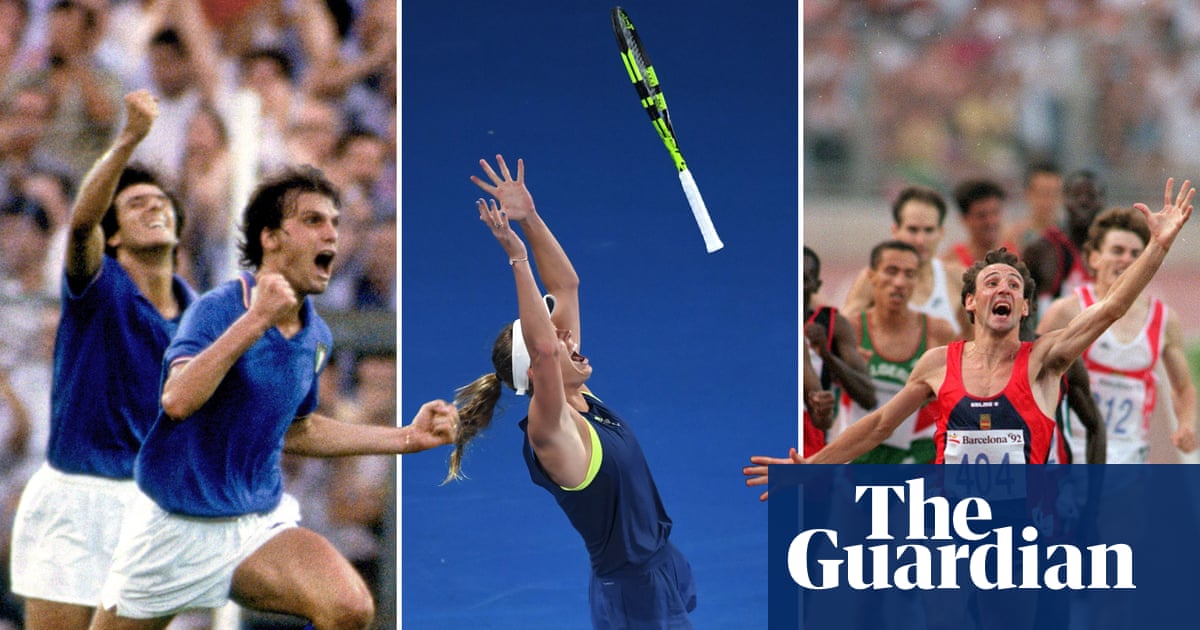
The pain of failure, both professional and personal, is one we all know well. We have ambitions and plans, backed by evidence and rationale, which prove why our life should work out … then it doesn’t.Often, there are mitigating factors that make it not our fault – skill, endeavour and kindness do not distinguish those who succeed from those who don’t. But at the same time, when we’re alone at night we can’t help but direct blame inwards, ruminating on the toll of our imperfections.So we reason with ourselves, explaining that validation comes from within; bargain with ourselves, debating what we’d give up to get what we want; and torture ourselves, replaying the near-misses while grousing about the glory of those less deserving, imagining what it’d feel like if we got there while planning for how we’ll handle it when we don’t.The agony of desperation manifests as a spiritual and physical convulsion, a perpetual drain on morale and worth. Roughly, the sense is of being imprisoned on the N29 bus having drunk 17 pints of Personality, forlornly hoping that some day, somehow, the cosmos allows us to disembark and experience the incomparable, incomprehensible release of relief so excruciating it stings to the back teeth.Between October 2010 and January 2012, Caroline Wozniacki spent 67 weeks as world No 1, holding the position at the end of both 2010 and 2011. That makes her, by any measure, an absolutely fantastic tennis player, except tennis players are measured not by ranking but by grand slam titles, and Wozniacki just couldn’t get it done.Though grass and clay weren’t her thing, her preference for hard courts gave her two majors a year at which to go and, in 2009, she made the US Open final only to lose in straight sets to Kim Clijsters. This was no disaster – she was young with plenty of opportunity ahead of her, except in the two following years she was beaten in the semis – first by Vera Zvonareva and then by Serena Williams, who also dispatched her in the 2014 final – while, in the 2011 Australian Open semi-final, she succumbed to Li Na.Wozniacki’s failure to win these two distinct types of matchup seemed set to define her career. A 1-10 record against Williams illustrated a fundamental lack of power and definitive weapons she couldn’t think her way around, leaving her impotent when athletically out-matched, while the defeats by Zvonareva and Li showed an inability to respond when less talented players did what she could not: produce their best form when they needed it most.In the meantime, majors were won by luminaries such as Li and Victoria Azarenka – both twice – Svetlana Kuznetsova, Samantha Stosur, Marion Bartoli, Flavia Pennetta, Jelena Ostapenko and Sloane Stephens, each of them an objectively inferior player to Wozniacki and somehow less worthy for being less good, but also more worthy for turning that less into more. We do not have to delve deep into our own psyches to feel this torment.If there was one thing Wozniacki didn’t need, it was the pain of a public break-up but, in 2014, she and Rory McIlroy disengaged. A few months later, she was 74 in the world, then lost to Angelique Kerber in the last four of the 2016 US Open and, at 26, with her year-end end ranking down to 19 and injuries biting, her time seemed to have expired.But in 2017 and following a dispiriting second-round US Open defeat, she won the WTA Finals, moving up to No 3 in the world – her highest ranking since 2011 – and was seeded two at the 2018 Australian Open, her 43rd grand slam appearance. And for once, with Williams absent having just given birth, circumstances were in her favour.Still, in round two she had to save match points against Jana Fett, coming back to win from 1-5 down in the third then, in the last eight, Carla Suárez Navarro took her to a third-set decider. She made it through, though, and victory over the unseeded Elise Mertens set up a final against No 1 seed Simona Halep – another prodigious talent, without a major win but with the heavy artillery that was usually too much for Wozniacki.Wozniacki took the first set on a tie-break but lost the second, after which the players broke for 10 minutes, so savage was the heat. Then, down 3-4 in the decider, she took a medical timeout and decided to forsake the insecure, defensive style that was a consequence of that comparatively lacking athleticism, commanding herself to step into court and swing freely.From there, she won three games in a row to end the ordeal, embracing positivity to find light in the maelstrom of the moment, uncovering a solution that had been right there all along.Immediately, Wozniacki broke down in tears and flopped to her back, unable to process a sensation she’d planned for her entire life and experienced many times in her imagination. “I dreamed of this moment for so many years,” she said afterwards. “I never cry, but today is an emotional moment.”An emotional moment that will never end. No doubt it drifts from her mind as other stuff happens, but it remains the case being Wozniacki is now an entirely different experience, every minute of her life powered by the unrivalled, triumphant joy of the greatest relief ever experienced.We’ve all experienced the joy of relief, but the joy of amazement – amazement being a feeling of bewilderment or stupefaction causing great surprise or wonder – is less familiar among those of us yet to win the lottery. Generally speaking, we know what’s going to happen in our lives; one of the greatest attractions of sport is that we don’t.In the 80s, the 1500m was athletics’ blue-ribband event. And though, towards the end of the decade, the 100m took over, it remained a big deal by the time of the 1992 Barcelona Olympics.Algeria’s Noureddine Morceli had won the 1991 world championships by a full two seconds – a ridiculous margin over the distance – so arrived at the Games as one of its strongest favourites. He duly won his heat and semi, but the final was run so slowly it hit the 800m mark in a time slower than that recorded in the women’s equivalent. Fermín Cacho, the home favourite, had been drawn on the inside so gone off quickest to avoid being boxed, but the pace shut down thereafter, everyone too afraid to make a move.At the bell, Morceli was fourth, with Joseph Chesire of Kenya seeking to win from the front. So the field moved right to attack him on the outside, leaving a gap through which Cacho, still on the kerb, steamed through, hitting the front at the top of the bend before repeatedly looking back over his shoulder, unable to believe no one was coming with him. But no one was, Morceli and the rest somehow with nothing left to give, leaving him free to celebrate well before crossing the line while still recording a 50-second final lap to complete what, at 3min 40.12sec, David Coleman called “the slowest winning time you could possibly imagine”.Not that Cacho cared, prancing in shock at what he’d achieved and crowning a terrific meet with a local win on its final day. As he cavorted on the track, the crowd and the King of Spain – the actual King of Spain, not Ashley Giles – went wild, a matter of seconds transforming a decent runner into a home Games gold medallist, forever immortalised in his nation’s history as an Olympic legend.At some point or other, everyone has experienced the intestine-swallowing terror of being in a fight. Naturally, most of us prefer to swerve it if we can, but people find joy in an amazing array of unfathomable things – beards, F1 and so on – so perhaps it shouldn’t be surprising that for some, a cage-based ruck against a wrecking machine primed to destroy you is exactly where it’s at.MMA is often described as “physical chess”, the analogy making no sense but also perfect sense. If pain and danger are either part of the fun or completely irrelevant – that’s the no sense bit – then the perfect sense bit tells us it’s simply a battle of wits and will, proactivity and reactivity, strategy and planning, expression and imagination that is good, clean, wholesome fun for all the family.Max Holloway began his prize-fighting career after just three days of training and his UFC career as the youngest fighter on the roster. In the nearly 14 years since, he has stepped into the octagon 32 times, winning the featherweight belt before defending it thrice.But it is not the success that makes Holloway part of this selection, rather the glory. No fighter in the featherweight division has more wins, more knockouts or more fight-time; no one, in any division, has landed more strikes, in title fights or in general; no one, in any division, has landed or absorbed more significant strikes. To watch Holloway compete is to experience extreme sensation.In 2019, the UFC minted a BMF belt with those invited to compete for it of elite ability but selected for purity of attitude. Roughly, they are fighters prepared to risk it all for joy, joy being a scrap as violent as possible that both participants seek to finish as spectacularly as possible.Even in the context, though, Holloway is special. Facing Justin Gaethje for the strap in 2024, he dominated for four rounds, four minutes and 50 seconds, but then, when the clappers went to signal the final 10, rather than await the judges’ verdict, he summoned his opponent – a bigger, heavier, more powerful man – to the centre of the octagon so they could stand and trade, then knocked him out face-planting cold with one second to go. No one had ever seen anything like it before; no one will ever see anything like it again.“He didn’t have to fight me … he had a guaranteed title shot,” Holloway said. “But you know, he took that challenge, he took me and it was his belt. So I was like ‘this guy is a standup guy, if the roles are reversed he’s give me a shot, so why not give it to him?”Or, as Dana White puts it: “Everyone acts like they want to do that; Max is the only guy that actually wants to do it.”Nor was this the first time. In 2016 when rising up the ranks, Holloway offered Ricardo Lamas the same opportunity, then did likewise against Dustin Porier – a man of similar mettle he later beat to become the first man to defend the BMF crown – in 2019. It was a matter of honour but also a matter of passion, the joy of competition and the joy of sport lived in their rawest, purest form, inspiring the joy of freedom and communion, bestowing a joy of respect and – most importantly – the elusive joy of self-respect.There is no place in the world more joyful than Brazil, a country where song and dance, food and drink, football and spectacle, are so culturally embedded as to be quasi-religious. Embodying joy in that context, with a rival cast of more than 213 million people, requires rare devotion and genius.But that was Garrincha. The personification of malandro, a mythical trickster-character and folk hero unbound by social convention and deploying underhand but morally defensible methods to speak truth to power, he is the little man tapping the big man on the shoulder to merrily boot him in the balls when he turns around, before stealing his wallet to buy champagne for the poor.Garrincha didn’t even start playing football seriously until his late teens, characteristically uninterested in his own celestial talent. Physically, he seemed weak, with his right leg, which turned inward, significantly shorter than his left, which turned outward. Except this was a classic malandro confidence trick, his unusual gait and flexibility helping him become perhaps the greatest dribbler ever.His achievements are significant – he won three state championships with Botafogo as well as the World Cup in 1958 and 1962, when he was also player of the tournament and top scorer. Pelé, though, took winners’ medals at both of those events and also in 1970, yet at the Maracaña, it is Garrincha after whom the home dressing room is named because – as evidenced, say, by the reverence for the 1982 team who failed to progress to the semi-finals, versus the tepid reception given to their 1994 world champions – in Brazil more than anywhere else, status is not measured in trophies but in joy.And no one brought more of it than Garrincha, The Little Bird who was Tweety Pie to defenders’ Sylvester. A mesmeric dribbler of invention and misdirection, hopelessly devoted to the sacred art of taking the piss, he would stand over the ball and dare defenders to take it from him like a Slapsies champ feinting for the reaction that always comes, before administering the free hit with elation.Another favourite move was making off but leaving the ball behind – and of course they always chased after him, unable to remember where they saw it last, it always in the last place they looked … until it wasn’t. A killer with comic timing, Garrincha was director and protagonist of a farce in which those in his way slipped, fell and collided, to the uproarious delight of everyone but them.Life, though, was not as simple as football. The son of an alcoholic, Garrincha became one himself and was involved in various drink-driving accidents, the worst of which killed the mother of his second wife, who left him after he hit her during an argument.Though the pleasure he bestowed did not redeem the pain, death rehabilitated his reputation. Existing in Brazil can be tough, and the man known as Alegria do Povo, the Joy of the People, was their delegate, representative and hero, playing for them by doing what they’d do, showcasing everything they loved about their game, their country, and themselves.George Bernard Shaw wrote that youth is wasted on the young, a way of feeling better about being old but a long way from the reality that actually, the young are wasted on youth. And so they should be, the joy of potential and adventure – of not knowing what the next hour will bring never mind the next day or decade, and making choices based on curiosity and pleasure, not obligation and necessity – profoundly intoxicating and addictive.The joy of youthfulness – whether we experienced it or wish we’d experienced it – is one we all understand, and sport is a way of maintaining our connection to it. We experience young people live their and our dream, enjoy them as they grow up without the stress of parenting, fascinated by how they change through a hyperreal life lived at the extremes of emotion.South Africa worships sport, athletic competition woven into its social, cultural and educational fabric. And now, post-apartheid, it is freighted with resonance beyond itself, seeking to repair and represent the rainbow nation by honouring values of equality and opportunity.In January 2018, Lungi Ngidi was picked to make his Test debut against India, aged 21. Bowling in the first innings, he managed a wicket and a run out but then, in the second, having already removed KL Rahul, he knocked over Virat Kohli, cricket’s biggest superstar.In the moment, Ngidi was all business but once eyes were off him and he retreated to field on the boundary, his face began twitching into a grin of satisfaction that he simply could not suppress, a schoolboy trying not to crease in class. Tiny movements of moving eloquence expressing satisfaction, possibility and wonder crystallised the greatest moment of his life, bringing him to emotional overload and the brink of laughter at the sheer ridiculousness of it all: the sense we almost never have, that anything is possible. Outwardly he did all he could to affect calm but inside he was leaping and we still can’t help but leap too, joy radiating through him and into us – all the more so given he returned figures of six for 39, winning the player of the match award as South Africa won by 135 runs.Cross the road, drop a shoulder; walk down the street, delivery stride and follow-through; frying pan, backhand slice; the freeing physicality of sport permeates our lives in numerous ways. And it has no greater expression than the iconic celebration, imitated after completing iconic tasks such as fitting everything into the dishwasher – cue the Cuddly – getting off a parking ticket – enter the Eric – or beating your daughter at Rummikub – meet The Menace.But when the time comes for our most joyous expression – one for which many of us are still waiting – we can only take out the Tardelli, its acme, epitome, zenith, pinnacle, quintessence, apex, apogee and apotheosis. No one has experienced or communicated the feeling at greater intensity, the ecstasy of 56.7 million Italians and centuries of history channelled through one man, and to conclude this piece in any other way would be improper, for it is joy incarnate.It’s probably accurate to say not many of us have scored in a World Cup final, and that even among those who have, it is rare for that contribution to be crucial and, further, a belter. But explaining L’urlo di Tardelli, the man himself delivered a message of universal significance from which we can all learn. “I was born with that scream inside me,” he said. “That was just the moment it came out.”

.jpeg)
Most Popular
Leach Clinches Again, Card Beats NC State
10 hours ago


What were the Monte-Carlo tennis results?
10 hours ago