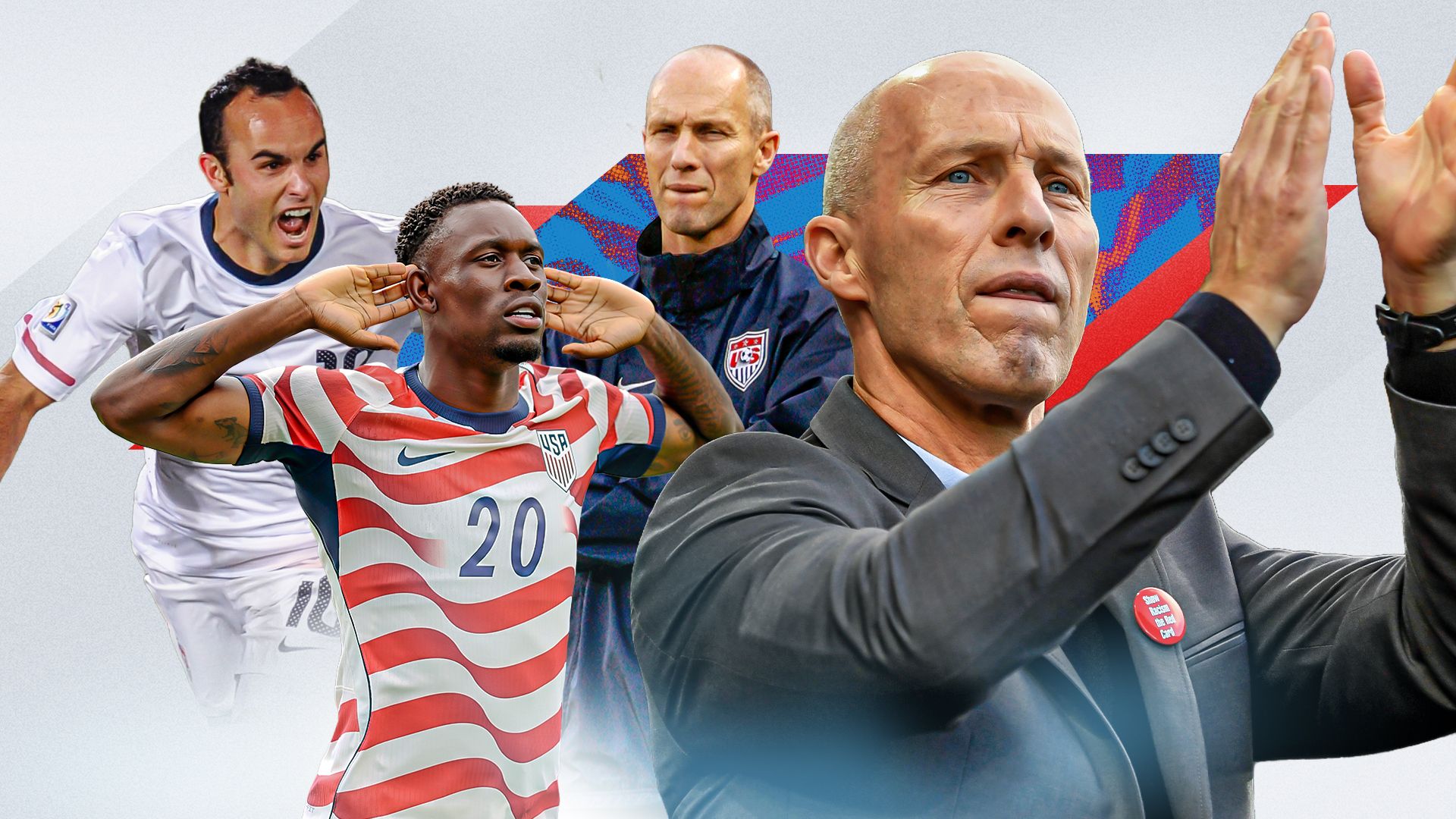
'It was pure domination' - Former USMNT boss Bob Bradley breaks down World Cup opener, reflects on Mo Salah bond and coaching future
GOAL:As a former national team head coach, what did you think of the USMNT's performance against Paraguay?BRADLEY: I was at the game, and simply put, it was the perfect way to start a World Cup. From the beginning, Christian [Pulisic's] dribbling, Weston [McKennie's] mobility, as we started to get going, [Malik] Tillman finding really good spots, everything headed in a direction toward [Folarin] Balogun. The coordination, timing and speed of movement. It was just a really, really good first half.I've said a few times now that if a team has a plan to press and the first time somebody steps up, our player can just go right by them, and it happens again and again and again. Then there's no more press. Paraguay couldn't get close to us, and they backed off. We found ways to create big spaces, and the first half was just fantastic in every way. It was pure domination.GOAL:When you look at that match, how much of that dominance was down to it being the U.S.'s first home World Cup game in decades and the adrenaline that comes with that versus tactics or just certain aspects of the game?BRADLEY: The crowd sure helps, but obviously [Mauricio] Pochettino had everybody in the right place. When a game starts like that, you absolutely say that the XI that he picked made sense. Let's take the midfield for a second. I like the roles. I think that McKennie is best when he's a little bit higher, when he can be part of the press, when he has opportunities to run.And there were huge spaces in the channels. Paraguay's center backs stood so close to each other with a balloon between them, and the distances between the center backs and the outside backs were enormous. They just couldn't deal with the fact that, in the coordinated way that we would move, they weren't sure.Paraguay's center backs didn't want to release, midfielders weren't sure whether they should run through, and in all those ways we just pushed them in at a speed. Physically, we're a really strong team, and if you look at the group of players we have on the field athletically, with speed and power, we've got a really good group.GOAL:It is typical for coaches, even in the best of wins, to find areas for growth. Where do you see this team needing to focus ahead of Australia?BRADLEY: I got asked [this] a bunch of times after the Senegal and Germany [friendlies], and [there are] absolutely concerns in the back. [There are times] when the back four at times weren't connected very well, the understanding in different situations of "Should I be [marking a] man or am I ready to pick somebody else up?"Teams would run players through from the second line, and sometimes we weren't in good positions to deal with that because we were locked into other things. At times, in the back, guys were tuning out and ball watching, and so, to be clear, Paraguay didn't test this in any of those ways.As great a game as the other night was, even the goal against [the USMNT] is a little bit of a blip. It comes off a long free kick from the keeper, and I think Chris Richards gambled a little bit and got caught on the wrong side. Then, when it was Tim [Weah's] turn to try to cover for him, [I] didn't like the way he reached across with his left foot, and it put Freeman in a difficult position. The way it was at that point, he wasn't quick enough to be able to help.So coaches can find all these things. When you win a big game, you don't want to ruin the energy that night, but when you have a chance the next day, you're looking at these details. You're starting to help everybody understand what the next game is going to be like, and when Australia defensively has an amazing performance and wins 2-0, as a coach, you have the message to your team that Australia is going to be a hard team to play against. It's a little easier to get that message across when they've come off a very important 2-0 win against Turkey.GOAL:It's still early, but after watching Friday's performance, what's your expectation from this group through the tournament?BRADLEY: Continue with the momentum, get out of the group, win the group, set up a good match in the Round of 32 and take this thing as far as you can.GOAL:Like the safe answer there, coach [laughs].BRADLEY: Go back one second to 2010, [when I coached the team]. We felt that there was an opportunity to do something special, and when we came out of the group, we were all focused in the right way. There was a real commitment to what we were all about as a team. We had proven that, and then you get into a game where, when it goes into extra time, it gets away from you, and we always look back on that World Cup like there was a lot more there for us.Did we set a specific goal ahead of time? The goal was to be a very good team, compete at the highest level and go as far as we could, and when we lost in the Round of 16, for all of us, it was disappointing. But we also were proud of what we were all about, and so again, the game keeps you honest.People on the outside want all of the [bold predictions], "We need to get to the semifinals, we need to get to the finals." Coaches all do it differently. I don't know behind the scenes how Mauricio has handled it, but in order to accomplish any goals, it's all about a group coming together in the right way, everybody believing and feeling good about what's going on. When different people get opportunities, they're ready to step up, and I'm hoping that we can see all of those things and go as far as possible.GOAL: You brought up 2010. What do you think is your legacy from that tournament? It's decades ago now. What did it all mean in the bigger picture?BRADLEY: Yeah, I never use the word legacy. It's not in my [vocabulary]. What I feel is this: I had the opportunity to be the national team coach, and when you get that chance, you think about all the people along the way and everyone in the country who has given to the game and what they're all about. Then you get the baton. You carry it for as long and in as strong a way as you can, and when the time comes, whether you like it or not, you give it to the next guy.When all of us look back on our team, I think the feeling [is] that everybody really enjoyed the group that we had. The way the team came together and the shared experience of a team that had a real identity. [We were] a team that wasn't afraid of playing against big teams and going after games and understanding on the field how to help each other and work for each other.I don't feel any need to try to convince anybody. If we were good, everybody can judge it whatever way they want, but from the inside, the feeling of what we were all about and the memories of that group, I'm always very proud of when I hear any of these guys talk because I think they all felt like they were part of something special.GOAL: So what have you been up to since you last left coaching, and is there a desire to get back into it at all?BRADLEY: Over the years, the ability to engage people around me, to challenge people, to lead discussions, to build a team, to help develop really good players and to have teams that are exciting, fun and competitive. I've done that for a long time, and I still believe I'm really good at that, and I'm excited to find the right next project. I've gotten into all different kinds of situations and found really good ways to create a culture that everybody feels is special, and I'm going to find the right opportunity and do it again.GOAL: Have you had conversations with teams about roles?BRADLEY: I've had some, and you never know what people are looking for. In certain cases, when the time comes, you have a football discussion, and in that call, you challenge people on their football ideas.[Do they] understand what it takes to create the culture that I just described? Understand what it means when it's your turn to lead, how you stand in front of a group, how you talk and whether you come across in a real way. And when things are going a little tough, do you know how to make sure that everybody still is on board?I've done all those things. I've done them in all sorts of places, with players from different backgrounds. If you look at the list of players that I've worked with, I would never say that any success they have is due to me. But I'm pretty proud when I see guys that I worked with move on and have really good careers.GOAL: One final one from me. LeBron James once said the biggest honor of his life would be to either play with his son or play against him in the NBA. With your son Michael now coaching the Red Bulls, how would it feel to potentially coach against him one day?BRADLEY: I coached against him as a player. I've obviously had him on teams I've coached. He always loved playing, and as he wanted to take his career as far and as long as he could, I'm proud that I was part of that.Then he had this idea, it was probably always there, that he wanted to coach. So when he finished in Toronto, a couple of days later, he joined me in Norway. That meant that every day for a year I was the first one in, and he was pretty close, No. 2.I'm really happy that I was able, not only at the very beginning, to get him going in the game and help create [the foundation he has]. He was around a lot of really good people and around the game from a young age. Then, in the next phase, as he transitioned into coaching, those experiences were pretty special, and I love watching his team.

Most Popular


Fans flocking to hotels for World Cup action
15 hours ago