ICONS: Fabio Grosso - Italy's unlikely World Cup hero
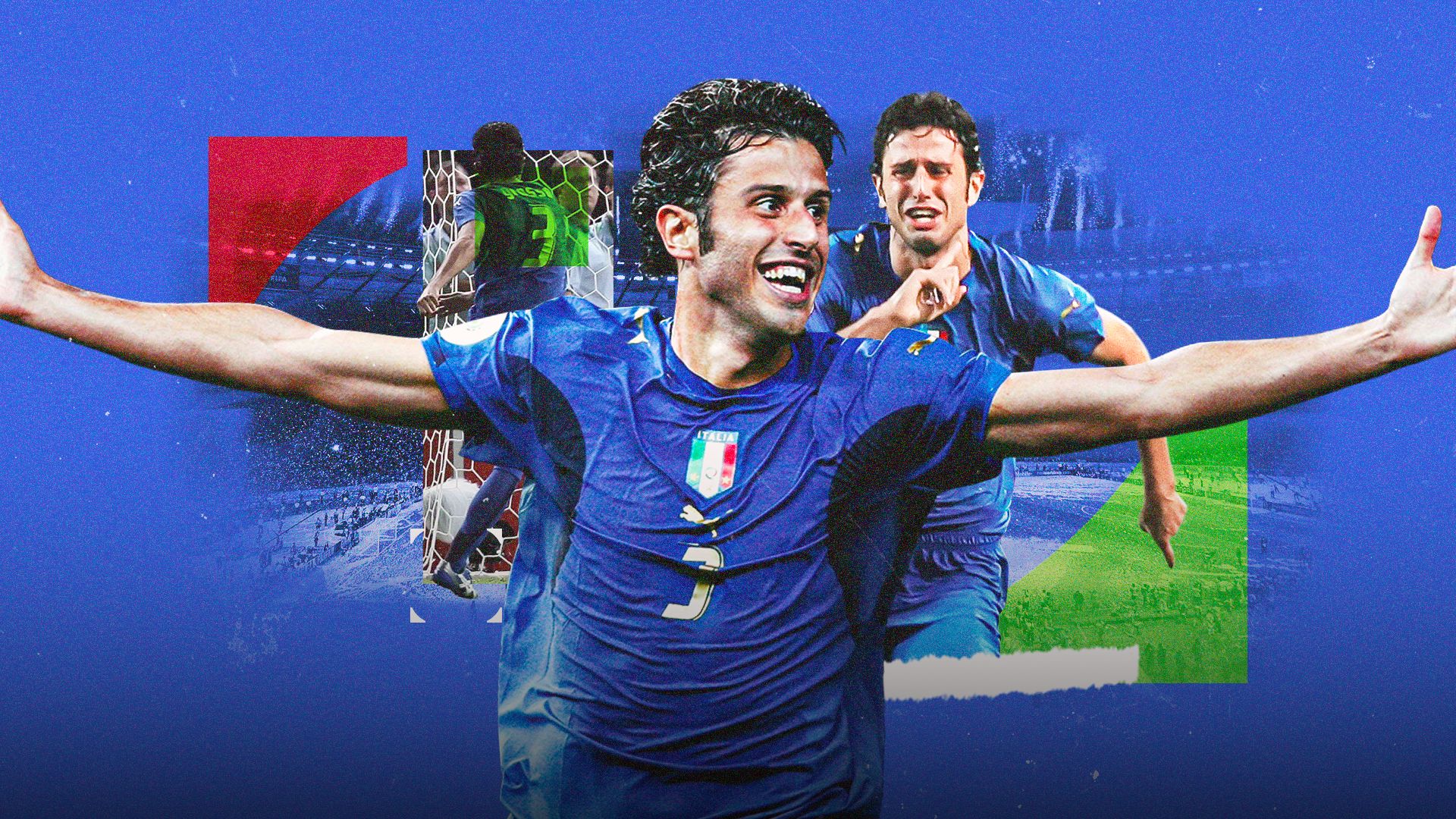
2006 was undoubtedly Grosso's World Cup. More so than Buffon, Francesco Totti, Pirlo or eventual Ballon d’Or winner Cannavaro. Grosso’s story is unique, his trajectory as beautiful as it was unexpected, from substitute to starter, from extra man to absolute protagonist.Not even Marcello Lippi, who consistently called Grosso up for qualifying matches and picked him in his 23-man tournament squad after a good season for Palermo, would ever have thought he had a world-class full-back on his hands.#Grosso’s goal against Germany was just one of the many highlight moments he produced over the course of the month. After being left on the bench for the only match Italy did not win at the tournament, the 1-1 draw with the United States in their second group game, Grosso was instrumental against Australia in the last 16 and against France in the final, converting the decisive penalty that sent Italy to top of football’s Olympus.The victory against Australia, coached by the formidable Guus Hiddink, was the sliding door of Italy’s World Cup. Totti’s injury-time penalty which secured passage to the quarter-finals was won by Grosso some 40 minutes after the Azzurri had been reduced to 10 men thanks to Materazzi's red card for a foul on Mark Bresciano. Though Lucas Neill and the Socceroos protested, Grosso and Italy were not to be denied."It was a clear penalty," Grosso said later in an interview with the Italian media. "I moved the ball and the defender blocked me from behind with his shoulders. Of course, my run wasn't pretty to watch, and it was quite tiring given the stage of the game, but it was certainly effective."Totti ended up on the scoresheet, but without Grosso's contribution, the story would probably have been different.After his impact against both Australia and Germany, Grosso put his signature on the game’s most important match: the World Cup final, doing so at the most important moment by scoring the decisive fifth penalty in the shootout.‘Why me?’ was Grosso’s instinctive response to Lippi when the coach told him he would be the fifth to take a penalty after Pirlo, Materazzi, Daniele De Rossi and Del Piero. Totti had been substituted, and while Juventus-bound striker Luca Toni and captain Cannavaro were options, Lippi entrusted his little-known left-back with the responsibility.‘You are the man of the last minute’, was Lippi's response, said with great conviction and without hesitation, referring to Grosso’s heroics in the previous round. But he was anything but a specialist when it came to spot-kicks. Before that night in Berlin, his most recent penalty had come five years earlier, in 2001, when he was playing for Chieti in Serie C2, the fourth division of Italian football.In those moments, with the eyes of millions of people on you, knowing that joy or pain, dream or nightmare depend solely on what you do produce in the next few seconds, the pressure can consume you. The line between failure and immortality is very thin."I tried in every way to stay calm inside," recalled Grosso in an interview with the FIFA website. "In moments like that, experience counts for little or nothing. Technical skills are certainly needed, but more than anything else, you need to be able to reach a particular mental state in the moments before the run-up."The memory of those moments is still vivid for Italian supporters even after so much time has passed. Grosso’s slow walk, trying to isolate himself from everything and everyone, before taking the ball in his hand and carefully placing it on the spot. Lippi takes off his glasses and wipes his eyes while others on the bench do not want to watch. Cannavaro remains motionless, as he has been during all four penalties taken by his team-mates. Pirlo embraces him from behind. The cameras return to Grosso, who turns towards the referee, then refocuses, looking at no one, neither Fabien Barthez nor the corner of the goal. His gaze seems lost, offering no reference points. He quickly runs his tongue over his lower lip, glances upwards briefly, takes a long run-up and fires off a perfect shot, high, strong and across goal, leaving Barthez with no chance as he dives to his right. A winning goal that beat France, Italy's ultimate nemesis, and put the Azzuri on the throne."I will always remember that I brought an end to the curse, the one hanging over Italy in major tournaments and in particular in matches that ended in extra-time or penalties," Grosso said of his match-winning moment. "From the World Cup final in 1994 to the quarter-finals at France '98, to the sensational Euro 2000 final, not to mention Italia '90 and the World Cup in Japan and South Korea in 2002. We were a little worried before the last match in Germany in 2006, but we managed to keep our cool and Mr Lippi gave us a decisive helping hand in finding our self-confidence.”Before the World Cup, no one would have believed that Grosso would become a national hero. Not only was an Azzuri victory deemed unlikely given the Calciopoli scandal that engulfed Italian football on the eve of the tournament, but Grosso was far from a household name."My path is that of a young man who was passionately devoted to football, having spent four years in the Eccellenza league, and at 22 I was in C2. At best, I could dream of playing in Serie A," Grosso explained to La Repubblica. "But beyond dreams lies utopia. They would say to me, ‘Come, we'll take you to play here or there’, but I just asked them to leave me where I was. ‘If I can’, I replied, ‘I'll get there later’. I wanted to follow my own path without jumping the gun."One story from his days playing for Renato Curi paints a perfect picture of Grosso’s character: "I was very young, and on the eve of our first match in Serie D, my coach called the most important players the night before the game for the latest information. When he called my house, however, he couldn't reach me. I was out with my friends. I treated it all like a game... I still felt like an amateur. But he had a lot of faith in me."My mother rang me to tell me about the phone call. She was disappointed too. The next day, there was a meeting to talk about what had happened, about the disappointment I had caused the coach. In the match, I scored a hat-trick and we won 6-2. From that day on, I became a professional."Grosso went down in history as an excellent full-back, but few remember his beginnings as an attacking playmaker. "I was an artist who became a full-back to further my career,” he told La Repubblica. "I always played as the number 10, then in Perugia the left-back was suspended and I played there. Instead of being transferred to Serie C, I became a starter in Serie A and began a new life. At the crossroads, I almost always took the right path. That is luck, but not only that."On my Serie A debut at San Siro against Inter, I was about to score the equaliser in the 91st minute," he continued. "I hit the post. Then, Inter counter-attacked, I committed a foul and was sent off. I could have collapsed, but somehow I was reborn. And I have no regrets: I have always been myself."Grosso's victory is that of a dreamer; the penalty in Berlin was the pinnacle of a career as a good footballer, certainly not as a star player. He accepts this label without batting an eyelid."The problem was the general expectation: I wasn't [Antonio] Cabrini or Paolo Rossi, I wasn't Salvatore Schillaci, but everyone expected me to be. That's why I don't like to talk about my penalty in Berlin; it's a part of the journey, an episode, but I lived so much before and after that shot. Few people will have noticed, but that's fine."I always wondered what an amateur who had gradually made his way into the professional ranks, starting from such a low level, was doing among the real champions. I wasn't convinced of my qualities to be there, but I knew how to be there."After 2006, Grosso's career took off, though only on paper. The joy of Berlin opened the doors for him to join Inter, with whom he made his Champions League debut and won the Scudetto under Roberto Mancini, though on a personal level, things did not go exactly as hoped.Grosso ended the season having made 35 appearances in all competitions, scoring three goals, but he was not central to Inter's plans, so much so that at the culmination of the campaign he preferred to move on join French side Lyon. His two years at the Stade de Gerland were full of success, as he won a Ligue 1 title, the Coupe de France and the French Super Cup. However, in the summer of 2009, Grosso decided to return to Italy and joined Juventus. At that point, however, his career was on the wane.Grosso took a 50 percent pay cut in order to move to Turin, but his adventure in black and white, where he wore the historic No.6 shirt, did not take off. After a good debut season, the full-back was subsequently left out of the squad, only to be reinstated out of necessity by coach Luigi Delneri.With the arrival of Antonio Conte on the bench, Grosso played a couple of games, but was then sidelined again, so much so that he was the only member of the squad not to take part in the trophy ceremony as Juventus won the Serie A title, and he left on a free transfer that summer. On December 5, 2012, Grosso made the decision to retire, justifying his decision a few months later."I decided to leave the field as a player after achieving enormous satisfaction because I no longer had the hunger that had distinguished me. I went abroad and played for great teams in Italy. This career has given me so much and will always remain with me. I wanted to stop to enjoy my family more and to cultivate my hobbies such as tennis and boxing. It's my life."In 2013, Grosso began his coaching career with Juventus Primavera, initially as Andrea Zanchetta's assistant before taking his place, where he won the Viareggio Tournament in 2016 while losing both the Coppa Italia and league finals to Inter and Roma, respectively.In the summer of 2017, Grosso was hired by Serie B outfit Bari and led them to a sixth-placed finish, only to have his contract terminated at the end of the season following the club’s off-field problems that led to their eventual bankruptcy. Grosso started again with another second-tier side Verona, but was sacked in the final weeks of the season with the team close to the play-off spots.Grosso’s first experience as a manager in Serie A was disastrous, as he oversaw three defeats in as many games at the helm of Mario Balotelli's Brescia, which led to him swiftly being relieved of his duties. From there, he headed to Switzerland and Sion, but things did not go much better, as his dismissal came with the team just one place above the bottom of the table.In March 2021, Grosso returned to Italy, taking over from fellow World Cup winner Alessandro Nesta at Frosinone, and he managed to save them from relegation. He remained in Ciociaria until the end of the 2022-2023 season, securing promotion to Serie A with three games to spare. On 16 October, 2023, he signed with Lyon, but left after only seven games, after securing just one win, two draws and four defeats. His adventure in France is instead mostly remembered for the attack on the Lyon team bus by Marseille fans, who threw objects at the visitors to the Velodrome, one of which hit Grosso in the eye.Since 2024, Grosso has been coaching Sassuolo, who last season won Serie B and were promoted to the top-flight. As a coach, just like as a player, his goal is to win, but that's not all."I never wanted handouts, I never lived off my earnings. I don't like talking about things, I like doing them. I stopped playing by cutting everything off, I switched off suddenly. Someone wrote: ‘Grosso wants to retire’, and I had already done so six months earlier. I did it so quietly that no one noticed. And I didn't write any books, I didn't become a television personality. I stayed on the pitch with the lads."I want them to learn to persevere in difficult situations, not to be satisfied with just doing the bare minimum. It's human to fear challenges, but that fear must be transformed into courage. And on the pitch, never think too much: thinking slows down action. For me, coaching is also a way of giving back some of the luck I've had. I want my lads to be happy and satisfied."

Most Popular