ICONS: Why Germany wore red and black in 7-1 thrashing of Brazil at the 2014 World Cup
.png)
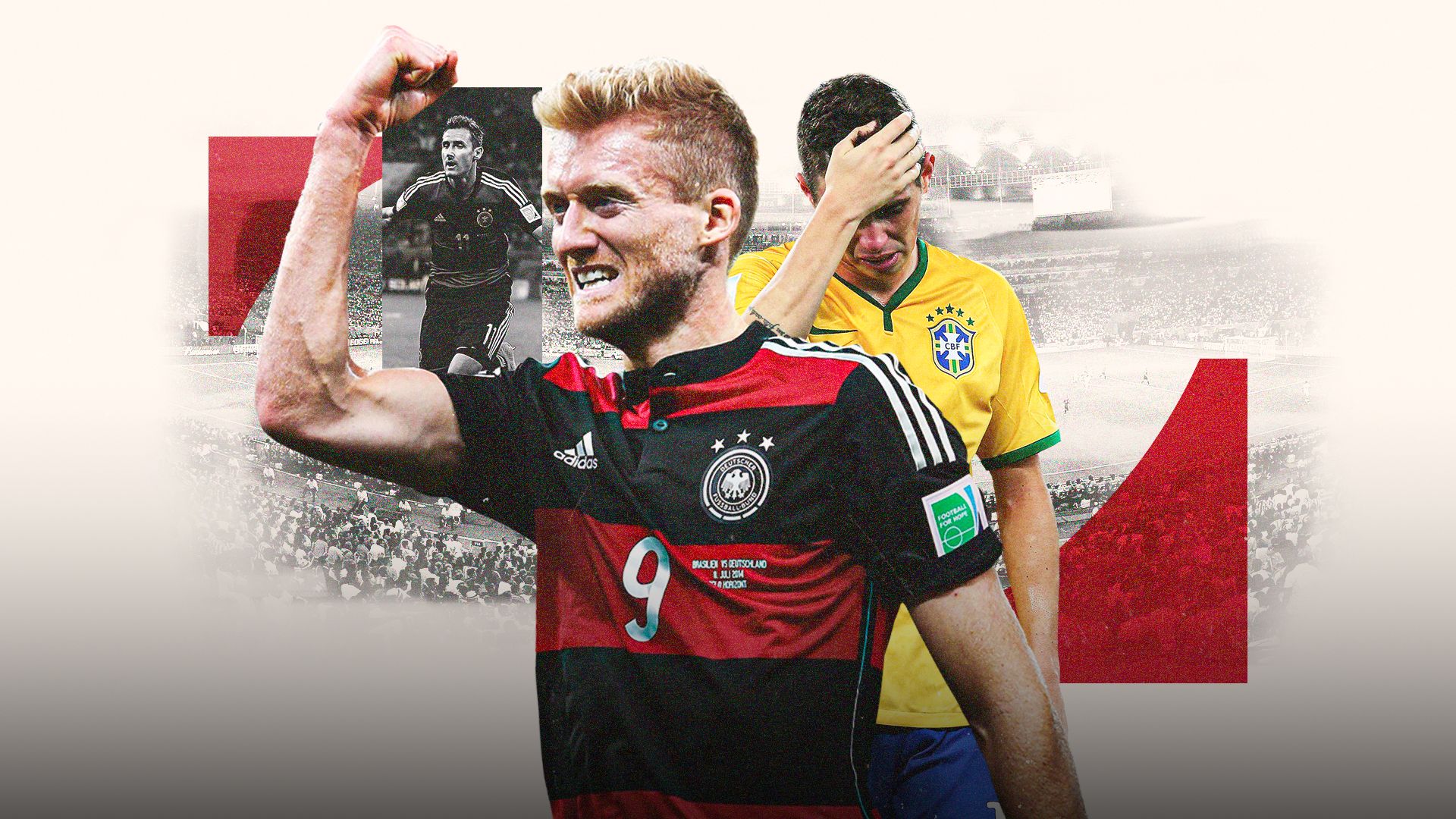
Traditionally, Germany are one of the least popular national teams on the planet, to put it mildly. In 1954 and 1974, they prevented the two most talented European national teams of the 20th century - Ferenc Puskas’ Hungary and Johan Cruyff’s Netherlands, respectively - from winning the World Cup titles many felt they deserved in hard-fought finals.By the 1980s, Germany's reputation in world football had been completely ruined. At the 1982 World Cup in Spain, there was first ‘The Disgrace of Gijon’, when Germany and Austria colluded to both progress at the expense of Algeria, before Harald ‘Toni’ Schumacher's attack on France's Patrick Battiston in the semi-finals.Instead of sympathy, however, Germany continued to diligently collect titles, winning the European Championship in 1980, the 1990 World Cup and Euro ‘96. "Football is a simple game," legendary England striker Gary Lineker is claimed to have said, "22 men chase a ball for 90 minutes, and in the end, the Germans always win."At the beginning of the new millennium, the tide slowly turned. The summer fairy tale of the 2006 World Cup on home soil, where Germany narrowly lost out in the semi-finals to eventual champions Italy, saw the country put on a tournament that the whole world embraced. The refreshing performance of Germany’s young, talented team at the 2010 World Cup in South Africa, meanwhile, saw them win plenty of admirers before their similarly narrow semi-final defeat to eventual winners, Spain. Now, they were out to gain friends in Brazil."Your jersey for Rio," was how the DFB chose to market its new red and black away jersey - practically an imitation of Flamengo’s iconic home shirt - for the upcoming World Cup in February 2014. Until then, Germany's away jerseys had been mostly green. Occasionally they would be red or black – but never both in equal parts."The new jersey looks great and reminds me of the Flamengo Rio de Janeiro kit," said Mesut Ozil. "It's sure to bring us luck for the World Cup in Brazil.” It was the start of a remarkable charm offensive as Germany aimed to win both another title and win the hearts of the hosts.The DFB's plan quickly paid off. Long before the World Cup even began, Germany’s away shirt caused excitement in Brazil."When the German jersey in the colours of Flamengo was unveiled, I decided to cheer for Germany," the local daily newspaper O Dia quoted a Brazilian fan as saying in an article about the special shirt.The enthusiasm was followed by a buying frenzy as, within a very short time, the jersey became a bestseller in Brazil. It was soon sold out in sports shops in Rio de Janeiro while counterfeits flooded the Copacabana. Back in Germany, Bastian Schweinsteiger posed at Bayern Munich’s training ground wearing an original Flamengo jersey to further the growing relationship.Meanwhile, a German expat in Rio named Bernhard Weber, AKA MC Gringo, seized the opportunity and, inspired by Germany's special shirt, wrote the song ‘Deutscher Fussball ist geil, beweg' dein Hinterteil’ (‘German football is awesome, move your bum’). In the accompanying music video, Weber danced through the streets, beaches, markets and favelas of Rio de Janeiro, singing alternately in Portuguese and German, wearing a red and black Germany jersey, a Flamengo cap and with a scantily clad Brazilian woman at his side. Soon the song was playing regularly on Brazilian television and in beach bars.At the beginning of June, the German team finally arrived in Brazil, moving into the Campo Bahia accommodation that was built especially for the World Cup, They immediately made a point of integrating themselves into the local community, as Schweinsteiger and Manuel Neuer danced with local fans to the anthem of a local club from Bahia while the whole team attended social events in the area. Brazilian sports journalist Renato Costa praised them in an interview with Deutsche Welle, saying, "You can tell that the DFB team has taken an interest in Brazil and is making a lot of effort."On the pitch, Germany played breath-taking football, beginning with an impressive 4-0 opening victory over Portugal, led by a hat-trick from Muller. This was followed by a draw against Ghana, before Germany wore their away kit for the first time in a win over the United States that secured top spot in their group. Despite that, they came close to elimination against Algeria in the last 16, needing extra-time to progress.Hosts Brazil, meanwhile, were also keeping their fans on their toes. After winning their group, the Selecao edged past Chile in a dramatic penalty shootout in the last 16. The home fans celebrated wildly, but so too did Schweinsteiger and Lukas Podolski, and videos of the German pair cheering with Brazilian flags went viral.In the quarter-finals, Brazil beat Colombia, but lost their absolute superstar Neymar to a back injury. Germany, meanwhile, were to visit Rio de Janeiro - the home of Flamengo - for the first time for their meeting with France.Clube de Regatas do Flamengo was originally a rowing club, but soon shifted its focus to football. In the 1930s, Leonidas, Brazil's first real football star and top scorer at the 1938 World Cup, was their leading man. Fast-forward almost 50 years, and in 1981, the legendary Zico led Flamengo to its first Copa Libertadores title as well as their Club World Cup, as Liverpool were swept aside in Tokyo. Since then, Flamengo has been by far the most popular club in the country.Almost all of the biggest Brazilian stars have played for Flamengo at some point, from Mario Zagallo to Bebeto, Romario to Ronaldinho, Adriano to Vinicius Jr, and after many years of drought, there has recently been more reason to celebrate. Flamengo won the Brazilian title in 2019 and 2020, the Copa Libertadores in 2019 and 2022, and the Copa do Brasil in 2022 and 2024.According to current surveys, Flamengo has around 47 million fans, more than a fifth of Brazil's population, and call themselves ‘the red and black nation’.Ahead of their first appearance at the Maracana, Schweinsteiger and Podolski shared a photo of themselves in Flamengo jerseys on a balcony overlooking the beach in Rio de Janeiro.Podolski, in particular, couldn't get enough of the growing relationship between the club and the Germany squad. During the World Cup, he regularly posted tweets in Portuguese and photos of himself with Ronaldo and Ronaldinho, while even after the tournament, he continued to interact with Flamengo fans on social media. The club even tried to sign him on multiple occasions over the next decade."Everyone knows that I have loved Brazil since the World Cup, and especially the Flamengo club," Podolski went on to tell Globo Esporte.In their first appearance at Flamengo's home ground, Podolski & Co. defeated France 1-0, Mats Hummels scoring the decisive goal with a header. Now the semi-finals, and Brazil, awaited.According to local media, over half a million Germany jerseys were sold in Brazil by the time the two teams met, the vast majority of them red and black. Brazilian sports newspaper Lance even called on its readers to send in photos of themselves wearing the red and black Germany kit. The jersey also sold brilliantly in Germany, and adidas reported that sales figures were "exceeding all expectations".Muller, Klose, Kroos, Kroos again, Khedira: After 29 minutes, the score in Belo Horizonte was 0-5, a demolition of historic proportions. Low called on his team to show restraint at half-time, and his team followed his lead. Substitute Andre Schurrle did still score twice in the closing stages before Brazil's Oscar made the score 1-7."Since 2006, we know how painful it is to lose a semi-final in your own country," the DFB wrote in Portuguese on its social media channels following the final whistle. "We wish you all the best for the future."Accompanying the message were photos of Schweinsteiger consoling his opponent David Luiz, Muller patting Dante on the back, Philipp Lahm looking after Oscar and the heart-breaking image of an elderly Brazilian man with a moustache who was to become the face of the tragedy in the media. Crying, he clung to a replica of the World Cup trophy in the stands of the Estadio Mineirao. Later, he dutifully presented the trophy to a young German fan.The man was later identified as Clovis Acosta Fernandes, a loyal fan who had followed his national team for many years and who was coming to terms with what was probably his most bitter defeat as a supporter in front of the world. After the match, he posted a photo of himself with Germany's then-team manager Franz Beckenbauer at the 1990 World Cup on Facebook and wrote in German: "I hope that on Sunday you will lift the trophy in the sacred temple of football, the Maracana."That post underscored the prevailing opinion in Brazil, that despite the historic demolition in the semi-final, the hosts would stand firmly by Germany's side in the final against their hated, arch-rivals Argentina.The internet portal UOL even claimed that Germany were "more Brazilian than Brazil" because of their style of play and, in part, their red and black jerseys. Newspaper O Estado de Sao Paulo meanwhile praised the "exceptional behaviour" of the Germans, saying, "they have learned to understand the spirit of this region". Looking ahead to the final against Argentina, the sports newspaper Lance simply wrote: "We are all Germany".Cheered on by the German fans who had travelled with them, but also by the local Brazilians, Low’s team defeated Lionel Messi's Argentina 1-0 in extra-time via Mario Gotze’s close-range finish. Germany not only won its fourth World Cup title in Brazil, but also gained a lot of new fans both around the world and in the host country.Podolski, perhaps unsurprisingly, posed with the World Cup trophy in a Flamengo jersey, meaning at least a little bit of the red and black nation was able to enjoy Germany’s success.

.jpg)

Most Popular


Ronnie Delany obituary: Irish sporting hero
9 hours ago