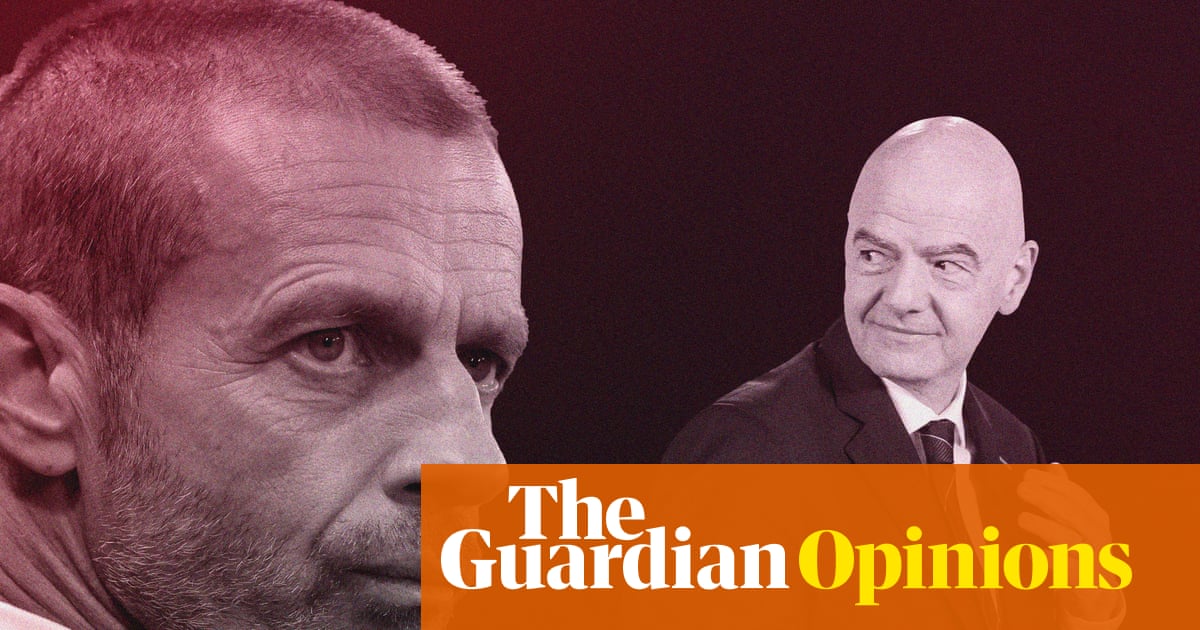
Uefa has to show backbone: concrete action can make Fifa’s World Cup plans untenable
As the World Cup neared its conclusion, one leading figure in European football pondered how Gianni Infantino might attempt to rinse away the damaging stain of the Folarin Balogun scandal. It all came down to money. “He will just announce more funds for everyone,” was the gist, although the tournament passed without any explanation of how Fifa would carve up its record $15bn (£11.2bn) haul.That was the tip of the iceberg. Infantino’s plan to sell chunks of the World Cup to private investors, announced on Tuesday, nine days after the final, has sent shock waves around the sport and left senior personnel scrambling. There is little time for a coordinated response given Fifa, at the height of what passes for football’s holiday period, has given FAs until 19 September to decide whether to accept the initial $20m payment that would effectively count as endorsement of the new scheme.The reaction must come quickly. Perhaps, when Uefa assesses its next move, it will look back to 2021 and remember the credit it happily banked in blocking the proposed European Super League. Fifa’s plan, which could allow private investors a say in how and when its tournaments are run, is potentially more seismic and global in scale. If football’s future has been on a ticking clock under Infantino, the time is one minute to midnight.Uefa’s speed in responding to the plan was of a piece with its renewed appetite, honed over a number of run-ins over the past 15 months, to stick the boot into Fifa. “This crosses a line that football’s governing institutions should never cross,” it said, although anyone feeling a sense of deja vu needed only to scroll back three weeks. On 6 July, another Uefa statement said the shelving of Balogun’s suspension “crossed a red line”. These are strong, accurate words, but they can be wielded only so many times.Infantino can rush his proposals through by counting on votes from the overwhelming number of FAs, primarily based outside Europe, who pledge fealty to his administration. But a show of backbone from football’s most powerful continent, a sporting behemoth that has eaten up any competition on the pitch and through the financial clout of its institutions, would be a major blow to Fifa. It would only take concrete action from a few of Europe’s major nations, with their governments in lockstep, to render any plan to sell off football’s crown jewels untenable.Who will put their heads above the parapet? This is a moment to remember that, as the Guardian revealed in mid-July, more than 200 of Fifa’s 211 members have already submitted letters in support of his candidacy for re-election early next year. Most of those resisting significant pressure to offer backing are from Europe, with Germany the highest-profile holdout. But England’s FA, which is hoping to rubber-stamp its hosting of the 2035 Women’s World Cup, was quick to offer its endorsement well before this summer.Then there are cases such as Finland, whose FA president, Ari Lahti, said in June that his country aimed “not to be an eyesore” by refusing to back Infantino. It is a common stance, even among federations who are vocal in private about their disgust for Fifa’s trampling over norms and proximity to the Donald Trump administration. Countries of all sizes have a duty to put the beauty contest on hold.Any talk of boycotting future World Cups, which would surely have to include the women’s edition in Brazil next year, is complicated by a section of Fifa’s statutes that says its members are obliged to take part in its competitions. The only way to avoid financially prohibitive sanctions may be to threaten the most radical step of all: a withdrawal from Fifa and the creation of a new governance model for football.Uefa’s position may be made trickier by its close relationship to the thus far taciturn European Football Clubs (EFC), which would like to set up a joint venture with Fifa to run the Club World Cup. EFC and Uefa already run a joint venture, UC3, that operates the commercial aspect of Uefa competitions, but one of the key differences from Fifa’s proposal is that it does not involve private capital.Somehow, everyone must be corralled together if Infantino is to be tackled. Another way would be to remove some wind from Infantino’s sails by putting up a serious electoral opponent. After the Balogun affair, conversations with figures at all levels of the sport speculated whether Uefa might endorse its own candidate to run for the Fifa presidency in March. Consensus suggested it would be too soon; that this will be a period of positioning for 2031 when, according to Fifa’s current rules, Infantino must stand aside.But there is no time to play a long game when Infantino plans to carve up football’s future among private interests in rapid order. Nor is there the opportunity to wait for any European Commission response to the complaint by FifPro, the global players’ union, and the European Leagues organisation about Fifa’s grip on the international match calendar, which was lodged in October 2024. A favourable outcome could place obstacles in front of any plans by Fifa, or its friends in private investment, to expand its tournaments, but no resolution appears in sight.Uefa and Europe must take a lead and reject the status quo. Doing so might reveal friends in unexpected places. There are certainly countries in Asia, among other confederations, that would be open to clear suggestions of a better path. The fear is that a rush of nebulous statements such as that by the Danish FA, which responded to Infantino’s plan by emphasising the need to “gain a complete understanding of the proposal and the process behind it” will result in nothing bar the standard procrastination and tacit acceptance.Bravery and sturdy spines are required now, more than ever, if football is to survive in anything resembling its present form.



Most Popular


FIFPRO Europe Statement: FIFA World Cup
3 hours ago