Sabres finally reward fans with long-awaited playoff berth
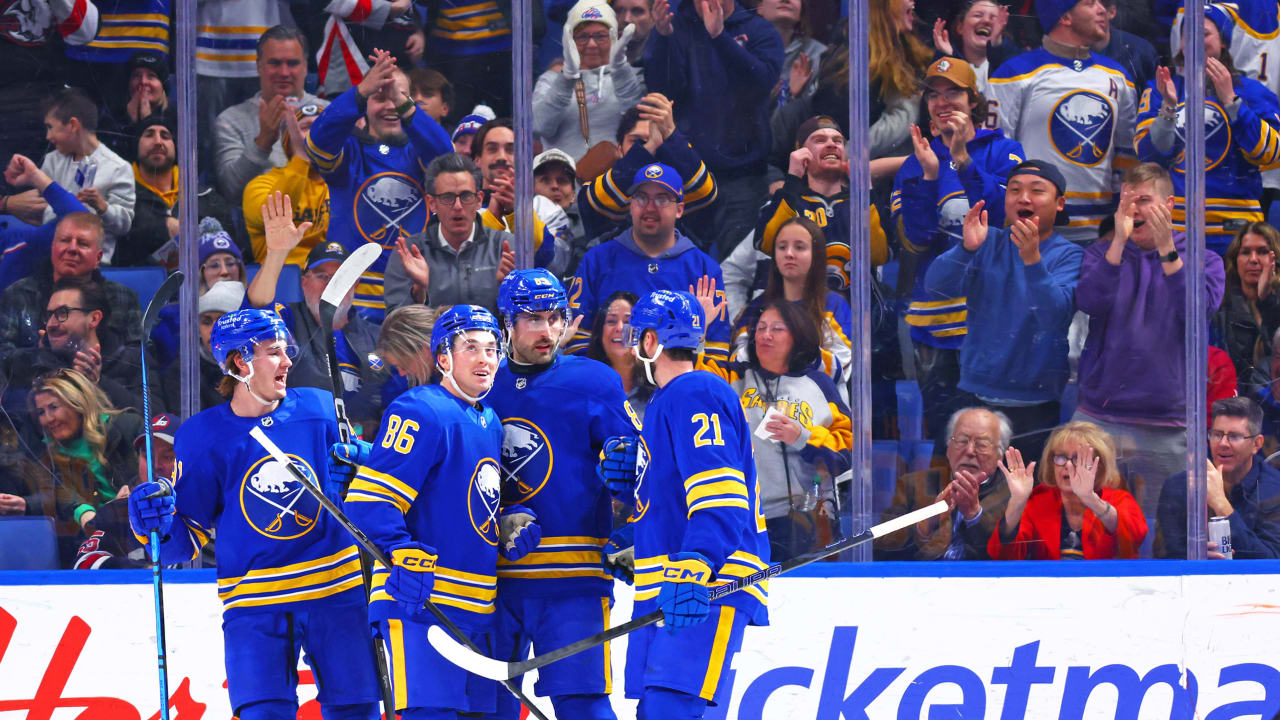
RUFFALO, N.Y. -- Drive toward downtown from Buffalo International Airport on Route 33 and you are suddenly greeted by a sign that describes the current vibe about the NHL team in these parts.“WELCOME TO LINDY RUFFALO,” it reads, paying homage to Buffalo Sabres coach Lindy Ruff and his team.Asked about it the other day, the 66-year-old was sheepish, admitting he thought it was an AI-generated image when first seeing a photo of it.“Just get rid of it by now,” he said half-jokingly.Sorry, Coach. Not going to happen. Not when the Sabres clinched a Stanley Cup Playoff berth Saturday for the first time since 2010-11, ending the longest postseason drought in NHL history.In fact, don’t be surprised if more of them start springing up around town, now that Buffalo is officially back in the playoffs.Indeed, there are reminders everywhere you look.Cross over the Peace Bridge from Fort Erie, Ontario, to Buffalo, and the electric sign boards indicating which customs lanes are open have the Sabres logo on them. On a rainy night last weekend, a huge projection of that same logo could be seen on one of the lakeside grain elevators just a couple of blocks from KeyBank Center, the Sabres’ home.The Sabres are relevant again, and this hockey-crazed city wants the world to know about it.“There’s just an awesome buzz around here,” Ruff said. “I mean, it's what you should expect when the team is doing well, and everybody's getting behind the team.”A franchise and its fan base that has gone too long without knowing what this feeling is like, especially in a market that has been thirsting for a winner for an entire generation.They do now.“The players have seen the sellouts, they’ve seen the energy,” Ruff said. “I can’t imagine what it’s like for them even just to walk around town.“But it’s well-deserved, for sure.”Not to mention overdue. Long overdue.When Buffalo officially clinched Saturday, it came 5,457 days after its 5-2 loss at the Philadelphia Flyers in Game 7 of the Eastern Conference Quarterfinals on April 26, 2011. No one could have guessed the Sabres wouldn’t play another postseason game for 15 years, a dry spell of historic proportions.To put that into perspective, Ruff, in that time, was fired by the Sabres, went on to coach the Dallas Stars (2013-2017) and New Jersey Devils (2020-2024) before being hired for a second run with Buffalo on April 22, 2024.While he was gone, the Sabres went through six coaches: Ron Rolston, Ted Nolan, Dan Bylsma, Phil Housley, Ralph Krueger and Don Granato. The assembly line of general managers over that period, which started with Darcy Regier overseeing that 2010-11 team, subsequently included Tim Murray, Jason Botterill, Kevyn Adams and Jarmo Kekalainen, who replaced Adams on Dec. 15.Just a week prior to the GM change, the Sabres lost 7-4 to the Calgary Flames on Dec. 8 and were last in the East after 29 games (11-14-4). The following night, they built a 3-0 lead against Connor McDavid, Leon Draisaitl and the high-flying Edmonton Oilers, only to cough up the lead and head to overtime.Same old Sabres, right?Not so fast.Instead of another collapse, Buffalo forward Alex Tuch scored 33 seconds into overtime for a 4-3 victory. It would spark an improbable run that ignited a remarkable 35-9-4 ascension and a visit to the playoffs no one could have envisioned.Perhaps it was fitting that it was Tuch who provided the moment that changed the narrative -- and the season.The 29-year-old grew up 150 miles east of Buffalo in Syracuse, where his neighbor was former Sabres forward Tim Connolly. He admittedly was a huge fan of the team at the time, and, as such, relishes seeing so many young Buffalo fans enjoying the success that eluded so many.“I mean, if you're born after, what, 2011, you haven't seen the Sabres in the playoffs before,” Tuch said. “So, I think it's going to be really special for all those kids.”Tuch compared it to the 2005-06 team that went on a magical run to the conference final before narrowly losing to the eventual Stanley Cup champion Carolina Hurricanes in seven games.“I mean, when I was watching that run back in 05-06, I was 9 or 10 years old, so it's right on the same age as these kids now,” Tuch said. “And I'm pretty sure it's a lot of fun and pretty special for them. And I know it's really special for their parents to have those moments like I did with my dad.”There are more special times in store this spring, he said. Simply qualifying for the playoffs isn’t enough.“I think when you go into training camp, the end goal for every team is to try to win the Stanley Cup,” Tuch said. “And that's our goal.”One that seemed pretty much impossible less than four months ago.* * * *Why the turnaround?What has changed? What has been the key to bringing these Sabres together in a brotherhood that is trying to turn around so much negative?“Drink beers,” captain Rasmus Dahlin said last month.It may have been the quote of the year in the NHL. Within minutes of uttering those words, they were going viral on social media. You can now go on the web and order “Drink Beers” t-shirts with Dahlin’s face on the front. In the blue-collar world of Buffalo where a brew more often than not is the beverage of choice over a high-end rouge after a hard day’s work, fans giddily embraced the captain’s message.But there was more meaning to it than just a nifty catchphrase.As Dahlin explained, it was all about galvanizing the guys in the dressing room off the ice as much as on it. Whether it was going out for team dinners or grabbing a sudd at a watering hole, it was important the group did things together “to get to know each other as people and not just as players.”Most importantly, if you didn’t want to play for the Sabres, they didn’t want you either. It’s a mindset Dahlin developed over the years after watching too many teammates look for a way out since he was selected with the No. 1 pick in the 2018 NHL Draft.Asked what the low point has been in his seven-plus seasons with Buffalo, the 25-year-old defenseman alluded to exactly that.“I mean, every time a guy wanted out of here, those were the toughest ones to take,” Dahlin told NHL.com in a 1-on-1 interview. “Like, you don’t want to be part of this?” It just (stinks).“And then, you know, coaches get fired, GMs, whatever. I mean, it was tough. It feels like you have to start over so many times.”It didn’t take long for Dahlin to be exposed to the trend of seeing teammates being disgruntled with the Sabres. Less than a week after the young Swede was drafted, center Ryan O'Reilly, who’d said months earlier that the losing atmosphere in Buffalo caused him to lose his love for the game, was sent to the St. Louis Blues in a blockbuster trade that landed a future star in forward Tage Thompson.In subsequent years, stars like Jack Eichel and Sam Reinhart were also shipped out, and each went on to win the Stanley Cup -- Eichel with the Vegas Golden Knights in 2023; Reinhart the following two seasons with the Florida Panthers.The Eichel divorce particularly struck a nerve with Sabres fans after he’d been selected No. 2 behind McDavid (Oilers) in the 2015 NHL Draft.Eichel and Buffalo parted ways because of a disagreement on how to treat a herniated disk in his neck. The Sabres were not comfortable with his desire to have artificial disk replacement surgery, which had never before been performed on an NHL player, and opted to trade him on Nov. 4, 2021, to Vegas, which allowed him to have the procedure.Adams was criticized for the deal, but two of the players also involved -- Tuch and forward Peyton Krebs -- have become key cogs in Buffalo.Two years later, Adams took more heat, this time for not being more active at the 2023 NHL Trade Deadline when the Sabres were actually competitive. Their only acquisition was forward Jordan Greenway, and Buffalo excruciatingly missed the playoffs by one point, leaving irked supporters wondering what might have been.The fan base finally lost its patience with Adams when the then-GM blamed climate as a reason it was difficult to woo free agents, saying Buffalo was not a “destination city.”“We don't have palm trees, we have taxes in New York -- those are real and those are things you deal with,” Adams said during a press conference on Dec. 6, 2024.It was an explanation fans didn’t want to hear, especially with the Sabres were in the midst of a 13-game skid. Callers flooded local sports talk radio station WGR, pointing out that cities that hosted Stanley Cup winners such as Detroit, Pittsburgh, St. Louis, Denver, Chicago, Boston, Washington and East Rutherford, New Jersey, didn’t have palm trees either.In the following handful of games, fans brought inflatable palm trees into KeyBank Center, a few chucking them on the ice in disgust. “Fire Adams” chants became commonplace.After a decade of watching an inferior product, they’d had enough.“These people don’t want to hear excuses. This is a great hockey town. Fans love their hockey. They also can identify what is bad hockey, and they’d see plenty of it,” former NHL coach and ex-Hockey Night in Canada broadcaster Harry Neale said.Neale, who coached 442 NHL games with the Detroit Red Wings and Vancouver Canucks from 1978-1986, has lived in the Buffalo area for more than two decades. Now 89, he’s still a regular in the KeyBank Center press box.“Sometimes the teams weren’t bad but just couldn’t get it done,” he said. “But when the Sabres couldn’t make the playoffs over and over again, sometimes with that already being crystal clear in November of a season, they’d stop coming.“Some kept coming because of their love of the game, and now, everyone is being rewarded.”If Adams’ comments about the palm trees hadn’t been perturbing enough, an incident two months later certainly was.On Feb, 2, 2025, Thompson, having already getting three points (one goal, two assists) in a game against the New Jersey Devils, took a check to the head from Stefan Noesen, who received a game misconduct penalty. Much to the dismay of the home crowd, let alone Ruff, Thompson’s teammates did not respond, much in the same way the Toronto Maple Leafs didn’t react when Anaheim Ducks defenseman Radko Gudas kneed Maple Leafs captain Auston Matthews last month.The next day, practice was canceled. A meeting was held instead.The ensuing message is one that resonates to this day, Dahlin said, and has brought these Sabres closer than ever.“It was a wakeup call for us,” Dahlin said. “We told each other, ‘This is never going to happen again,’ and, you know, this year we really worked on the team chemistry. It’s a brotherhood, and now it just comes naturally.“If someone does anything to one of the guys in here, I’ll protect them. That’s the culture we’ve created here.”One that has resulted in a tight-knit group that is playoff-bound.“Everyone wants to be here,” he said. “Otherwise they shouldn’t be here.”* * * *When Ruff’s return to Buffalo was announced two years ago, two questions immediately came to mind.Why would they bring in a retread like Ruff? Sure, he’d coached 15 seasons here, but wouldn’t a younger coach relate better to a rebuilding team?More importantly, why, at this point in his life would Ruff, 64 at the time of his hiring, want to return to a franchise that hadn’t been to the postseason in 13 years?“I get why you’d ask that,” he told NHL.com with a laugh. ‘I just felt the group had a lot of skill and that there was a lot of talent. And if we could defend better and play better away from the puck, you'd give yourself a chance to win every night.“And what I'd heard about most of guys was that they were all good guys, that they were all eager to find a way to win.”In order to do that, they would have to get over a psychological hurdle first.No matter where they went in town, the narrative was the same. The Sabres have been struggling for a long time. Ruff needed to instil they weren’t responsible for past failures.“That was actually part of the speech I gave them,” Ruff recounted. “I told them, ‘Some of you guys have been part of this for a year, some of you guys for two years, maybe few of you for a little bit longer. Not all of you have been part of the 13, 14 years. It's not your fault.’”“I said, ‘Maybe a few of you have been a small part of what has gone wrong, but all of you can be a big piece of what can go right.’ And I said, ‘You're not going to believe how good it's going to feel to turn the corner.’”They do now. But not without some growing pains, none more than that dismal 13-game slide they endured in late 2024. For a franchise that endured years of lows, this could have been rock bottom.Except Ruff and his players wouldn’t allow it.“We were the better team in half of those games,” he said. “We were pretty good at trying to win, but we didn’t understand how not to lose.“If I would have seen guys give up or putting in a lack of effort, that’s one thing. But they didn’t -- they kept at it. And when you can overcome that type of adversity, it makes your group stronger. It may sound like a cliche, but I mean, look at where we are now.“Our players believe.”And so does the city. Whereas empty blue seats at KeyBank Center used to be the norm, the Sabres have had 15 consecutive sellouts of 19,070 … and counting.For Ruff, who kept his house here even when he was coaching elsewhere, this excitement reminds him of 2006. There was a lengthy wait list for season tickets following Buffalo’s run to the conference final.“It’s great,” he said. “The entire community is alive again about this team.”Buffalo mayor Sean Ryan couldn’t agree more.He’d seen western New York come alive like this in recent years for the NFL’s Buffalo Bills and their star quarterback, Josh Allen.But the Sabres?“It’s great to have them winning again,” Ryan told NHL.com, sporting a white Sabres jersey during a recent home game. “Ever since they started turning it around, the arena is full of energy. The whole community is. People are in the bars watching the games. People are watching them at home.“It doesn't take long for Buffalo to turn it back on for the Sabres to be the talk of the town.”Not that he’s surprised. Far from it.“For years we’ve had some of the highest national TV ratings for the people watching playoffs games when we weren't in it,” Ryan said. “So, (I’m) very happy this year we break that long, awful streak and they can watch the Sabres in there for a change. Hopefully it’s the start of a multiyear run of seeing the Sabres in the playoffs year after year, like they should be.“It’s a great sports town. But it’s funny -- for years, either the Bills were good and the Sabres weren’t, or vice versa. Now we have both teams in the playoffs at the same time. And you’re starting to see less Bills flags and more Sabres flags around town.”In fact, go to Sabres games these days and you might see a current or former Bills player in the house. One of those is Steve Tasker, the elite special-teams expert and seven-time Pro Bowler who played for the Bills from 1986-97 and is currently a Sabres season-ticket holder.“I love football. I’m a football guy and you know I always have been, but hockey is the best live sport there is,” Tasker, wearing a Sabres hoody, told the Sabres Live show with Brian Duff and former Buffalo goalie Martin Biron earlier this year.Growing up in south Buffalo, Patrick Kane was a Bills and Sabres fan. His dad first took him games at the old Memorial Auditorium to cheer on the likes of Hall of Fame goalie Dominik Hasek, then to KeyBank Center when it opened in 1996.Three decades later, the 37-year-old is a forward with the Atlantic Division rival Detroit Red Wings. He won the Stanley Cup three times with the Chicago Blackhawks (2010, 2013, 2015) and is the NHL’s all-time leading American-born scorer with 1,393 points (506 goals, 887 assists).Through all those accomplishments, he’s never forgotten what the Sabres meant to his hometown. And, for that matter, still do. As such, he could feel the electricity when the Red Wings recently visited Buffalo.“It's great for the city, getting some excitement around the city,” Kane said. “I mean, we've seen it with the Bills for a bunch of years. I think it makes people around the city feel good and excited about something, so I think that that's great, first and foremost, and obviously the Sabres haven't been in the playoffs for a while. I think it's a great hockey market and good to have them doing well and back in the playoffs.“Obviously it's tough when they're in your division, but it's always good to see Buffalo teams or people from Buffalo have success, especially when you're from the area.”Or, for that matter, if you play for the team.“Every time we come out for the national anthem, and it’s sold out and the place goes nuts after the anthem is over, it fires you up for the game,” Thompson said. “And obviously, whenever we make a big play out there and score a goal, the place gets rocking. And yeah, it fuels us.“We definitely feel the energy and it's a really fun environment.”After a 15-year run of futility featuring heartaches and bad breaks, bad teams, an assembly line of coaches and GMs, a 13-game skid and even inflatable palm trees, that word “fun” is being associated with Sabres hockey again.After all, they’re in the postseason for the first time since 2011.And, as the locals here say, “Welcome to the Sabre-hood.” The good times are finally back.NHL.com independent correspondent Heather Engel contributed to this report


Most Popular

Women’s Tennis Staves Off Spartans for 4
16 hours ago

No. 2 Aggies Gator Done Against No. 16 Florida, 4
13 hours ago