
UEFA holds emergency meeting to discuss controversial FIFA investment plan

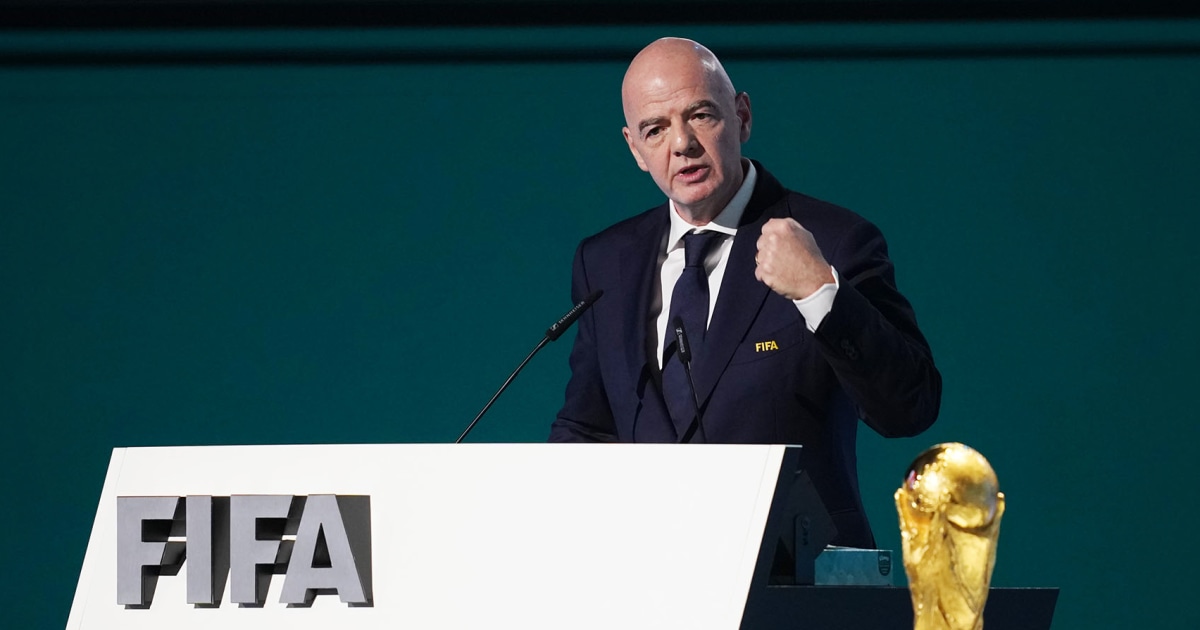
With UEFA’s emergency meeting underway, former England Football Association chief executive Mark Palios has told CNN that a World Cup without Europe’s top nations would be hard to fathom and “severely reduce” FIFA’s ability to monetize its competitions.Six of the current top ten nations in FIFA’s World Rankings hail from Europe.Palios, who was in his role between 2003 and 2004, said he wouldn’t be surprised if UEFA played its major card and withdrew European clubs from all FIFA competitions following today’s meeting.On the proposed investment plan, Palios said the announcement by FIFA President Gianni Infantino was symptomatic of the organization’s approach to leadership, characterized by “poor governance, poor process and it doesn’t involve the stakeholders.”He also said the surprise move raised bigger questions over FIFA’s wider structure.A Swiss administrator who rose up the ranks to become the most powerful man in soccer, Gianni Infantino’s decade-plus-long reign as the head of the sport’s world governing body, FIFA, has been signposted by controversy, expansion and monetary growth.He was initially set to serve for a period of three years but has been re-elected for subsequent terms, running unopposed.Having qualified as a soccer lawyer, Infantino held multiple roles at European governing body UEFA, before taking over the FIFA presidency in February 2016 at an extraordinary congress as corruption allegations swirled around the organization.Infantino has overseen three men’s World Cups in his time: Russia 2018, Qatar 2022 and most recently this summer’s tournament in North America.Each edition, though, has been mired in controversy: Infantino’s close ties to Russian President Vladimir Putin; the Gulf nation’s treatment of migrant workers; and the FIFA chief’s flattery of President Trump.Under his leadership, FIFA has expanded the men’s World Cup from 32 to 48 teams, with reports that a 64-team format is under consideration for the 2030 edition.Infantino has also sought to substantially bolster the FIFA coffers with lucrative sponsorship ties.It’s not the first time he’s explored the idea of selling off parts of FIFA.In 2018, Infantino proposed a $25 billion deal with Japan’s SoftBank to create new global competitions, including an expanded men’s Club World Cup.That ultimately failed after meeting fierce resistance from UEFA.Whether or not his latest proposal gets green lit remains to be seen.It remains to be seen what takes place today in UEFA’s emergency meeting, but the member associations are sure to consider a plethora of options.Among the measures that are reportedly on the table is a boycott of any FIFA-controlled competitions, including the World Cup, Women’s World Cup and Club World Cup. CNN Sports has reached out to UEFA for comment.If there were to be a boycott by both national teams and club sides, that would likely end FIFA’s drive to establish this separate entity for its commercial and operational interests.Imagine a World Cup without Spain, France or England (three of the four semifinalists at this year’s edition) or a Club World Cup without Chelsea, Paris Saint-Germain, Real Madrid or Barcelona. Similarly, next year’s Women’s World Cup would be without defending champion Spain or England, another powerhouse. These wouldn’t be legitimate competitions in the eyes of most fans around the planet and almost no one would watch or pay the substantial amounts of money for tickets, concessions and merchandise that investors would likely push for in the future.Other measures reported to be under consideration include a breakaway governing body to compete with FIFA that would be formed with other continental confederations, but this is far more unlikely than a boycott.It’s safe to say that Europe’s soccer governing body did not react well to reports breaking the news of FIFA’s plans.In a post on X Tuesday, UEFA strongly condemned the reported proposal, saying, “This crosses a line that football’s governing institutions should never cross… The soul and governance of football are not assets to trade – especially with zero transparency as to who gains financially.Roughly two-and-a-half hours later, FIFA released a rough outline of its proposal. The Associated Press then reported that FIFA President Gianni Infantino had set a September 19 deadline for its 211 member associations to accept a one-off $20 million payment underwritten by the private investment into its new scheme, including from an entity owned by Joshua Kushner, brother of Jared Kushner, son-in-law of US President Donald Trump.After news of that deadline dropped, UEFA was even more resolute, posting on X:“Today, we have learned of FIFA’s deadline to associations to support their proposals or have the one-off payout offer withdrawn. This says everything you need to know about this plan.“But having held discussions with many stakeholders across the game, UEFA knows there is significant and growing opposition to FIFA’s scheme. FIFA cannot continue to use our sport to enrich themselves and their friends. We can grow the game correctly. It’s time to prioritise associations, clubs, leagues, players and fans.”The FIFA proposal was developed rather opaquely. The first news of it came in a report in the Times of London before it was confirmed by the global soccer body.Soccer authorities have criticized FIFA for not consulting them on the plans before they were released to the public. Both CONCACAF (North and Central American and Caribbean governing body) and the Asian Football Confederation released statements saying they were unhappy at the lack of consultation.The plan to create a commercial subsidiary, which would be called FIFA Forward Enterprise (FFE), has also brought a lot of heat due to the involvement of private investors, in particular the main proposed investor group, Thrive Eternal. It is headed up by Joshua Kushner – brother of Jared Kushner, the son-in-law of US President Donald Trump.The fear is that investors, seeking return on their investments, will push to influence matters beyond their remit in order to maximize their profits.For example, the newly expanded men’s World Cup allowed for a lot more revenue through additional games, while hydration breaks gave broadcasters opportunities to play more ads if they so chose. Under this proposal, there would be even greater incentive to expand the World Cup and the Club World Cup further to include a higher number of teams, providing more games for more revenue. This isn’t speculation, but rather something already postulated by Infantino during the 2026 edition. Would investors also pressure FIFA to hold the World Cup more frequently: every two years instead of every four?That would then affect player welfare and competitions outside of FIFA’s remit, such domestic leagues and continental club competitions like the Champions League. Players are already nearing their physical limits with additional games, so would this move mean further injuries and have a negative effect across the sport?European soccer player union FIFPRO Europe said in a statement that it has “deep concern” over the FFE proposal, saying that it risks turning the World Cup and other competitions into “investable assets for private capital, a move that would fundamentally and irreversibly reshape the incentives underpinning the competitions in which players work, compete and build their careers.”CNN Sports has reached out to FIFA for comment on the proposals.FIFA is proposing a new entity called FIFA Forward Enterprise (FFE) that will control the commercial side (including broadcast rights, sponsorship, ticketing and licensing) and the operational side (planning, setting up and delivering tournaments) of its competitions, including the World Cup, Women’s World Cup and the Club World Cup.FIFA insists it would own and have “sole control” of this subsidiary – which it says has an initial equity valuation of $20 billion – and have “exclusive authority” over the sporting side of things, including competitions, governance, match calendars and regulatory/sporting decisions. All net benefits of FFE would be reinvested back into the worldwide game, according to the organization.Central to the proposal is the introduction of private investment; FIFA says it will raise $4.2 billion by partnering with certain “long-term investors who will purchase minority, non-controlling interests in FFE.”The money raised by the scheme would allow FIFA to provide up to $40 million to all of its 211 member associations: $20 million for the next budget cycle of 2027-2030 (up from $8 million currently budgeted) and an immediate, optional $20 million from the $4.2 billion of private investment. According to the Associated Press, Infantino has set a September 19 deadline for the member associations to accept the optional payment.There are similar entities in sports currently. For example, Liberty Media owns Formula One’s commercial and operational rights, while motorsport governing body FIA leads the sporting side of the partnership. The intersection of sports with Wall Street is not new – just look at the investment of private equity into the NFL, NBA, MLB and the PGA Tour – but the trend seemingly continues to accelerate into global sports.The entire proposal though is just that: a proposal. As FIFA itself said in a statement, it still has to be approved by the majority of FIFA’s member associations and by the FIFA Council.Roughly a week and a half on from the end of one of the best ever World Cups, news has dropped that bring FIFA and its president, Gianni Infantino – fresh off their massive win in North America – crashing back down to Earth.The world soccer governing body announced plans Tuesday to set up a separate entity – which would include private investors – that would have control of the commercial and operational rights of one of the globe’s biggest sporting events.This proposal, though, has come under intense scrutiny and criticism from many around the world, including European governing body UEFA, which warned that the “soul and governance” of the game are under threat.UEFA and its 55 member associations are meeting virtually today to discuss the proposal and possible reactions to it. UEFA is strongly against the sale of any portion of FIFA’s remit to private investors and pointed to a lack of transparency around who stands to gain financially from the plan, which it called a “line that football’s governing institutions should never cross.”It remains to be seen what comes out of today’s discussions, but whatever UEFA decides to do could either preserve or shake the very foundation of the global game as we know it.

Most Popular



.jpg?w=1120&h=630)


Auckland FC name replacement for title-winning coach
12 hours ago