Women’s T20 World Cup ‘breaks cricket into mainstream’ but money still an issue
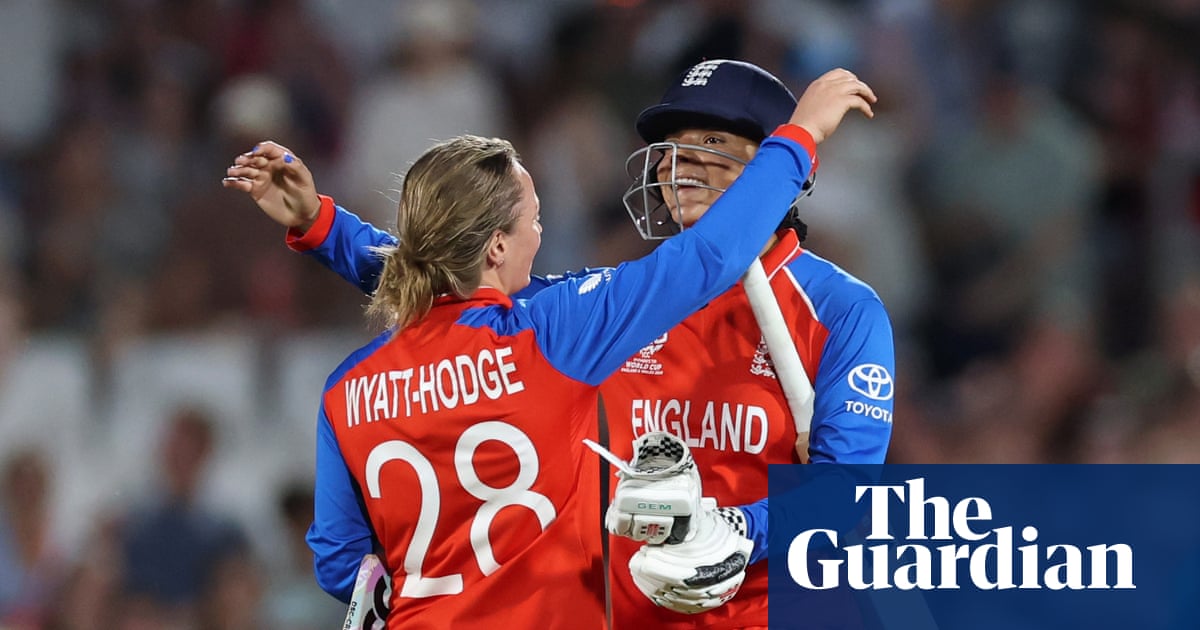
The results are in: England will play South Africa in the T20 World Cup semi-final on Thursday, after Australia face off against West Indies on Tuesday. It all came down to the double-header at Lord’s on Sunday, played in front of a crowd of 27,000, which began with South Africa limping across the line against Bangladesh despite a flurry of late wickets, and ended with India crashing out of the tournament after a six-wicket defeat against Australia.This has been a good fortnight for women’s cricket. The tournament director, Beth Barrett-Wild, was upbeat on Sunday. “It’s been incredible,” she said of the tournament so far. “We set out on a mission to break women’s cricket into the mainstream, and over the course of the last three weeks we’ve seen record-breaking crowds. I feel like we’ve definitely delivered.”The scale of the event dwarfs that of 2017, the last global women’s tournament hosted by England and Wales. Despite extreme heat causing many fans to stay away over the past week, attendance is already double what the England and Wales Cricket Board achieved nine years ago – up around 160,000. Record crowds have been achieved at Edgbaston (18,814 for India v Pakistan) and the Oval (21,018 for England v New Zealand), while the final at Lord’s next Sunday is a sell-out. The presence of ticket touts outside St John’s Wood tube on Sunday, last seen for a women’s game during the 2017 World Cup final, felt like a significant milestone in itself.Barrett-Wild said 2017 “was the first spark of what could be achieved”, but: “We’ve had multiple instances already through this tournament that have had that same vibe, and the same level of scale, as that one-off moment in 2017 [at Lord’s].”It helps that the cricket has been as scorching as the heatwave which hit England last week. This is the first edition of the tournament in which more than one century has been scored: we have had three and counting, from England’s Danni Wyatt-Hodge, Sri Lanka’s Chamari Athapaththu and South Africa’s Tazmin Brits. The idea of a “record run chase” has essentially become meaningless given how often totals of more than 170 are now being gobbled up for breakfast. On Saturday, Ireland finally broke their 12-year duck by beating West Indies to seal a maiden World Cup win; Scotland came agonisingly close to beating Sri Lanka last week. There are no also-rans here.“It’s been really pleasing just how competitive the cricket has been,” Barrett-Wild said. “Coming into the final weekend with everything still on the line in both groups is brilliant, and I think just testament to the growth and development of women’s cricket globally.”It is also helpful that England have won every group game, despite the absence of their captain Nat Sciver-Brunt through injury. Barrett-Wild’s recent WhatsApp conversations with the England head coach, Charlotte Edwards, have involved generous use of the thumbs-up emoji. “Obviously as tournament director, I’m not allowed to have favourites,” she says. “But speaking with the ICC, everybody is recognising the power and the impact of the home nation getting into the latter stages of the tournament.”One challenge for ticket sales is that until Sunday evening no one knew which semi-final England would be playing in, despite the hosts sealing qualification four days earlier. Nowadays, in women’s and men’s cricket it is the demands of Indian broadcasters which dictate the timings of semi-finals: had India qualified, they were always going to play on Tuesday afternoon to ensure a primetime slot back home. If you are reading this and wondering how that’s fair, you aren’t alone. But he who pays the piper calls the tune, as they say; and in this case, that is the Board of Control for Cricket in India.For England, then, a minor scheduling irritation. But try being Scotland or the Netherlands. Scotland cannot afford to host bilateral cricket; their women’s team had no sponsor for this World Cup. How do they develop now? Netherlands are a team of amateurs; it is all very well to admire the dedication of Caroline de Lange quitting her job as a doctor to play in this tournament, but perhaps we should be asking why she has to juggle cricket with work in the first place. The ICC has taken the first step: it chose to expand this World Cup from 10 teams to 12. But if it could also arrange to spread cricket’s revenue just a little bit more evenly, wouldn’t we all be better off?Next Sunday at Lord’s, England may yet secure their first silverware in almost a decade, bringing untold riches to Sciver-Brunt and her team. But until the International Cricket Council begins to really think globally, there will always be more losers than winners.


Most Popular



AFL 2026, Round 16 Report Card
6 hours ago