
The middle-overs riddle - KKR's 2025 problem continues into 2026
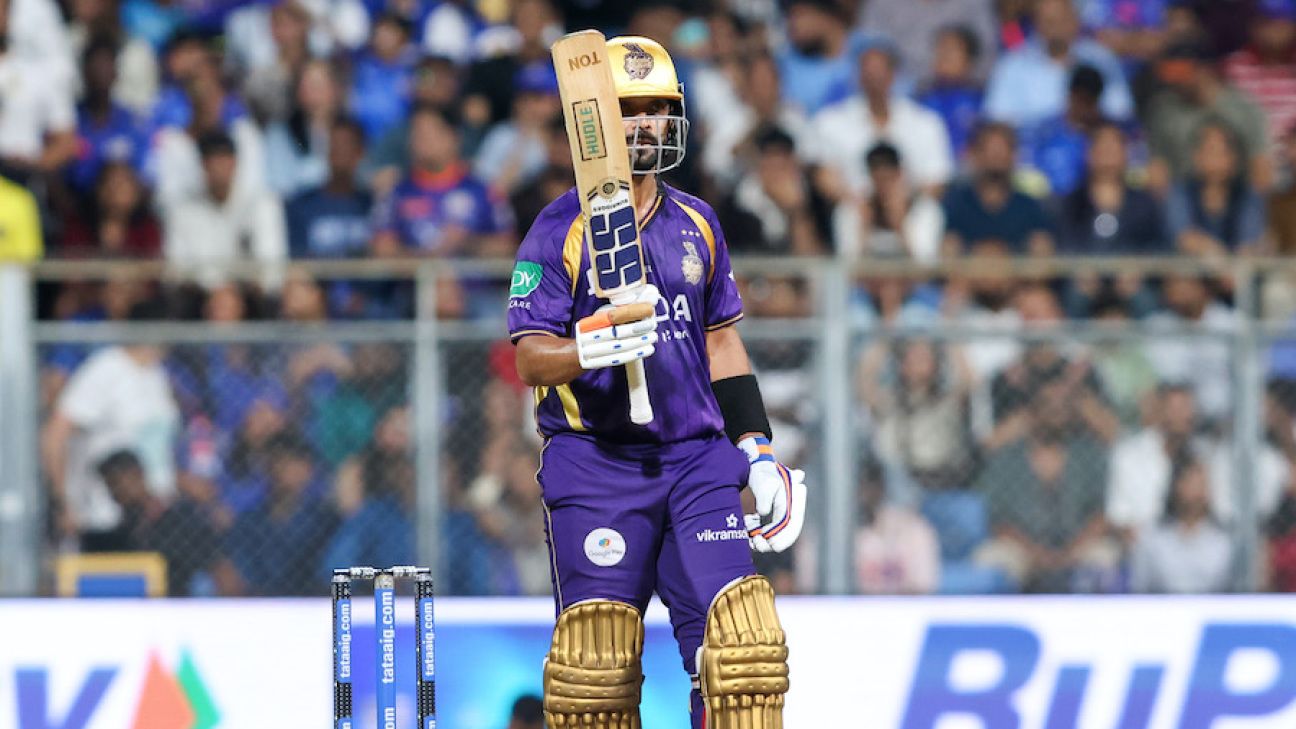
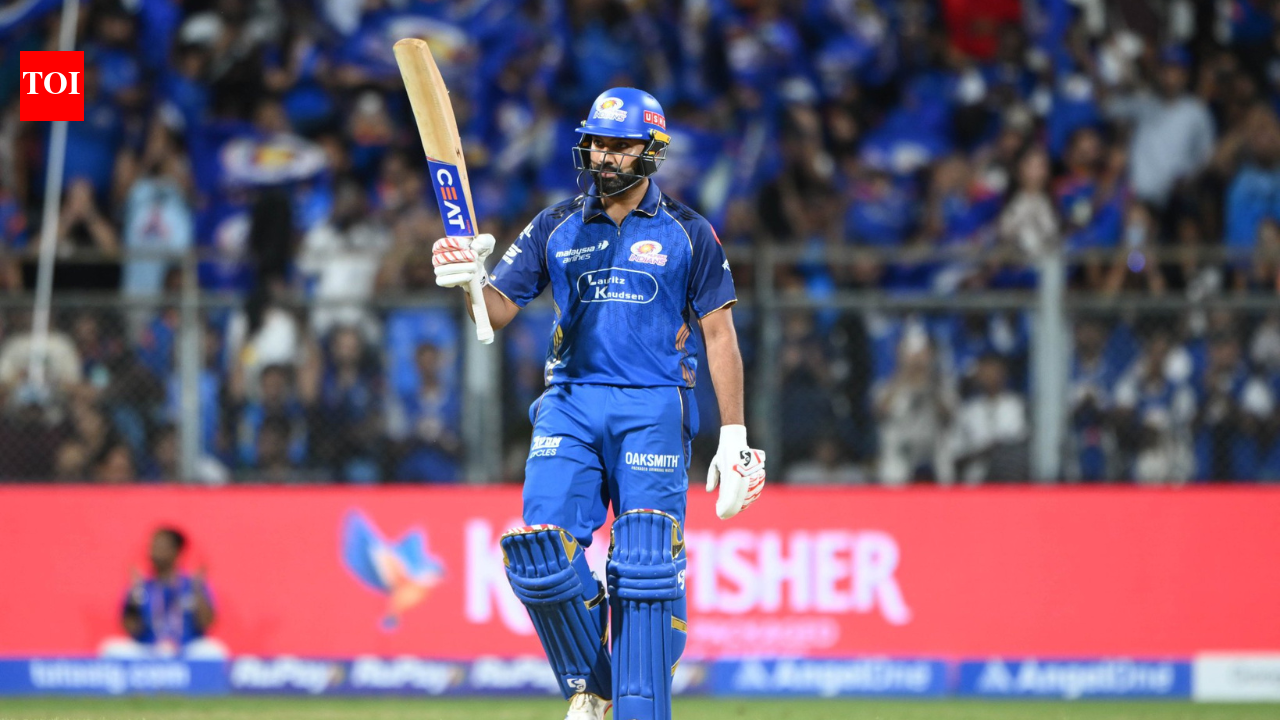
Against MI, KKR slowed down in the middle overs, which cost them the game - an issue that dogged them through 2025Karthik KrishnaswamyPublished: Mar 29, 2026, 8:12 PM (10 hrs ago)Almost exactly a decade ago at the Wankhede Stadium, Ajinkya Rahane played an innings that changed T20 cricket forever. It wasn't just that one innings that did it, and it didn't happen all at once, but to look at that scorecard now, a decade on, is to gaze upon an artefact of a long-lost past.On that day, in a T20 World Cup semi-final, Rahane spent 15.3 overs at the crease and scored 40 off 35 balls, hitting two fours and no sixes. India lost just two wickets while posting a total of 192. West Indies, playing an entirely different brand of T20, romped home by seven wickets, hitting 11 sixes to India's four.On Sunday at the same venue, Rahane batted in a very different way against Mumbai Indians, showing the effects of all the work he has put in over the last three years or so to maximise his boundary-hitting and keep himself relevant in this format. He's so relevant, in fact, that he captains Kolkata Knight Riders (KKR) in IPL 2026 while contemporaries such as Rohit Sharma and Virat Kohli have passed that baton on to other, younger players in their teams.RelatedStats - Mumbai Indians end 14-year drought with record chaseBatter-only Green: Rahane unhappy; Cricket Australia says KKR 'fully aware'Rickelton, Rohit and Thakur break Mumbai's first-game jinxOn Sunday against MI, Rahane hit three sixes in his first nine deliveries, and by the end of the powerplay, was batting on 36 off 18 balls. Two runs per ball. This Rahane was nothing like the Rahane of 2016.The T20 contest of 2026, however, is nothing like the T20 contest of 2016, particularly at venues like the Wankhede, where India and England slugged it out in a 253-meets-246 World Cup semi-final less than three weeks ago.In 2026, at venues like the Wankhede, two runs per ball in the powerplay is very, very good, but it's a job only half done. If you're still at the crease at the six-over mark, you need to keep going at more or less the same sort of pace - because if you can do it, so too can the batters in the other team, particularly if they're chasing and are abetted by dew.On this day, Rahane followed up 36 off 18 in the powerplay with 31 off 22 balls when the field spread. KKR lost a significant amount of momentum through this period, particularly when Rahane batted in partnership with Angkrish Raghuvanshi. They put on 36 off 28 balls for the third wicket, and by the time their stand ended in the 14th over, KKR's run rate had dropped from 13 at the end of the powerplay to below 11.After posting 220 and losing with five balls to spare, KKR would probably look back at this middle-overs period as a phase of the game that cost them heavily.This wouldn't be a major issue for a team if it was a one-off, particularly in their first match of a new season. But KKR are coming off a season in which they were the tournament's worst-performing middle-overs (7-16) team with the bat: they had the worst run rate of any team in IPL 2025 in that phase (7.96), and the worst average as well (20.52).KKR lost a lot of wickets in the middle overs during IPL 2025, and they didn't score particularly quickly when they didn't lose wickets either. Of the 29 batting pairs who put on 200-plus runs over the season, Rahane and Raghuvanshi had the fifth-worst scoring rate (9.02).Sunday, then, must have felt like deja vu for KKR and their fans. The events of IPL 2024, when KKR romped to the title with a line-up of seldom-seen-before power and depth, must have felt like they happened two decades and not two years ago.Between that title run and now, KKR haven't just lost a massive amount of batting firepower - Phil Salt, Shreyas Iyer, Venkatesh Iyer and most recently Andre Russell - but also the flexibility and versatility that defined the 2024 line-up. And as good as their current overseas batting contingent looks - Finn Allen, Cameron Green, Tim Seifert, Rovman Powell and Rachin Ravindra - KKR can play at most three of them on a given day.On this day, with Green unable to bowl - thanks to a Cricket Australia diktat relating to workload management, going by Rahane's post-match interview - KKR could only pick two of them.With Sunil Narine not opening, possibly to allow Rahane to bat in his ideal position, KKR lacked depth. And with Allen and Green as the only overseas batting options, the Indian batters had to do a lot of heavy lifting. And on this day - as churlish as it might seem to point it out when KKR scored 220 - they seemed under-powered in this department.As creditable as Rahane's T20 reinvention has been, it doesn't speak convincingly of KKR's squad that he isn't just a first-choice player in 2026 but their captain too. And as gifted as Raghuvanshi is, and as high as his ceiling may be, he hasn't yet cracked the tempo that an upper-middle-order role now demands.Rinku Singh is an elite end-overs hitter against pace, but he is almost a hyperspecialist in that role because of his weaknesses against spin. Whether it's KKR or India, his teams are reluctant to send him in before his preferred entry point has arrived.This KKR line-up, in short, is one with a clear middle-overs weakness. The issue dogged them right through IPL 2025, and a new season has begun with no obvious fix visible on the horizon.Karthik Krishnaswamy is an assistant editor at ESPNcricinfo


Most Popular


Jumbo Men's Tennis Tops No. 18 Amherst Sunday, 6
8 hours ago


Alex Eala drops to 45th at WTA official rankings
7 hours ago