
Ben Shelton’s Wimbledon return and a quest to master the subtleties of grass

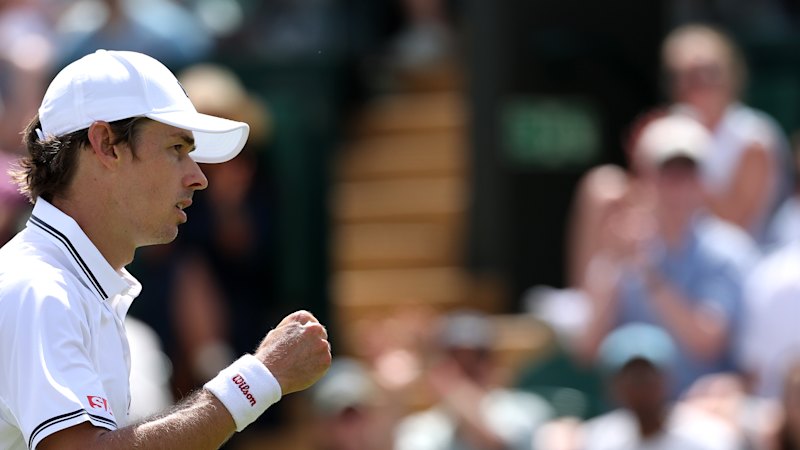
The Athletic has live coverage of the 2026 Wimbledon Championships.THE ALL ENGLAND CLUB, London — On the face of it, Ben Shelton should be salivating at the opportunity that lies before him at Wimbledon this year.With Carlos Alcaraz sidelined with a wrist injury, Shelton, the world No. 5, will be the No. 4 seed at the All England Club. The elevated seeding guarantees that Shelton will not face Jannik Sinner, the world No. 1, defending champion and consistent Shelton slayer, until at least the semifinals.Shelton’s game, which he has built around a left-handed serve that can boom and slide and kick and torture opponents, should be even more lethal on grass. The Wimbledon grass is slower and the ball bounces higher than the serve-and-volley-crash-bang of the 1990s and early 2000s, but it’s still grass.Shelton also loves to come in and finish points at the net as quickly as possible. He’s a big, aggressive hitter at a tournament where big, aggressive hitters can thrive.Grass-court tennis is a little more complicated than that these days. Wimbledon is perceived as a server’s paradise, but that really means that the return is king — and the big problem for Shelton is that he only gets to serve in half the games played in each match.He has to return the ball in the other half, and as much as he has tried to improve his return of serve, Shelton is still a below-average returner who will be competing on a surface where all the advantages he gains on his serve will likely accentuate his disadvantages on return.Here’s a very basic number that ultimately lands Shelton in the danger zone. This year, he has won 90 percent of his service games, which is about 11 percent better than the tour average of 81 percent. That’s great.He’s won 13 percent of his return games, which is about 33 percent worse than the average tour player, who wins 19 percent of return games.That’s not great. A great server who isn’t great at breaking serve will play a lot of tiebreaks, and tiebreaks are very often close to coin flips. Players can win a lot of them in a row, or lose a lot of them in a row, but something close to a 50-50 win rate is what comes out in the wash. Across five-set matches at a major, that’s a whole lot of variance — the kind that can be the difference between making the promised land of the last four or crashing out early.“You’d like to be able to break every set and hold serve all the way through,” Shelton said in his pre-tournament news conference Saturday. “That’s just how tennis goes sometimes.”Shelton, 23, has had a very good grass season so far.He won the Stuttgart Open in Germany, beating Taylor Fritz, a Wimbledon semifinalist last year, in three sets. Then he made the quarters at the Halle Open, losing in three tight sets — again to Fritz.Zoom in, and the high-variance nature of Shelton’s wins becomes more apparent. Six of the seven matches he has played on grass this season have gone to a third set. Eight of the 20 sets in those matches ended in tiebreaks. In Stuttgart, he needed a third-set tiebreak to edge past Marcos Giron in his opening match, and then had to save match points in a second-set tiebreak against Jiří Lehečka, which Shelton won 16-14.This has been pronounced across surfaces — when he won the Dallas Open on indoor hard courts in February, four of his five matches went the distance, and five of the 14 sets went to tiebreaks. Miami Open: first-round loss, two tiebreaks out of three. U.S. Men’s Clay Court Championships: two matches, five sets, three tiebreaks.Of course, Shelton doesn’t want to win that way all the time, because it’s not reliable enough. Living on the edge has consequences. After Stuttgart, the clock struck midnight in Halle. In his quarterfinal against Fritz, a fellow master server, all three sets went to tiebreaks. Fritz won two of them.Fans and commentators have been drooling about Shelton’s serve since he burst onto the tour at the Australian Open in 2023. Shelton won the NCAA title in 2022, left the University of Florida after two years, and essentially played a version of college tennis during his first year on the tour.That produced pretty good results. He made the quarterfinals in Melbourne and the semifinals at the U.S. Open. Looking back, he likens himself to being something of a serve bot. He was raw. In college, whenever he got into trouble, his fastball could almost always get him out of it.That doesn’t work so well in the pros. Top-100 players can get most big serves back if they don’t land in the right spots. So Shelton has learned how to hit a nasty kick serve and a slick slice.He’s learned how to stay on offense more efficiently when opponents do get the ball back. This season, he’s winning 77 percent of points on his first serve and 56 percent of points on his second, nearly five percent better than the average tour player.Nearly half of his first serves don’t come back. Twenty-seven percent of his second serves don’t come back. That’s double-digit percentage points ahead of the average. He only loses his serve once every 10 games.Now put Shelton on the receiving end. Shelton believes he’s made major progress on his returns.“If you look at my return numbers in terms of percentage of points won, you know, break point chances and percentage of games that I broke from when I came on tour, it’s black and white where I am as a returner,” he said. “I was way below the average of top 100 players. Now I’m around the average in terms of top 50 for a lot of the return stats.”Shelton is better in some categories, but in a lot of them he’s still looking up at the average tour player instead of down, and he’s miles behind a lot of his company in the top 10.Shelton wins just 32 percent of his return points. The average on the ATP Tour is 35 percent. He’s only getting 60 percent of first-serve returns back in the court. The average player is at 65 percent.He’s below average in his backhand return and his forehand return. He only wins 23 percent of the points on his opponent’s first serve, compared with 28 percent for the average player.Shelton has gotten better at putting his returns deeper into the court. But too many of them land in the middle third of the court, or close enough to it that his opponent can hit a shortish forehand on their second shot, and that can cause trouble.Add all that up, and it means a lot of holds, not many breaks, a lot of 6-6 sets, and a lot of coin flips. Shelton has already played 29 tiebreaks this year. He has a 19-10 record in them. Still, he’d rather not play them at all.“I’ve played a lot of really good servers and really big servers the last couple weeks, so I feel prepared,” he said in a news conference. “If a guy is serving great on the grass, has a big serve, more likely than not he’s going to hold against pretty much anyone in the world,” he said. “To win a point here or there, to be able to flip it, take advantage of second serve returns, and be clutch in the tiebreak is what’s most important on grass.”Given how good he is at serving, he knows he’s starting from a position of strength. Otherwise, he wouldn’t be the world. No. 5. If he could just become average at returning, who knows how high he could climb?“I have a lot more room to grow,” he said. “But I do think I have made big strides, and I think it has shown in certain points in the year where I’ve played really well.”It doesn’t take a master data analyst to figure out the book on Shelton.Play short points and the opponent is in trouble. He wins 53 percent of points that last less than five shots. If he did that on all his points, he’d be one of the greatest players in history. Roger Federer only won 52 percent of the points he played across his career.But if opponents can extend points beyond four shots, they’re in business. This season, Shelton is only winning 45 percent of points that last between five and eight shots, and 46 percent of points that last nine shots or longer.Nearly 75 percent of his points are short, compared with the tour average of 65 percent. That’s why he’s the world No. 5. He should play even more short points on the grass at Wimbledon, but the location of Shelton and his opponent during those points is also important.On average, 75 percent of of points on the ATP Tour end with both players at the baseline. Just under 70 percent of Shelton’s points end there, but he loses more than half of those points, 52 percent.Life is way better if he can get to the front of the court. He gets there on nearly 20 percent of his points, about 50 percent more than the average player, and he wins two-thirds of the points when he gets there.If Shelton is playing the way he wants to be playing, he will be running forward every chance he gets during the next two weeks. He wants to dictate and be aggressive.The challenge, especially when he’s returning serve and starting on defense, or when he is hitting his second serve and the point becomes neutral, will be getting out of neutral, or winning from a defensive position. The tour calls that last situation a player’s steal score — how often does he escape from a defensive position and steal a point?Few players do this more dramatically than Shelton. His combination of speed and power makes some of his scrambles thrilling. He can generate awesome shots on some of those Hail Mary runs into the corners.But those scrambles are far less successful than just about everyone on the ATP Tour. Shelton’s steal score is 29.2 percent the past year. That’s not even in the top 100.On the Wimbledon grass, his front-foot play can only get him so far. It’s how he responds and reacts to what’s in front of him that will determine how far he can go.



Most Popular
Alex Eala seeks to make more history at Wimbledon
16 hours ago


India eye redemption against settled England
4 hours ago

Start time, TV channel for singles match
7 hours ago
