Miami University's Cradle of Coaches Grows Up On The Screen
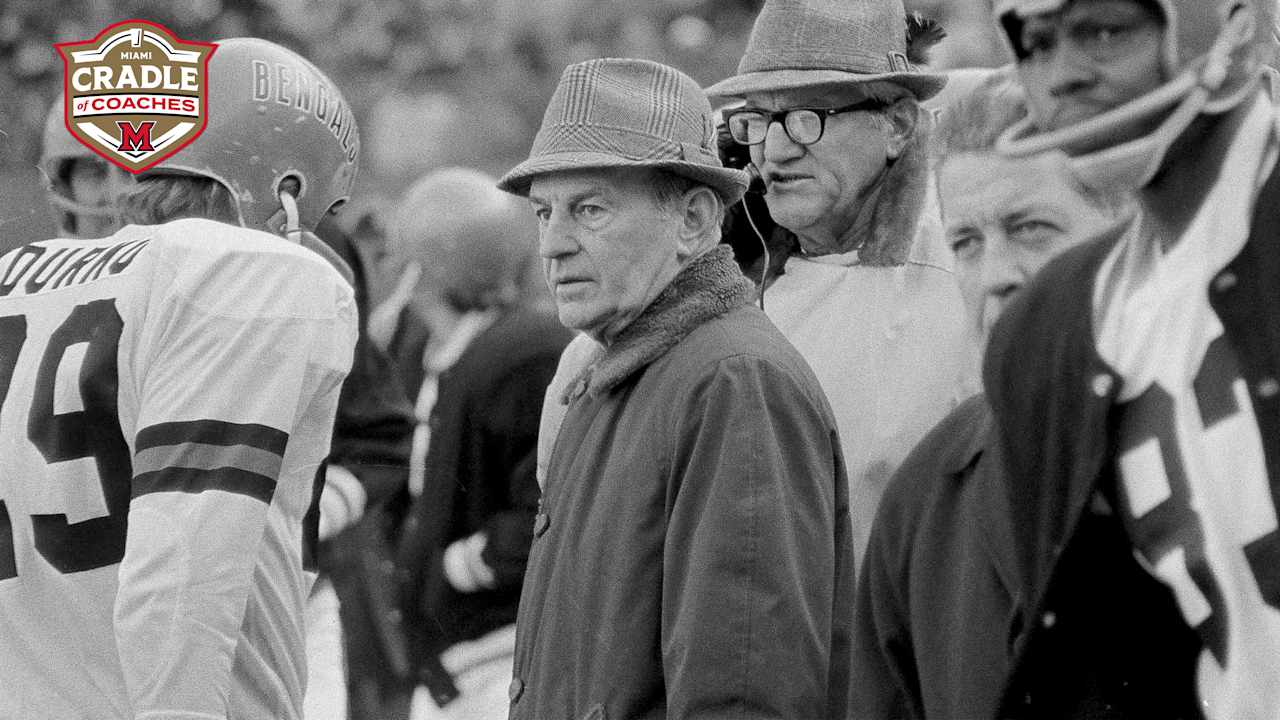
OXFORD, Ohio - In King Library's stately hush of academia tucked among the bricks of Miami University, Jacqueline Johnson is showing us the game plan Paul Brown drew up for the Bengals' first foray into pro football.There is the red ballcap that spells "Weeb," and the 100-year-old program from when Red Blaik was a Miami assistant coach, and a "Red Wave," towel from the last game safety John Harbaugh and the boys ever played at Miami Field.Yet Jacky Johnson is taking us over to Paul Brown's exhibit in the Cradle of Coaches room. "He was always so well dressed," as she points to a black windbreaker with an orange "PB," stitched on the left-hand side.But …"The first thing I wanted them to see?" recalls Johnson of the day the documentary people called and said they planned to rock the Cradle of Coaches on screen."Paul Brown's playbooks," says Johnson, Miami's indefatigable head of special collections and archives. "He would give intelligence tests to his players. So he was really thinking of their minds."When director Scott Thompson and producer Jesy Herron showed up on campus to begin breathing life into the 10 statues silently holding a staff meeting at Miami's Yager Stadium, Johnson told them to touch the playbooks.Startled that such an ancient, regal artifact was so accessible, Herron looked at Johnson and wondered if they should wear gloves."No," Johnson told them. "I want you to feel them."Like one of Brown's draw plays he invented with intuition and then perfected with repetition, they executed. In their film, "Cradle of Coaches," Thompson and Herron make you feel Miami's legends and their impact on football by unleashing a wave of pulling guards providing the narration during 65 interviews from 26 cities across a dozen NFL facilities and nine college campuses.They range from 91-year-old Bengals president Mike Brown talking about his father and the father of The Cradle, Paul Brown, to Chris Shula, the college roommate of Sean McVay, the youngest of the 10.During the project, four of the sources passed, including Bengals Ring of Honor member Bob Trumpy. They probe with locker room intimacy as Trumpy says of a Paul Brown anecdote, "Use it or not," or showing two old Paul Brown Super Bowl safeties in an emotional meeting before they interview Dick LeBeau and Solomon Wilcots.It's currently streaming not only on Peacock but also through the latest generation of the game. Players, coaches and fans who are too young to know that McVay's short, player-friendly practices began in the 75-minute labs of Paul Brown in the days after World War II."It seems comical to me," Thompson says, "to think about football before Paul Brown."Thompson, owner and founder of the Cincinnati-based digital creative agency RESLV, is a serious sort who has won Emmys and found a willing partner in the King Library. What better place, really, since a heavy theme is that Brown spawned the Cradle by bringing academics into the locker room and opened a Pandora's Box of creativity for the coaches who followed."They opened their arms to us," Herron says. "It was an open door all the time. When John Harbaugh gave the commencement speech this spring, we were able to do an interview on site and they pulled out all the stops."The King Library is named after Edgar Weld King, appointed Miami librarian in the early 1920s at about the time Paul Brown was finishing up his quarterback duties at Miami Field. King served until 1956, about the time Brown was inventing the first quarterback radio helmet.There's a lot of quiet toiling among the shelves of King, the largest of Miami's four libraries. The statues over at the stadium would call it "grinding." Jacky Johnson and her co-collaborator on the Cradle exhibit, manuscripts librarian Candace Pine, were suddenly ushered out of the anonymity."It was thrilling," Johnson says. "We don't see it happen every day. It's not often someone wants to (come by) and do a documentary for Peacock. It's like our Academy Awards."(Thompson) is so easy to work with. He really invited us into the production and we were honored to be a part of it because he loved working the story. He asked the right questions."Or, as Thompson says, "Jacky told me I had her dream job, and I told her she had my dream job. A really cool partnership."Most of the memorabilia from the Cradle exhibit has come from the families. The Browns have long donated pieces of PB's story to Miami and the Pro Football Hall of Fame, but for the documentary they again opened up Paycor."The thing I like about him," Johnson says of Paul Brown, "is he was not only a good leader, but he was able to figure out how to lead each individual player and after that he was able to organize a team."Johnson says she got to know Brown best through his 1979 autobiography he wrote with Jack Clary. PB: The Paul Brown Story has a prominent spot in the exhibit, standing sentry in front of a 1975 Bengals team photo, Brown's last and best club in Cincinnati.Take a stroll.There's a Miami media guide from 20 years ago, before McVay won the Miami Scholar-Athlete Award in 2007. Then, he was merely "an excellent route runner," a junior wide receiver from Marietta, Ga.There's one of Michigan's block M's from Glenn "Bo," Schembechler's reign in Ann Arbor.A Weeb Ewbank playbook from 1966: "We will never blitz linebackers without pinpoint coverage responsibilities."Now, Jacky Johnson is looking at the Weeb exhibit.As Thompson and Herron remind us, Ewbank is the winning head coach in two of the most important pro football games ever played ten seasons apart, the 1958 NFL Championship and the 1969 Super Bowl. Your eyes immediately go to a photo of Ewbank with his Super Bowl-winning Jets quarterback, the glamorous Joe Namath who called Weeb "a father figure."But Johnson is looking at the red "Weeb," ballcap.Wilbur "Weeb," Ewbank, Paul Brown's close friend and Miami teammate, would work on his Cleveland Browns' staff 30 years later before taking over the Baltimore Colts. It will be recalled that about 20 years after that, when Brown's Bengals outlasted Ewbank's Jets at Riverfront Stadium, Brown told the New York writers, "Tell Wilbur we may have gotten away with one."The caption tells you how Wilbur has a hat named "Weeb.""As a child, one of his brothers couldn't pronounce 'Wilbur,'" Jacky Johnson says. "It came out, 'Weeb.' That's how he's known worldwide. A childhood nickname."Last month, in the run-up to the release of the documentary, the Bengals hosted a panel discussion at Paycor (where, by the way, former Miami running back Travis Prentice scored the building's first touchdown for Cleveland, the first NFL team Paul Brown founded) and Johnson and Pine ferried in some Cradle artifacts."There were a lot of great things there," Johnson says. "But the thing people kept coming around to was Paul Brown's playbooks. They'd take out their phones and take pictures."They brought the 1968 Bengals Offense and the 1954 Browns Offense. The fans seemed to delight in that fine schedule: "$500 going out after curfew when the curfew is in effect … $500 loss of playbook …$100 and up for any infraction such as disorderly conduct, drinking, or any action detrimental to the welfare of the team."The story, it seems, got to the screen from King Library in much the same, pristine way."I'm not going to watch the whole thing until they show it here at Homecoming in a special viewing for staff and faculty," Jacky Johnson says. "I want to see what everybody else is thinking in the moment."




Most Popular