Pep Guardiola: Manchester City's new tactics analysed
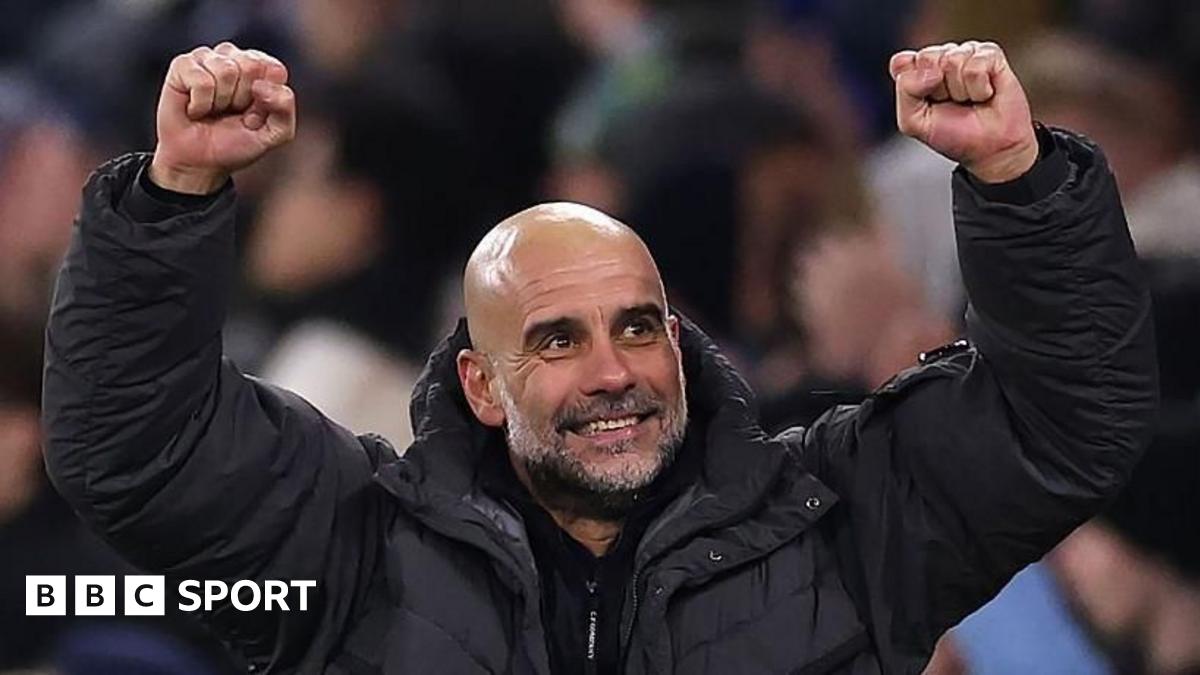
Last week, Pep Guardiola replied to a journalist's question by saying: "Do you want to be my assistant coach? You are brilliant, you are top."The journalist asking that question was me.The reason for my question was to try to gain insight into Manchester City's increasing use of narrow and fluid attackers.In City's stellar side of 2017-18, Leroy Sane and Raheem Sterling would finish games with white paint on their boots after being stationed high and wide.Almost a decade on, Guardiola's system looks very different.To understand why requires a deep dive.In my question I referenced an article Guardiola wrote for Spanish newspaper El Pais in 2006, in which he analysed Spain's 3-1 win against Tunisia.An important aspect of that column was his analysis of how to break down low blocks, which has been a key theme this season."When you decide to play on the counter-attack, you have plenty of space. When you decide to attack [with the ball], you have less. [But] when you play on the counter-attack, the ball belongs to the opponent," he wrote.At the start of this season, City leant into the counter-attacking strengths of individuals such as Erling Haaland and Tijjani Reijnders. By November, they had scored more goals from fast breaks than in the previous two league campaigns combined.In response to increasingly physical and centrally compact defences in the Premier League, City were scoring by bypassing teams' low-blocks altogether.And although City still look to use their fast attackers, the Spaniard has applied the brakes in recent weeks, with his words from 20 years ago hinting as to why.Playing more directly can lead to more turnovers, especially centrally.In those circumstances, the attacking side can become stretched with the forwards far from the midfielders and defenders.If a side's shape off the ball is not compact and a team loses the ball often, the logic behind Guardiola wanting to minimise the risk around playing directly is obvious."After [their opening goal], Tunisia wanted the game to be 14-a-side. They wanted a game with little space," he continued in his column.Given how many Premier League teams now look to defend City in a way that mirrors how Tunisia played on that day, the rest of his words become even more insightful.At the start of February, Pep said the game has more "man-marking" and is "more aggressive" whereas before it was more "zonal", referring to how teams behave when defending.But "if you do the process well, always the spaces are there", he added - suggesting there wasn't a need to throw game plans in the bin, but to simply execute them correctly.So how do Guardiola's City look to "do the process well" against physical mid and low blocks?City recently beat Fulham 3-0 with 56% of the possession. Antoine Semenyo and Haaland played as split strikers with Phil Foden behind them.In profile and shape, that City side was surprisingly similar to the Luis Aragones' Spain side that unlocked Tunisia's low block. Aragones' team was the side that became known for tiki-taka.Both sides played with a narrow and fluid front three. In fact Guardiola described Spain's forwards as "position-less".They were flanked by two full-backs, high and wide.Xavi and Marcos Senna were central midfielders with license to push up when spaces presented themselves, protected by single pivot. For Spain this was Xabi Alonso and for City, Rodri.When I read his column from 2006 back to him and suggested comparisons with his current City tactics, Guardiola nodded. It hinted his comments from 20 years ago, at least in part, revealed the intentions of his current side.On Spain's fluid Spanish front three, Guardiola wrote, "[they come] to the centre so that [full-backs] Sergio Ramos and Pernia can go up but the key is knowing when they're dropping deep".The timing of those movements was the important detail.And with City's attackers taking turns to partner Haaland centrally in a fluid manner, their positioning and movement has been key for City.At times Guardiola has been seen calling for restraint in his attackers' movements from the touchline, despite affording them more freedom in these areas than in previous seasons.Holding a high position pins opponents back, especially in a game that has become more 'man-to-man' in defence.Defenders and midfielders are less likely to step up and press the ball, wary of the likes of Foden and Semenyo behind them.This gives City's defenders and defensive midfielders more room to build out from the back in what looks like a mini-game with the opposition's front two or three against a City back two and a midfield two often playing around them.This helps City get up the pitch and push teams back, allowing Guardiola's side to dominate the ball.When possession has been established in the opponent's half, restraint is still needed for the narrow attackers.When analysing Spain, Pep said: "If (the attackers) drop in too early, it creates a space problem, forcing Xavi, Senna, and Cesc [Fabregas] back and putting them up alongside Xabi Alonso."And for City this could easily be replicated if the attackers drop in too early, forcing Nico O'Reilly and Bernardo Silva alongside Rodri.Against compact sides that aim to block the middle of the pitch, the space exists deep - with the likes of Marc Guehi, Ruben Dias and Rodri - or out wide. Ensuring Rodri has the space to showcase his passing quality is essential.City's attackers are encouraged to stay in-field too, to pull the opposition's wide midfielders and full-backs inside with them, creating space for Matheus Nunes and Rayan Ait-Nouri to attack.This isn't to say that attackers shouldn't move from their narrow position at all.In fact about Spain, Pep wrote: "It's good the forwards drop deep to receive the ball, but they need to do it a little later. Spotting this is difficult."If they manage it, it will allow Xavi, Cesc, and Iniesta, to receive the ball behind the opposing midfielders."And in recent weeks, these well-timed dropping-deep movements have been seen at Etihad Stadium.With City's attackers waiting before dropping deep, City's defenders are able to carry the ball into the space that opens up.Forward passes and dribbles often cause opponents to drop deep in response which is often a cue City's attackers use to burst away from their marker – towards the ball.Delaying the drop-deep movements allows City's forwards to arrive on the ball at the right time, at which City's midfielders have been seen pushing up into the space behind the opposing midfielders, as per Guardiola's recommendations for 2006 Spain.City have also often used the movement of attackers dropping deep to then find wide players in space unopposed too.In response to my question, Pep focused on player quality."We adapt to the quality of the players that we have. We have just one proper proper winger right now in Antoine and we adapt the system to make comfortable the players."It's telling that for one of the most successful coaches in football, his approach is player-led.In recent years, numerous coaches have been hired and subsequently sacked for a tactical style they have been unwilling to waver from.Guardiola in 2026 still believes in unlocking low blocks by dominating possession, and pinning teams into their own half, as he did 20 years ago but in aiming to get the best of his team, tweaks his tactics based on his players, to perform these principles.Although Guardiola and his staff will be drilling into their players the best way to move and interact with their team-mates, the reason these tactics have worked well for City in recent weeks is due to the players suiting the positions they've found themselves in.Pep has reinvented his side numerous times throughout his career. Promising coaches are sometimes described as playing like Pep but this claim is often less true given that Guardiola's sides looks so different, so often.Despite this, the way he thinks about the game and his core beliefs have been unwavering over a remarkably long time and his 2006 columns provide clues as to how the City manager was likely always destined for the top.

Most Popular