2026 poster: JR focuses in on Roland
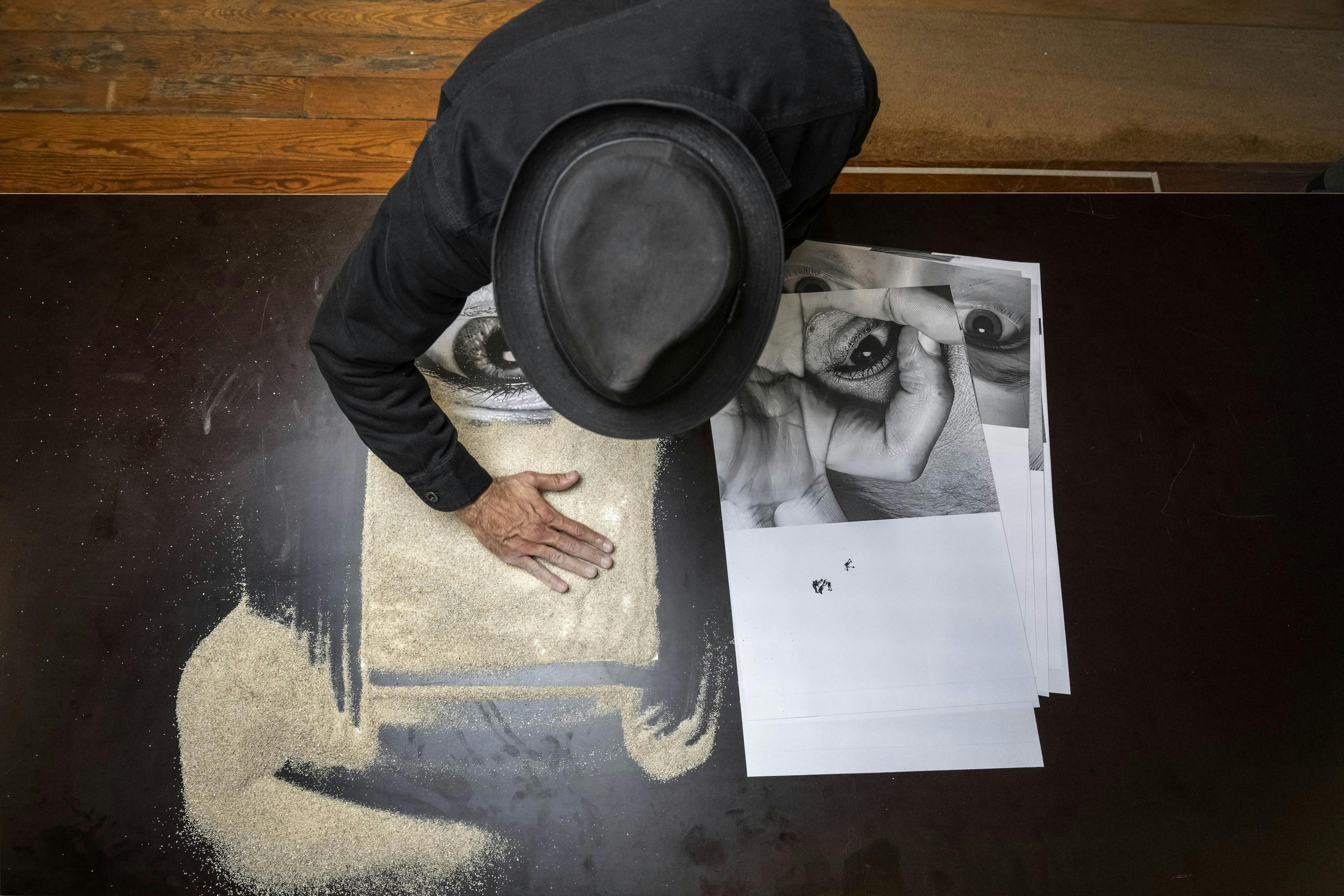
Through JR’s eyesFor many years now, the artist JR has made a name for himself by creating monumental projects in city centres across the globe. Having first come into the spotlight with Portrait of a Generation (2004–2006), he has, over the years, produced a growing number of socially engaged works, from Face 2 Face (2007) in Israel and Palestine to Déplacé.e.s (2022) in refugee camps, via Kikito (2017) across the border between the United States and Mexico. Winner of the TED Prize in 2011 for his collective photography project Inside Out (2013), JR creates in collaboration with communities, exhibits in major international institutions and constantly explores various media and artistic pursuits, from film to dance. From 6 to 28 June 2026, he will also present his latest artwork, La Caverne du Pont-Neuf, a temporary installation centred around Paris’s oldest bridge.Encouraging people to think is at the heart of JR’s approach. He demonstrates this once again by creating the official poster for Roland-Garros 2026. "My work is participative," he told us during an interview in his studio in Paris. "And on the courts, the spectators physically share an experience, all together. I find these collective experiences even more vital now that so many things take place behind a screen. Roland-Garros represents the pinnacle of this experience: in the middle of the day, in full daylight, every single spectator is connected. It is something that needs preserving. The stadium has been extended over the years because people need that; they need to live this experience together."A poster that makes you thinkThe 2026 poster is the fruit of a meeting between the red clay – a strong identifier of the Parisian Grand Slam – and JR’s singular world. He shines the spotlight on the red clay, which takes centre stage in this poster, and gives a special insight into how the courts are prepared in the Porte d’Auteuil stadium."I’d found some photos that show how the clay is spread on the courts," he explains. "It was fascinating to me, because we never actually see this process happening. When you arrive on court as a spectator, it’s all set up. I never thought that seeing a member of the maintenance staff spreading the clay could have such an impact on me. My team and I did a lot of research, going in so many different directions, including collage, which my pieces often feature. When you tackle a world as fascinating as Roland-Garros, as the world of tennis, you want to peek behind every door. But you always come back to your roots, and during our research we stumbled upon this picture. I found the ritual so vivid. That image really struck me, and I kept coming back to it because it was so powerful, the ochre colour contrasting with my signature black and white. It was a very natural choice. After putting the image together in the studio, we then photographed the whole process in real life, in the stadium."How and why did he come up with the idea of adding a black-and-white eye, created using photo collage, a technique that has become one of his hallmarks ?"That’s the mystery of creating," he continues. "The eye is one of my signatures. I also thought about how the poster would be used, the framework for which it is created, its history, the artists who came before me, the ways in which it would be displayed, would be used. At first glance, you needed to recognise that it was Roland-Garros, rather than one of my pieces. I felt that was important, because I am putting my skills to the service of the image. What is more, the poster will be everywhere. My pieces take on a life that I have no control over. That’s what is so thrilling about my work."Designed and put together in JR’s studio in Paris, this poster is unusual in that it is a photograph of a real task, carried out on the legendary Philippe-Chatrier court in the middle of winter. The piece can be interpreted in many ways, allowing the viewer’s imagination to run wild."I never give advice or instructions about my work," he concludes. "My pieces are for everyone. I’m more interested in people’s interpretations. I’m always questioning, rather than answering. The viewer’s narrative is more interesting to me than my own. I would rather hear what the viewer has to say; it teaches me a lot. I would rather not “force” them to see it in a certain way. I have no idea how the poster will be received. Once it leaves my studio, I have no control over what will happen to it. I am looking forward to seeing how different people perceive it. There’s always a touch of the unknown, especially since I never sign “JR”, my initials. My work often features a black and white image contrasting with something, which allows some people to recognise my work. On other Roland-Garros posters, sometimes you can immediately recognise the artist’s signature style, and sometimes you can’t."


Most Popular


Ronnie Delany obituary: Irish sporting hero
14 hours ago