
NFL draft storylines: what should the Jets do at No 2 and will the Cowboys trade up?
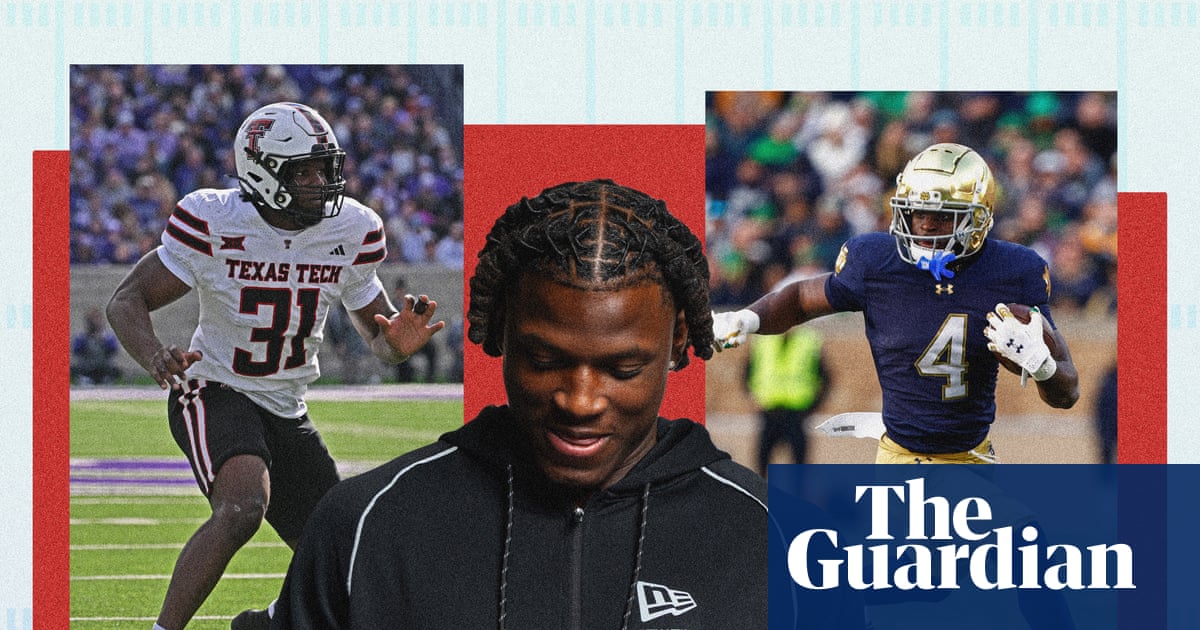
Who will be drafted No 2 overall?The draft begins with the second pick this year. We know Fernando Mendoza will be the Las Vegas Raiders’ selection at No 1 overall. With the second pick, the Jets have a decision to make: edge-rusher David Bailey from Texas Tech or the hybrid defender Arvell Reese from Ohio State.Bailey is widely viewed as the top pure edge-rusher in the class. He has a similar profile to Denver’s Nik Bonitto, a speed-bend-burst edge-rusher who relies on his unteachable first-step speed. The only problem: Bailey is a liability against the run.The Jets already have Will McDonald, a dip-and-rip style pass-rusher similar to Bailey. But after trading Jermaine Johnson to the Titans, they are lacking some sizzle off the snap. Bailey has the potential to be a game-breaker, but the Jets must weigh up whether he is good enough against the run to be an every-down player or whether he is a pass-rush specialist.Reese is the best player in the class. At Ohio State, he played as an off-the-ball linebacker and part-time edge-rusher. He is an explosive, physical, smart defender who can play around the defensive front. Most teams are projecting Reese to play full-time on the edge in the NFL, but there is a limited sample size of him playing that role in college. There have been some comparisons to Micah Parsons, who transitioned from linebacker to edge-rusher after the Cowboys drafted him in 2021. But Parsons had been an edge-rusher in high school, and he was not the same caliber of linebacker prospect that Reese is.Drafting Reese to be purely an edge-rusher would be a gamble. He recently told ESPN’s Ben Solak that he didn’t know what he was doing when released to rush the passer and that he was making his moves on instinct. The Jets desperately need defensive playmakers, and they’ve made noises about becoming a more versatile defense. Reese fits that mindset. He is the kind of player you structure a defense around rather than force into a box. He can play off-the-ball on early downs and line up anywhere along the front in pass-obvious situations. Passing on him would be a mistake.Will the Titans really pick Jeremiyah Love at No. 4?Beyond Mendoza to the Raiders, the chalkiest pick of mock draft season has been the Notre Dame running back to the Tennessee Titans.There are incessant arguments about the value of selecting running backs high in the first round. But if you look back over recent history, the hit-rate on backs taken at the top of the first round is pretty impressive. Since the 2016 draft, seven running backs have been selected in the top 15, and it’s a who’s who of All-Pros: Ezekiel Elliott, Leonard Fournette, Christian McCaffrey, Saquon Barkley, Bijan Robinson, Jahmyr Gibbs and Ashton Jeanty.Sure, you can argue about how much those individual players have affected a team’s success, but it’s undeniable that five of the seven were hits. Only Fournette was a disappointment. With Jeanty, it’s too early to tell.Things run haywire when you look at the history of late first-round picks at the position. But at the top of the board, teams have done a solid job of distinguishing which running backs are worthy of high selection. What distinguishes all those backs is the value they bring in the passing game, as receiving threats or blockers.Love is no different. He is a walking big-play threat as a runner and receiver. Around 48.5% of his career rushing yards have come on explosive runs of at least 15 yards, one of the highest marks in the history of college football. As a receiver, he averaged 10.4 yards per reception in his final year in college. Love does most of his damage by making tacklers miss and turning solid gains into chunk plays.New head coach Robert Saleh may pound the table for another defensive difference-maker, and there will be plenty of them available on the board. But the goal for the Titans is to find another offensive anchor they can pair with second-year quarterback Cam Ward. Value-wise, adding Ohio State receiver Carnell Tate makes more sense. But Love may simply be too tempting to pass up.Will Ty Simpson be a first-round pick?Simpson is this year’s most polarizing prospect. To some, he is the most polished, ready-to-go quarterback in the class. To others, he’s a fragile, short, inaccurate passer who should have stayed in college for another year. There is no dispute, however, that he will be the second quarterback selected.Simpson started for only one year in college, playing in a hyper-aggressive, pro-style offense at Alabama under the tutelage of former Seahawks offensive coordinator Ryan Grubb. Over the first eight weeks of the season, he was lights-out. He is a small, agile quarterback with a similar skillset to Brock Purdy.Like Purdy, Simpson is a distributor more than a playmaker. Everything about his game is fearless: he is tough in the pocket, challenges defenses vertically and rips throws to the middle of the field with good anticipation. He isn’t going to wow you with his athletic traits, but he has just enough juice to threaten the edge on rollouts and is a talented thrower on the move.For the first half of last season at Alabama, Simpson’s smarts and feel for the position leapt off the screen. Everything he did was fast. But over the second half of the year, he crumbled. He battled injuries. His accuracy eroded. His decision-making was erratic. As opposing defensive coordinators gathered more film on Simpson, he struggled to adjust. NFL teams are evaluating Simpson on a small sample size. Will they be getting the Simpson of the first half of the year or the second half?The history of quarterbacks who play at Simpson’s size and weight makes for grim reading. In the last 20 years, there have been only six quarterbacks who were 6ft, 1inch or shorter and weighed 215lbs or less who have started more than 40 games in the NFL: Drew Brees, Russell Wilson, Baker Mayfield, Michael Vick, Kyler Murray and Bryce Young. All of those players had an easy-to-define super-skill, be it their athleticism, intellect or accuracy. And while Wilson, Mayfield and Brees were small, they had the necessary body armor to survive the down-to-down punishment in the NFL.Simpson falls short on those measurements. Add to that, only 13 of the 118 quarterbacks in the last decade have started 21 games or fewer: Mitch Trubisky, Kyler Murray, Trey Lance, Mac Jones, Dwayne Haskins and Anthony Richardson. The bulk of those quarterbacks were blessed with either electric feet or a high-wattage arm. Teams were betting on their upside. Simpson is more in line with Jones and Haskins.Three teams make sense for Simpson: the Jets, Cardinals and Steelers. All have a quarterback need. Simpson doesn’t profile as a traditional Mike McCarthy quarterback, so that probably takes the Steelers out of the mix. The ideal fit for Simpson would be with the Cardinals, probably at the top of the second round.Who will trade up?When you have a class light on blue-chip prospects at premium positions, it means one thing: trades!The consensus sure-fire prospects in the 2026 class are linebackers, safeties and interior offensive linemen. There is a sharp drop-off from those highly regarded prospects to the meat of the class, with little then separating the 12th-best player from the 45th one. Finding value – both the position selected and the range the player is taken in – is the name of the game. And teams have long been queasy about taking the positions deemed less valuable with the highest picks.Almost every team in the top 10 will be making the same calculation: do we take an outstanding prospect at a non-premium position, reach for a lesser prospect at a deluxe position, or trade down to add more picks and select a player in a range that better represents their talent?Most likely, the rebuilding teams at the top of the order will try to shuffle back from their spot to gather more picks without those traditional, foundational players on the board.Added to the mix is the fact that five teams picking in the top 14 will enter next season believing they can be Super Bowl contenders: the Commanders (No 7), Chiefs (No 9), Cowboys (No 12), Rams (No 13) and Ravens (No 14). Save for an injury to their quarterback, none of those teams will expect to pick in this range again next year. And all are just a couple of spots away from being able to move up and select one of the premium players in the class. According to draft insiders, the league’s general view of the class means that trading up will be cheaper than in recent years, which should fuel a lot of movement in the first round.Arizona, picking at No 3, and Cleveland, picking at No 6, are two prime candidates to move down. Most of the pre-draft speculation about who will move up centers on the Rams and Cowboys. After picking up an extra first-round pick from a trade last year, the Rams could move from No 13 into the top six on draft night to secure the top wide receiver on their board. The Cowboys have their eyes on a defensive difference-maker. If they don’t believe one of their top targets will slide to No 12, they could leap as high as No 3 to secure a player they feel is the best in the draft.


Most Popular

Women's Tennis Sweeps Adrian In Road Victory
13 hours ago

Troy University Athletics
14 hours ago




Whangārei mourns Colin Thorne, 102
9 hours ago