Gender equality in tennis, 10 years after scandal at Indian Wells: ‘I think we are the leaders’
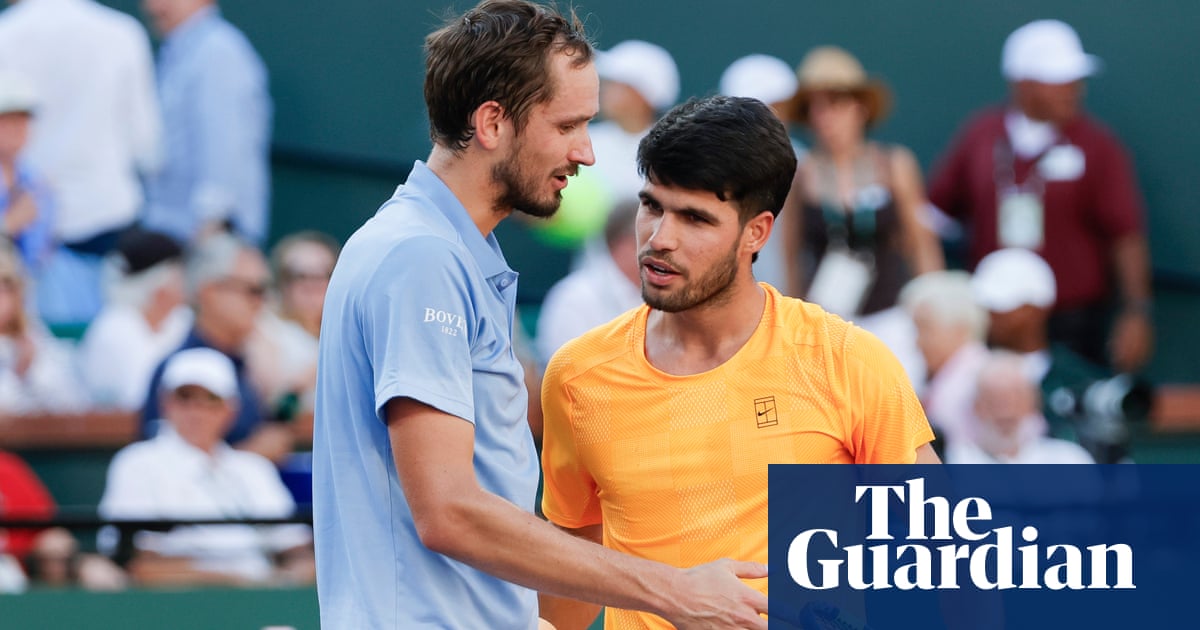
INDIAN WELLS, Calif. — A decade has passed at the BNP Paribas Open since Raymond Moore, on the final Sunday, made the sexist comments that led to his resignation.Moore was chief executive and tournament director when he said in a news conference ahead of the 2016 singles finals: “In my next life, when I come back, I want to be someone in the WTA, because they ride on the coattails of the men. They don’t make any decisions, and they are lucky. They are very, very lucky.Advertisement“If I was a lady player, I’d go down every night on my knees and thank God that Roger Federer and Rafa Nadal were born, because they have carried this sport.”Moore described several WTA Tour players as “very attractive prospects,” clarifying that he meant physically as well as competitively.Moore, who did not respond to an interview request for this story, apologized for his comments before resigning, calling them in “poor taste and erroneous.” Legends of the women’s game, including Serena Williams and Billie Jean King, criticized him for his remarks.Hours after Moore’s news conference, Novak Djokovic said the remarks “were not politically correct” after thrashing Milos Raonic in the men’s final.Advertisement“I understand how much power and energy WTA and all the advocates for equal prize money have invested in order to reach that,” Djokovic said in his post-match news conference.“They fought for what they deserve and they got it. On the other hand, I think that our men’s tennis world, ATP world, should fight for more because the stats are showing that we have much more spectators.”Djokovic issued an apology a couple of days later. “I don’t make any differences between the genders. I am for equality in the sport,” he said in a statement on Facebook.Also during his news conference, Djokovic described prize money — and with it equality and equity — as the defining theme in tennis in the years before 2016.AdvertisementTen years later, in interviews with dozens of people in tennis, a complicated picture emerges of how those themes persist. In a sport that has made greater strides than any in the world in some areas, but remains less equitable in others. While structural inequalities manifest in scheduling, media, commentary and other areas, the root remains money, even as equality on that front has improved more than any other.As night follows dayKing, the Grand Slam champion and trailblazing co-founder of the WTA Tour, is adamant that as long as men and women play different formats at Grand Slams, there will be inequality. “Same format. Equal content. Equal exposure” is her mantra for equality in tennis.While the ATP and WTA Tours are both best of three sets, King’s argument is that at majors, which are best of five for men, the potential for a women’s match to last only 60 percent as long as a men’s match means that players also receive proportionally less television exposure and time on show courts.AdvertisementThe order of tournament finals also largely prioritizes men’s matches. The men’s singles final comes last at mixed events, including combined ATP and WTA 1000 tournaments, which are held at the same venue in the same week. At Wimbledon, the men’s singles champion opens the tournament on the first Monday.Across the Grand Slams, and even at the U.S. Open, where the Saturday night women’s singles final gets better television exposure than the men’s final on Sunday because of the NFL season start, this order of operations causes problems.The women’s final being Saturday means that half of the draw has to play on consecutive days between the quarter and semifinals, because under the best-of-five format, that would be an unreasonable demand on men’s players.The French Open did not respond to a request for comment on format changes, while a spokesperson for Wimbledon said that there are currently no plans for them, but the tournament is always open to discussing the matter with the players.AdvertisementA Tennis Australia spokesperson said via email that format discussions “continue to evolve as the sport does.” Craig Tiley, the organization’s outgoing chief executive, suggested ahead of his departure for the United States Tennis Association (USTA) that women could play best-of-five-set matches at the Australian Open from the quarterfinals onward, to which several WTA players have responded with either ambivalence or a polite decline.USTA spokesperson Brendan McIntyre said via email: “In terms of the formats and overall tournament schedule, we look at all areas of our event every year, looking for any opportunity to enhance the experience for players, fans, broadcasters, partners, and all those involved in the event.”The French Open is the tournament at which scheduling is most contentious. Since it introduced a single-match night session on its biggest court in 2021, it has scheduled four women’s matches out of 53 played on Court Philippe-Chatrier. Last year, broadcaster Amazon Prime requested that French wild card Loïs Boisson’s fourth-round match against Jessica Pegula get the slot, but the tournament declined.Boisson and Pegula played second in the day session in front of swathes of empty seats, which filled only as Boisson got closer to and then secured an upset victory. Some considerations involved broadcasting: Amazon Prime is paywalled and has exclusive rights to the night session, while free-to-air TV in France shows the day matches.AdvertisementIn news conferences, tournament director Amélie Mauresmo and French Tennis Federation (FFT) president Gilles Moretton said that spectator value is behind the scheduling, arguing that a men’s match runs less risk of being a less-than-an-hour blowout, which, in their view, would short-change fans.Ons Jabeur, a three-time Grand Slam finalist, said in response in a news conference: “They don’t show women’s sport, they don’t show women’s tennis. Of course, they watch men more because you show men more. Everything goes together.”Players generally believe that scheduling at combined ATP and WTA Tour events has improved.“I think now it’s always women’s match and men’s match in night sessions,” Elina Svitolina, a pro since 2008, said in a news conference Wednesday after reaching the Indian Wells quarterfinals. According to WTA data sent to The Athletic, around 75 percent of men’s matches were on one of the three main courts at the California event in 2016, compared to just under 60 percent for women. Now, there is an even split.AdvertisementTournament director Tommy Haas, who replaced Moore in 2016, said during an interview Wednesday that gender equality is a “very, very high priority.” Unlike other combined events, the Indian Wells singles finals are still played on the same Sunday, and the former world No. 2 said “there are always discussions” about playing the women’s final second.Scheduling, still, is complex. Fans want to buy tickets to see stars and their favorite players. Those players have preferences about courts and court times, as do television companies, both domestically and in other time zones.Aryna Sabalenka and Iga Świątek, the two best players of the past few years, prefer earlier daytime slots, which tend to be less popular, especially on weekdays. Plenty of women’s players prefer not to play at night, just as plenty would rather not play best-of-five.Television considerations can lead to decisions that look strange from the side of the court, but make total sense when considering the time zones in which a given player’s fans will be watching. And sometimes circumstances conspire against giving women’s tennis the limelight.AdvertisementThe Italian Open started its women’s final at 11 p.m. local time in 2023 after rain delays, instead of rescheduling it to be played on the same day as the men’s final. Elena Rybakina lifted the trophy after midnight, in front of a sparse crowd, and had to prompt organizers to give her the trophy.“I think it can still be better,” Belinda Bencic, who has been on the tour since 2012, said in a news conference Monday.“For sure, it’s gotten better, but there are some tournaments where it’s better than others, and I definitely think that we have to speak up. I understand, if there is a match with (Carlos) Alcaraz or (Jannik) Sinner and everyone is interested, and the revenue and everything. But I also think women’s sport is very attractive and a lot of people are watching women’s tennis.“So I think it’s hopefully going in the right direction to become equal at some point.”AdvertisementPegula, the American world No. 4 who is heading up a new WTA council to address player concerns about the tennis calendar, echoed Bencic’s view.“I understand it’s a fine line if something else is more popular and they want to put that in a better spot, but at the same time, I think when you have such a great product and so many great players, we should get some better spots,” she said during an interview Monday.“A lot of it is looking at the data and then going back to tournament directors and being like, ‘Hey, this isn’t fair, this isn’t working. Can we get a better spot? Can we get this to change?’”(Prize) money talksUnderpinning the structure of tournaments is finance: revenues, sponsorships, media rights, and prize money.AdvertisementThe latter, which Djokovic described as a cornerstone issue a decade ago, has improved in the 10 years since.In June 2023, the WTA pledged equal prize money for combined 1000- and 500-level events by 2027, and by 2033 for non-combined, single-week 1000- and 500-level events.Major pay disparities remain. The Italian Open, a combined 1000-level event, paid out $9.2 million to the men in 2025 and $6.9 million to the women. In the same year, the Cincinnati Open’s figures were $9.2 million against $5.1 million.A disparity will remain at the 2026 edition of the Cincinnati event, but with a 2.4 percent increase in the men’s and a 44 percent increase in the women’s prize money, to $9.4 million and $7.4 million respectively. The Italian Open did not respond to a request for comment on its 2026 prize money.Advertisement“I think there is still a big gap,” Svitolina said of some tournaments. When the WTA announced its intentions in 2023, Paula Badosa, a one-time world No. 2, said during an interview with the New York Times: “I don’t know why it’s not equal right now.”Sabalenka, the world No. 1, called for improvements during an interview two years ago. Other tournaments with the ability to do so have outpaced the WTA plan. Last month, the Charleston Open became the first standalone WTA 500 event to proactively offer equal prize money with its ATP equivalents.According to WTA data, prize money paid per year at WTA Tour events and the Grand Slams has grown from $142.5 million in 2017 to $249 million in 2025 — a 70 percent increase. Sabalenka set a new WTA record in 2025 with more than $15 million in single-season prize money, far exceeding Serena Williams' previous record of $12.4 million in 2013.AdvertisementFor the second straight year, Gauff was the highest-paid female athlete, with $30.4 million in total on- and off-court earnings. Świątek and Sabalenka placed second and third, and seven of the top 10 highest-paid female athletes were women's tennis players, according to Forbes. Rybakina's $5,230,500 prize for winning the WTA Tour Finals was the largest single payout in women's sports history, and a record in ATP and WTA tour-sanctioned professional tennis events.But money is so powerful that its relationship to other factors in equity and inequality is not straightforward. Extending some WTA 1000 tournaments from seven days to 12 has made increasing prize money possible, the tour says, but many top players have lamented the impact on their schedule and their wellbeing.The ATP Tour, through ATP Media, owns the Tennis TV platform that broadcasts its tournaments outside the Grand Slams; the WTA's equivalent, WTA TV, is available in fewer countries. Tennis TV originally launched as a combined platform in 2009, but the WTA pulled out in 2016.In a news conference Tuesday, Sabalenka said: “I would probably do a little bit better job on promoting our sport. I love the way ATP promotes and how the marketing for ATP works. I feel like this is the gap where we can improve and bring more attention and more eyes on women's tennis.”AdvertisementDuring an interview a couple of years ago, during the Madrid Open, Jabeur said: “I don’t really think that it’s just a question of money, but also respect. It’s small details that make the difference,” when anecdotally commenting on a disparity in the number of social media posts that combined tournaments make about men's and women's players.WTA data shows that its social media following grew eight percent year-on-year in 2025 to 8.2 million, while live attendance went up by 14 percent to 4 million fans last year, the highest in WTA history. Player and fan discontent is more often qualitative.The growth of the WTA Tour Finals, including its prize money, has come from a three-year deal to host it in Saudi Arabia, which has been criticized for its human rights record when it comes to women. The Public Investment Fund, which sponsors the WTA and ATP rankings and also funds a WTA maternity program set up last year, has declined to comment on its relationship to the Saudi Arabian state.Any commercial merger between the two tours, which has been discussed for several years, remains distant. The WTA last year brought on Mercedes-Benz as its main partner in the largest sponsorship deal in its history, but its most recent accounts showed a loss of $4.9 million, compared to the ATP's $52 million profit.AdvertisementIntangible inequalitiesJust as individual matches and tournaments are built on their social and economic foundations, tennis' structural issues manifest in smaller and subtler ways.At the 2023 Madrid Open, organizers denied the women's doubles finalists the customary winners' and losers' speeches, after the tournament had given Carlos Alcaraz a significantly larger birthday cake than Sabalenka.Tournament director Feliciano López responded to criticism from two-time major champion Victoria Azarenka with a photo of another birthday cake given to Holger Rune, of a similar size to Sabalenka's.AdvertisementTournament chief executive Gerard Tsobanian issued an apology for the women's doubles incident, promising that “this will not ever happen again.”More widely, commentary and discourse around the sport can feed into unconscious biases.“With guys it's like ‘Oh, they're so competitive and so tough,'” Martina Navratilova, who won 59 Slams across singles and doubles in a legendary career, said during a phone interview. “But with women it’s, ‘Oh, they're catty.’ The same quality the guy has is a plus, and the same quality for a woman is a minus.“And either there are complaints that, ‘Oh, it’s the same players in the final,’ or it’s the opposite, it's like, ‘Oh my god, the women, you never know who's going to be in the final, how can you promote anybody?’ But with the guys, when it was Roger (Federer) and Rafa (Nadal), it was going to be the same two or three players getting to finals and that was a good thing.Advertisement“So it's the double standard, you just have to laugh at it, otherwise you'll be crying and screaming.”The shorter format in women's tennis also means that one-sided matches, especially finals, can lead to a referendum on the state of the WTA Tour. On the men's side, a one-sided Federer or Nadal final would instead often be hailed as a “masterclass.”Bencic this week said that the longer Grand Slam format on the men's side favors the best players, because an upset becomes less likely. For this reason, as a top-20 player, she would be in favor of playing five sets; the three-set format is also a contributing factor to what often gets labeled as randomness or unpredictability in the women's game.Discourse around perceptions of men's and women's tennis reached a fever pitch ahead of December's "Battle of the Sexes” match between Sabalenka and the then-world No. 671 Nick Kyrgios. The organizers believed the event would be a positive for women's tennis, as it showed that Sabalenka could compete with a former men's singles Wimbledon finalist. But the court was also modified to supposedly level the playing field, and the lose-lose element of pitting a world No. 1 against someone who has barely played the past few years led to criticism.AdvertisementAlizé Cornet, the former world No. 11, said in an interview with RMC Sport that the adjusted court that favoured Sabalenka was “absolutely stupid” and that the match “doesn’t give a very good image of women’s tennis.”After the match, which Kyrgios won 6-3, 6-3, Sabalenka said in a news conference that she “did not understand how people were able to find something negative in this event.”The organizers of the Grand Slams point to some positive changes: from the biggest events down to recreational tennis. Tennis Australia in 2022 launched a strategy designed to encourage more women to play, supported by an $8.4 million federal grant, which has led to 51 percent of girls playing tennis as of June 2025, up from 44 percent in June 2024.The WTA Tour has labeled the growth of the sport in Saudi Arabia, through in-tournament coaching clinics and year-round initiatives, as a benefit of its deal to host its flagship event there.AdvertisementSome tournaments have also made changes outside of high-profile rounds. Wimbledon expanded its women's singles qualifying draw to 128 to match the men's, and scrapped the use of prefixes on court in 2019 before removing them from honors boards three years later. It also relaxed its all-white clothing rule in 2023, after multiple players explained how anxiety-inducing it was to have to wear all-white underwear when menstruating.This understanding is yet to extend down to the way women's matches are commentated. Zheng Qinwen said menstrual cramps affected her performance in a French Open defeat to Świątek in 2022, who has also been open about the relationship between the two, but apparently unexplainable dips in performance still draw bemusement from commentators.“I don’t know any female tennis players that haven’t had issues with managing their menstrual cycle and figuring out a way to compete at their best level at all times,” 18-time Grand Slam doubles champion Pam Shriver said during an interview.After resigning from the BNP Paribas Open, Moore reached out to a number of players, including Shriver, to try to make amends and learn from his mistake. Now 79, he is no longer prominent in tennis.AdvertisementDjokovic, meanwhile, said in a news conference Monday that: “It's not what I think. It's the fact: Women's tennis has been by far the most successful, I guess, global women's sport and also most paid, so it's great to see that. I'm happy for that, and I'm proud of that. I think it's in a good place.”Male allies are also seen as key to progress. Denis Shapovalov, the Canadian world No. 39, whose wife, Mirjam Björklund, is a former player, wrote in a 2023 essay for The Players’ Tribune: “I think some people might think of gender equality as mere political correctness. Deep down, they don’t feel that women deserve as much.”Andy Murray, who corrected journalists who didn’t acknowledge female players' achievements throughout his career, remains notable. This is true of any sporting context because of the role they play in freeing women from having to constantly advocate for themselves instead of focusing on their sport.Świątek, who criticized women's tennis detractors after her year-defining 2024 Madrid Open final against Sabalenka by saying, “Who can say women's tennis is boring now?" said in a press conference this week that she did not “know what particularly could be unequal.” In an interview Monday, Qatar Open champion Karolína Muchová said, “I’m not really thinking of that.”AdvertisementPegula, who has become the WTA Tour’s unofficial figurehead, expects more change over the next decade and further increases in prize money. And for all the issues around equality in tennis, she doesn’t want to lose sight of where it sits in the wider picture of women’s sports.“Even though we fight or argue about all these things that need change, I still think we are the leaders of all the women's sports in the world, which is pretty crazy,” she said.“And so to be part of a sport that is driving that change is really amazing. It’s a privilege and hopefully we can keep pushing that forward.”This article originally appeared in The Athletic.Sports Business, Culture, Tennis, Global Sports, Women's Tennis2026 The Athletic Media Company


Most Popular