LEGACY: Why Brazil ditched tradition and turned to Carlo Ancelotti in bid to end World Cup drought
.png)
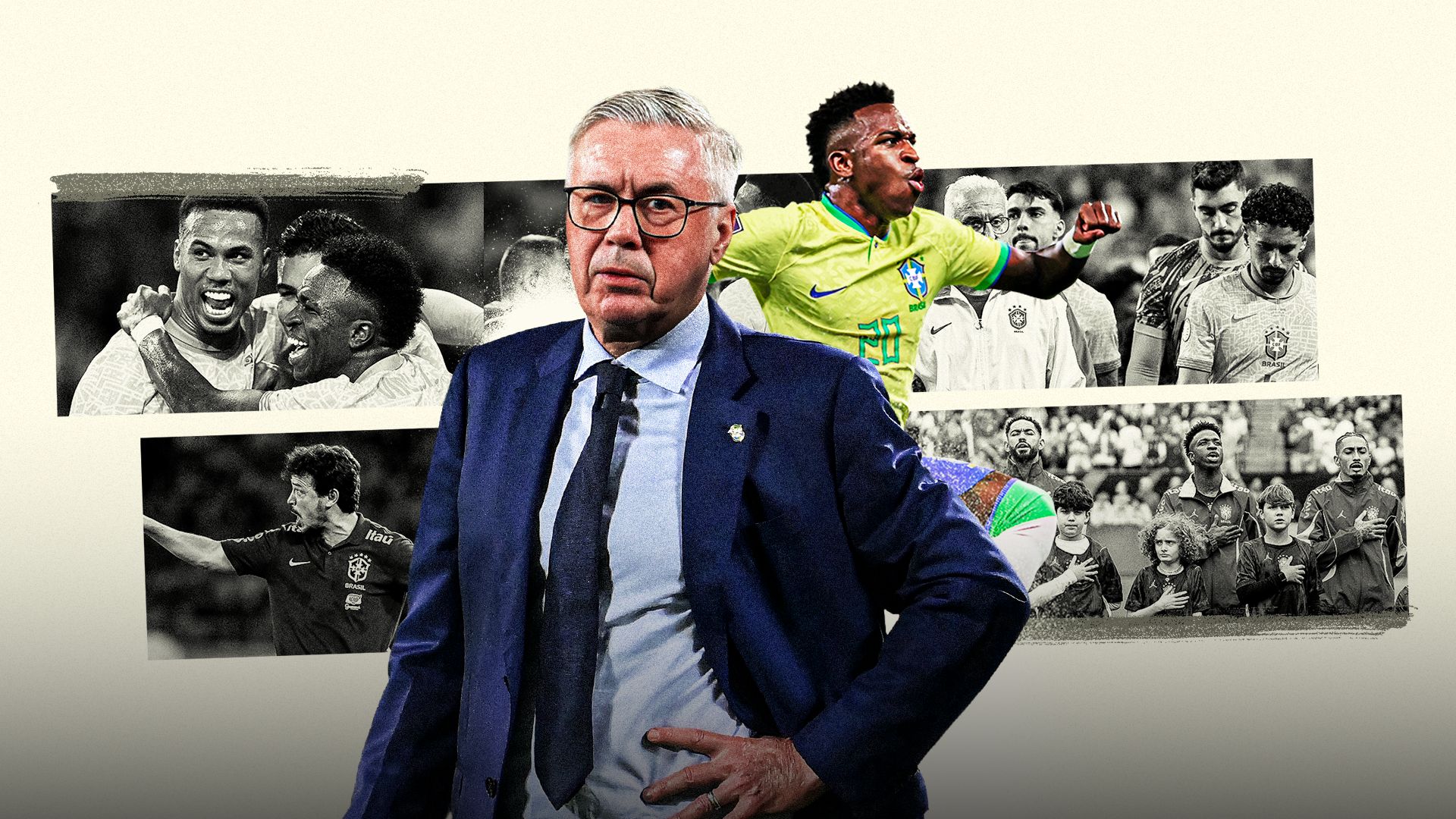
The excitement over the Italian’s arrival, even so close to the World Cup, was not exaggerated. For years, many Brazilians had dreamed the almost impossible idea of seeing Pep Guardiola in charge of the national team. Having one of the best coaches of all time, coming off successful spells at Real Madrid where Ancelotti had become deeply familiar with many of Brazil’s top players, was reason enough to dream again.But the arrival of the first foreign full-time head coach of the national team also symbolised a painful truth that had become an elephant in the room: The accelerated decline of Brazilian managers.Foreign coaches are nothing new in Brazilian football, and have made enormous contributions to its evolution. The so-called ‘Hungarian school’, active worldwide in the 1940s and 1950s, also reached Brazilian fields through figures such as Dori Kurschner, who introduced the first deep tactical ideas to Brazil, and Bela Guttmann, whose assistant at Sao Paulo in 1957, Vicente Feola, went on to coach Brazil to its first world title in 1958.In 1965, Argentine Filpo Nunez did such outstanding work with Palmeiras that his team officially represented Brazil, wearing the yellow national jersey in a friendly against Uruguay.But starting in 2019, the success of Portuguese manager Jorge Jesus with Flamengo blew the doors wide open for foreign coaches. Other Portuguese coaches - Abel Ferreira at Palmeiras and Artur Jorge at Botafogo - went on to make history with remarkable title wins. Argentine Juan Pablo Vojvoda arrived in 2021 as an unknown name, but soon became a legend at Fortaleza, leading the underdog club to dream of national and continental trophies, while he even rejected multiple offers from bigger clubs before leaving in 2025 with an emotional farewell.Meanwhile, Brazilian coaches were increasingly pushed aside. They became, for the most part, a Plan B. Half the managers in Brazil’s top-flight now come from other countries.The consensus belief - and it may still hold true - is that Brazilian coaches have long been outdated. If Argentine or Uruguayan managers sometimes coach top clubs in the Champions League, why has no Brazilian done so in decades? The last ones were Luiz Felipe Scolari at Chelsea and Vanderlei Luxemburgo for Real Madrid in the mid-2000s.Those who succeeded within South America often became victims of Brazil’s relentless coaching carousel, or were eventually appointed to the national team, only to turn from geniuses into failures in the public eye, judged solely by disappointing results.The same country that exports the best footballers in the world has struggled to produce elite thinkers and strategists. With rare exceptions, Brazil has spent the last few decades recycling the same profiles to lead the national team; from the veteran who succeeded long ago, to the disciplinarian, to the trendy name of the moment, to the fatherly figure.Carlos Alberto Parreira, a world champion in 1994 and one of the leading tactical minds of his generation, led the team again in 2006, but failed to organise a squad full of stars such as Ronaldo, Ronaldinho, Adriano, Kaka, Roberto Carlos, Cafu, Dida, Juninho Pernambucano, Ze Roberto, Lucio and Juan.The reaction to that failure, blamed partly on the players’ excess of celebration and ego, was to appoint a hardliner who had never even coached a club: Dunga, Brazil’s triumphant captain from 1994. He had two stints, between 2006–10 and 2014–16, but neither impressed.Mano Menezes briefly rode a wave of popularity after 2010, but couldn’t sustain it. Scolari then returned in 2013 based purely on nostalgia for the 2002 World Cup and his famous ‘Scolari Family’. He even appeared in an advertisement playing a loving father figure guiding children on a football pitch. In the end, that fatherly image became cruelly ironic when Brazil lost 7–1 to Germany in a World Cup semi-final that resembled men against boys.Among this rotating cast of characters, Tite seemed the most prepared when he took charge before the 2018 World Cup. His early run in the qualifiers was inspiring, and having emerged as the best coach in Corinthians’ history, winning nearly every major title available, he commanded universal respect. He was even described as ‘a European coach in Brazilian skin’.But Tite, too, fell short, unable to get past the quarter-finals at two World Cups. After stepping down in 2022, he failed to land any major job in Europe, as had been his dream.Having lost its most competent coach in years, the CBF - themselves mired in institutional turmoil - made one wrong decision after another in its preparation for 2026.Fernando Diniz was the most innovative Brazilian coach in decades, known for his bold possession-based style. In 2023, he was leading Fluminense to a historic campaign that would culminate in a Copa Libertadores title when CBF president Ednaldo Rodrigues called him to double up and manage both club and country on an interim basis while still chasing Ancelotti.The mistake? Bringing in the most original Brazilian coach of the modern era without any long-term project or plan. Everything was, therefore, improvised. Predictably, it failed. Ancelotti renewed with Real Madrid at the end of 2023, while Diniz managed only two wins in six games.The opportunity then fell to Dorival, coming off solid spells with Flamengo and Sao Paulo. His biggest assets were his calm demeanour and his reputation as a player’s coach, someone who handled egos with diplomacy. At the time, the perfect Plan B to Ancelotti, but we know now how that ended.In truth, Brazil were lucky to secure Ancelotti. The Italian endured a disappointing final season with Real Madrid in 2024–25, and the club opened the door for an elegant exit. He didn’t miss his chance to make history by accepting Brazil’s call. Negotiations begun by Rodrigues were concluded by new CBF president Samir Xaud after his predecessor’s removal from office.Not everyone was pleased, however. Several Brazilian coaches criticised the decision to hire a foreigner. Antonio Lopes, a respected name domestically and a coordinator during the 2002 World Cup triumph, voiced disapproval, asking GE, “Brazil became five-time champion with five Brazilian coaches. Why bring in a foreign one?”Former Brazil coach and 1970 World Cup winner Emerson Leao also lamented the circumstances that led to Ancelotti’s arrival. “All the big clubs are being run by foreigners. Where is Brazil? Where are the Brazilian coaches? Where are the people leading this show?” he asked on CNN. “I’m deeply disappointed with this new generation of coaches, who allow this to happen, unable to show more strength, more rights, more quality to be part of our national team."Other greats, however, endorsed the move. The last two World Cup-winning Brazil coaches, Parreira and Scolari, offered their blessings to the Italian. Ancelotti even received a replica of a jacket worn by Mario Zagallo, one of Brazil’s most symbolic figures, as a welcome gift.In a video message shown during the unveiling ceremony, Parreira said: "Dear Ancelotti, we are very happy that you accepted the invitation to coach Brazil, one of the world’s most famous teams, now led by one of the greatest managers in football history. May you achieve the long-desired sixth title. All the success in the world to you."Present at the event, Scolari embraced Ancelotti warmly. "It’s a pleasure, a joy, a satisfaction, and a privilege to be here with you," he said. "Be yourself, the person you’ve always been, and you’ll achieve in Brazil what you’ve already achieved elsewhere. All the best, for you and for our Brazil. We’ll always be with you.”Even Dorival later appeared in a friendly photo with his Italian successor, smiling side by side.Among the eight nations that have won the World Cup, three of those enduring the longest title droughts are currently led by foreign managers: Uruguay under Argentine Marcelo Bielsa, England with German Thomas Tuchel, and Brazil with Ancelotti, who now represents the Selecao's best hope to finally claim its sixth world title.Despite the coincidence, each situation has its own context. Brazil’s, however, speaks volumes about the shifting identity of the national team.Since 2006, more than 80 per cent of Brazil’s World Cup squads have consisted of players based in Europe. Many leave for the continent as teenagers and complete their development there. As a result, they are no longer deeply immersed in Brazilian football’s domestic culture. A European coach for players who are, in many ways, European-minded athletes makes sense - and even more so when that coach is Ancelotti.Ancelotti’s career has long run parallel to the green and yellow of Brazil. As a player, he was one of the favourite pupils of Swedish manager Nils Liedholm, a man who became an admirer of Brazilian football after experiencing it first hand; Liedholm scored for Sweden in the 1958 World Cup final, which Brazil won.Before retiring, Ancelotti also played alongside two Brazilian midfield greats, Paulo Roberto Falcao and Toninho Cerezo. But as a manager, his bond with Brazilian stars deepened.At AC Milan, he coached Ronaldo, Ronaldinho, Cafu, Dida, Rivaldo, Serginho, and many others. Most notably, he shaped Kaka into a Ballon d’Or winner in 2007.At Real Madrid, Ancelotti was instrumental in Vinicius' transformation from a talented but inconsistent youngster into a world-class forward, scorer of decisive goals. Under his guidance, Vinicius was named FIFA’s The Best men’s player in 2024.Ancelotti knows the personalities and playing styles of Brazil’s current generation intimately: Casemiro, Rodrygo, Eder Militao, and even Richarlison, whom he coached briefly at Everton and nearly took to Madrid, are among the more than 30 players to have played under the Italian during his career.If the global flow of money has transformed Brazil’s national-team players into essentially European professionals, moulded by European academies, tactics, and lifestyles, then having a European coach who truly understands them might be less a betrayal than a necessity.Few managers know Brazil’s stars as deeply as Ancelotti. He has guided, challenged, and celebrated them for decades. So if modern Brazilian footballers have become global citizens, why shouldn’t the man leading them be someone who knows their world inside out?In the end, the fact that Ancelotti is Italian is just a footnote - unless, of course, you are a Brazilian coach still dreaming of the job he now holds.
.png)

Most Popular