Roger Federer's wife leaves tennis great laughing, crying with Hall of Fame speech
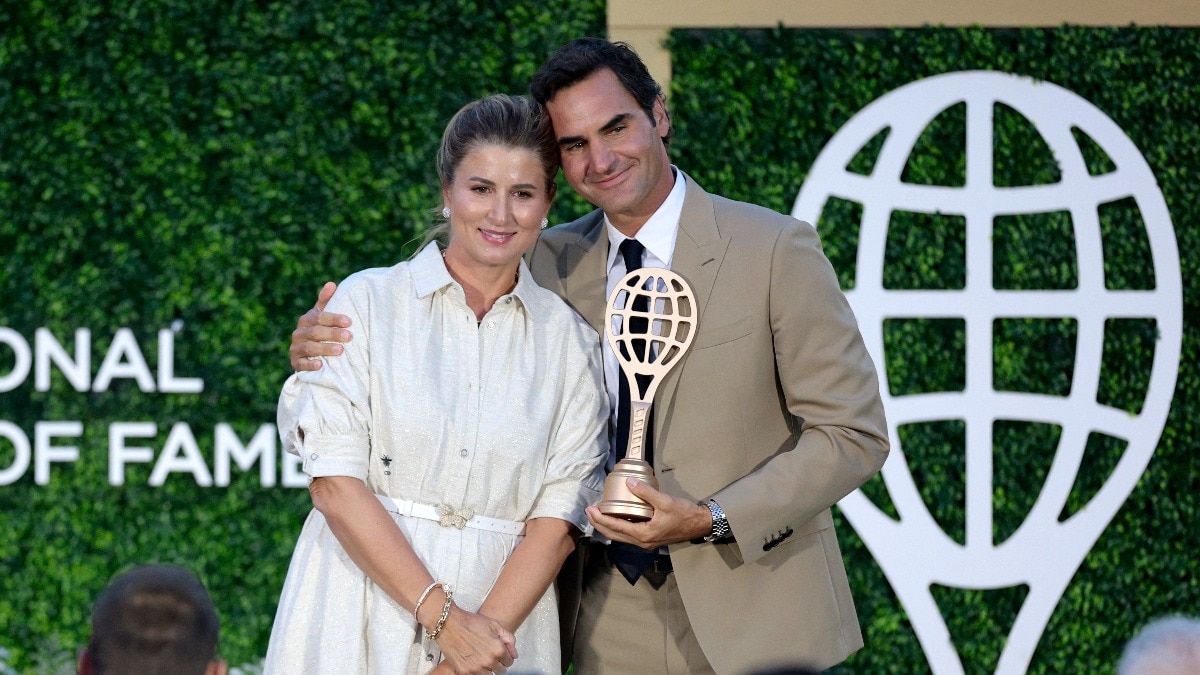
For much of his extraordinary career, Roger Federer was the man who left people searching for words. On Saturday night in Newport, it was his wife Mirka who had that effect on him. Federer had just been inducted into the International Tennis Hall of Fame when Mirka, who had introduced him, stepped away from the microphone. He walked towards the stage, embraced and kissed her, wiped away tears and then tried to collect himself.“Oh man,” Federer began, followed by a confession.“She is a good public speaker. I didn’t know that.”The 45-year-old Swiss had not heard his wife speak publicly in a long time. “The last time I heard Mirka speak publicly was probably at our mixed doubles we played at the Hopman Cup, 24 years ago,” he said.He looked at her and smiled.“So this is very well done. I don’t know if you had been secretly practising. But this is a very high level and a tough act to follow. But I am so glad you did it.”It was an unexpectedly perfect beginning to an evening that was supposed to celebrate Federer’s extraordinary career, but instead became something more intimate. Mirka had spent her speech talking not about the 20 Grand Slam titles, the 103 ATP titles or the weeks Federer spent at No. 1, but about the man behind those numbers.And Federer, visibly moved, seemed almost surprised by how much her words had affected him.GOING BACK TO SYDNEYMirka began by taking the audience back to where their story started, at the Sydney Olympics in 2000. Federer was 18. Mirka was 21.“Yes, I was the older woman,” she joked. “Apparently, Roger decided right away that age was just a number. He pursued me anyway and thankfully, he was persistent.”At the time, Federer had not won a single ATP title.“When we met, he had exactly zero ATP titles. Zero,” she said. “Looking back, I suppose I was there for all 103 that followed.”ANDY RODDICK’S JOKEThe couple have been together through every chapter of Federer's rise, from promising teenager to one of the greatest players the sport has known. Mirka was not simply watching from the players' box. As a former professional player herself, she occasionally helped Federer warm up before matches.She recalled Andy Roddick's reaction after losing the Cincinnati final.“I can’t believe I lost to a guy whose girlfriend warmed him up,” Roddick had joked.“He really said that, and I remember,” Mirka said. “We still smile every time we speak about that.”The laughter, however, soon gave way to something more revealing.“One thing I learned immediately about Roger was that he always wanted the people he loved close to him,” Mirka said. “That is one of the qualities I have admired most about him, not just as a tennis player but as a person.”For years, she had perhaps the best seat in tennis. She watched Federer make one of the hardest sports in the world look effortless, while knowing exactly how much work went into creating that illusion.“I saw the work, the hours, the discipline, the commitment,” she said. “I saw everything that went into making it look so easy.”But tennis, she insisted, was never what impressed her most.“The man behind it all is even more remarkable.”‘I WON’T PLAY ANYMORE’That was when Mirka turned to Federer the father.She recalled the moment they discovered they were expecting twins for the first time. Worried that travelling with two babies would make life on the tennis tour impossible, she told Federer that her travelling days were probably over.“Then I won’t play anymore,” was his response.“He wasn’t being dramatic,” Mirka said. “He meant it. That’s who Roger is. His family comes first.”They eventually found another way. Babies, strollers, toys and books became part of life on the road, followed years later by a second set of twins. The tennis tour became the family home.Their four children, Myla, Charlene, Leo and Lenny, knew Federer not as the Swiss Maestro but simply as Papa.“The Papa who read bedtime stories, played games with them, who ran their baths, who made them laugh no matter how busy he was,” Mirka said. “Whether he won or lost, he always made time for them.”She spoke of Federer as a husband, son, brother and friend, crediting his parents, Robert and Lynette, for giving him the values that shaped him.“Robert and Lynette raised a champion and they raised a genuinely good person,” she said. “They taught him humility, gratitude and kindness, and they taught him to treat everyone with the same respect.”For Mirka, Federer's greatest achievements had little to do with tennis.“The trophies and records are extraordinary. But they are only part of his legacy,” she said. “What makes me proudest isn’t what Roger accomplished when the world was watching. It’s who he is when nobody’s watching.”By the time Mirka reached the end of her speech, Federer was already emotional.“Watching your career gave me one of the greatest privileges and joys of my life,” she told him. “And sharing your life has been even a greater one.”Then she introduced him simply and beautifully.“My husband, my best friend, and now the newest member of the International Tennis Hall of Fame.”FEDERER SPEAKS ABOUT MIRKAFederer became tearful several times as he reflected on the people who shaped his career, including childhood hero Stefan Edberg and longtime coach Severin Lthi. When it was time to speak about Mirka, the emotions overwhelmed him again.“Now the Mirka part,” he said, before pausing.“Oh gosh, this is such a mess.”He joked that he needed “tissues and sunglasses” before trying to continue."Mirka is my wife, which is greatest understatement I can make. She has also been my coach, my hitting partner before matches," he said."Andy, sorry man," he added, referring to Mirka's joke."My reality check. Also, my stylist. I definitely needed one at that time."It was fitting that the man being honoured for a career built on control, precision and extraordinary composure found himself struggling to speak when the subject was the person who had been beside him for almost all of it. When he finally did speak about Mirka, his words were strikingly similar to the message she had delivered about him.“Mirka’s the person who showed me how to get more focused about tennis, and take joy in everything else,” Federer said. He called her “a wonderful mother to our four kids” and added: “She and I grab each other's hands, and we run through walls.”For all the grandeur of the occasion, Federer did not spend much time celebrating himself. He spoke instead about the sport that had given him his life, the people who had helped him along the way and the friendships that remained long after the trophies had stopped coming.“This is one of the greatest honours of my life,” he said. “They call this the Hall of Fame, but fame was never the goal.”His goal, he explained, was to spend his life doing something he loved with people who loved it as much as he did.“Tennis meant the world to me,” Federer said. “Not just playing, not just winning, but creating something new.”He spoke of his childhood in Basel, his memories as a ball boy and the feeling of standing close to the players he once idolised. He thanked his parents, coaches, rivals, friends and fans. He looked back at a career that delivered 20 Grand Slam titles, 103 ATP titles and 310 weeks at No. 1.But by the end, the numbers felt almost secondary. Federer said he was still writing his “love letter to tennis”. His playing days were over, but the sport would remain central to his life.“My family, our friendships, the past 40 years, the future we’re building, tennis, for me, is responsible for it all,” he said.“So this is not a goodbye.”It was a fitting end to an evening that had taken an unexpected turn when Mirka stepped up to the microphone.Federer had spent 25 years dazzling the world with a racket in his hand. In Newport, his wife offered a glimpse of the man away from the courts, the records and the fame.And when Federer finally had his turn, he could only smile, laugh and fight back the tears as he admitted that Mirka had given him a tough act to follow. For once, the spotlight was not really on Federer. It was on the woman who had been beside him all along.- Ends


Most Popular